Troubleshooting
How to Diagnose and Fix Mushroom Growing Problems
Published July 21, 2026 · By MushroomGrowLab
Contents
What’s wrong with your mushrooms? Start here#
You opened your tub or bag, saw something you didn’t expect, and now you’re trying to figure out whether it’s a problem or just part of the process. Most growing problems are much easier to handle when you catch them early, and a few of the scariest-looking ones turn out to be normal.
Troubleshooting a grow is identification first, action second. Before you spray anything or throw anything out, the goal is to name what you’re looking at. Use the table below to match your symptom to the likely cause, then jump to the section that covers it.
| What you see | When it usually shows up | Likely cause | Where to look |
|---|---|---|---|
| White, cottony or fuzzy growth | Spawn run or colonization | Usually healthy mycelium | Is this mycelium or contamination? |
| Grey, wispy, fast-spreading web | Late colonization or fruiting | Cobweb mold | Is this mycelium or contamination? |
| Green patches or spots | Any stage | Trichoderma, Penicillium, or Aspergillus | Identifying green mold |
| Slimy texture, sour or foul smell | Spawn run or colonization | Bacterial contamination or wet rot | Bacterial contamination and wet rot |
| Amber or yellow droplets on mycelium | Colonization or fruiting | Usually normal metabolites | Bacterial contamination and wet rot |
| No pins after about two weeks | Pinning | Environmental stress or overlay | Mushrooms not pinning |
| Tiny flying insects near the substrate | Fruiting | Sciarid flies or fungus gnats | Sciarid flies and fungus gnats |
| Moving specks or dusty patches on caps | Fruiting | Mushroom mites | Mushroom mites |
One theme runs through almost everything below: prevention beats recovery. A clean sterile or pasteurized start, fresh spawn, and good air exchange stop most of these problems before they begin. When something does go wrong, the honest answer is often to scrap the affected grow and fix the process for the next one. We’ll flag which problems are worth fighting and which aren’t.
Contamination problems#
Four of the most common problems are competing organisms that got into your substrate: cobweb mold, green molds, aggressive Trichoderma, and bacteria. Your sterile technique, pasteurization, and hygiene are what keep them out, so a recurring contamination problem is usually a signal to tighten the substrate prep and sterilization chain rather than to keep treating symptoms.
Is this mycelium or contamination?#
The most common panic is mistaking healthy mycelium for mold. Healthy mycelium is bright white, grows at a steady pace, and knits into a dense, rope-like mat. It’s supposed to be there.
Cobweb mold is the lookalike to know. It shows up as a greyish, wispy growth that spreads much faster than mycelium and looks like a fine spiderweb draped over the surface, usually during late colonization or fruiting. Despite the harmless-sounding name, cobweb is a genuine pathogen (the fungus Cladobotryum), not just a cosmetic film, so it’s worth acting on rather than ignoring.
The quick field test many growers use is a spray of 3% hydrogen peroxide on the suspect patch. Cobweb mold melts back; true mycelium doesn’t react. Small, early patches are often spot-treated with hydrogen peroxide or salt. That’s grower practice rather than a proven commercial control, so treat it as a stopgap and watch closely: if the grey growth keeps returning, it’s time to scrap.
Identifying green mold#
Any green on your substrate means a mold has taken hold, but not all greens are equally dangerous, and the color helps you tell them apart. Research on green mold in edible mushroom production by Šašić Zorić and colleagues (2023) notes that Penicillium and Aspergillus are comparatively weak pathogens, while Trichoderma is the aggressive one.
- Trichoderma starts as thick, white, pillowy mycelium, then turns a distinct dark forest green with a granular, powdery surface as it sporulates. The green is intense and it spreads fast.
- Penicillium tends toward blue-green, often with a thin white margin and slower, less aggressive spread. The texture reads more velvety or dusty.
- Aspergillus shows up as olive-green to yellow-green, powdery, and usually slower to invade than Trichoderma.
The diagnostic question that matters most: is the green growing noticeably faster than your mushroom mycelium? If it’s racing ahead, assume the worst and treat it as Trichoderma. If a patch is small, localized, and not spreading, you have a little more room to isolate the tub and watch it. Rapidly spreading green mold is a scrap.
Trichoderma, the most aggressive contaminant#
Trichoderma earns special attention because it doesn’t just compete for space, it attacks your mushroom directly. T. aggressivum in particular is a mycoparasite, meaning it feeds on other fungi. It coils around and penetrates mushroom hyphae and produces hydrolytic enzymes, including chitinases and glucanases, that break down fungal cell walls.
That aggression translates into real losses. Trichoderma accounts for roughly 20% of oyster mushroom losses in one Sri Lankan production study, and it drives the green-mold epidemic in commercial Agaricus bisporus, where severe outbreaks can wipe out 60% to 100% of a crop. It also sporulates prolifically, and those spores travel on air currents, water, and your hands to every other grow in the room.
There’s very little upside to fighting an established Trichoderma infection. Bag it up, remove it from your grow space, and clean thoroughly before starting anything new nearby. For the full breakdown of the different Trichoderma species, how to confirm it, and when a grow is worth saving, see our Trichoderma identification guide.
Bacterial contamination and wet rot#
Not every problem is a mold. Bacterial contamination shows up as slimy or wet-looking substrate, yellow or brown discoloration, and a distinct sour, sweet, or putrid smell. Healthy grows smell earthy and mushroomy; a foul odor is one of the most reliable warning signs you have.
Amber or yellow droplets are the exception that trips people up. Beads of yellow-to-orange liquid on otherwise healthy white mycelium are usually normal metabolites, especially on oyster mushrooms, not a sign of infection. Judge them by the company they keep: if the mycelium around them is white and firm, carry on; if it’s slimy and smells sour, that’s bacterial stress.
Substrate that has gone slimy and foul is compromised beyond recovery. Scrap it, and look upstream at your sterilization or pasteurization, since bacterial problems almost always trace back to an incomplete kill or a hydration that ran too wet. Bacterial wet rot is one of several non-green contaminants that behave this way; the contamination identification catalog breaks down bacterial blotch, pin mold, black mold, yeast, and sour rot in depth, including how to tell them apart by sight and smell.
Pests: mites, flies, and fungus gnats#
Pests tend to arrive after pinning rather than during colonization, and they’re often a symptom of excess moisture, exposed substrate, or an open window. Identify which pest you have before you treat, because the two most common ones call for different responses.
Mushroom mites#
Mushroom mites are tiny, sometimes microscopic, and easiest to spot as slow-moving specks near the gills or a fine “dusty” film on the caps. They usually appear during fruiting.
A light presence may be manageable with strict hygiene, but a heavy infestation is generally not worth saving. Mites reproduce quickly and spread to nearby grows, so a badly infested crop should come out of the room and the space should be cleaned before you start again.
Our deep dive on identifying mushroom mites tells the four common species apart under a hand lens, separates them from fungus gnats, and covers what actually controls an outbreak.
Sciarid flies and fungus gnats#
These are the small, dark-winged flies you’ll see near the substrate, resting on surfaces, or drifting toward a window. Their larvae are clear with distinct black heads and live in the substrate itself, where they tunnel through mycelium and open paths for mold and bacteria.
The good news is that mild to moderate infestations are treatable. Bacillus thuringiensis israelensis (Bti), sold in home products like Summit Mosquito Bits and Gnatrol, targets the larvae in the substrate, and yellow sticky traps catch the adults. Cutting excess surface moisture and covering exposed substrate removes the conditions they breed in. Our deep dive on sciarid flies and fungus gnats tells them apart from phorids and mites, walks through the Bti evidence, and covers exclusion in detail.
Some links in this guide are affiliate links: if you buy through them we may earn a small commission, at no extra cost to you.
Pinning and fruiting problems#
Sometimes nothing has contaminated your grow and no pests are present, but the mushrooms simply won’t form. This is frustrating precisely because the substrate looks fine.
Mushrooms not pinning#
When a grow won’t pin, you’ll usually see either a fully colonized block sitting there doing nothing, or a dense white mat of overgrown mycelium called overlay. This happens at the transition from colonization to fruiting.
The first thing to check is your environment: carbon dioxide, humidity, and temperature. Elevated CO₂ is the most common culprit. High CO₂ suppresses cap formation, so a poorly ventilated grow tends to throw leggy stems with small or missing caps. Most gourmet species need a drop in CO₂ (more fresh air exchange), high humidity, and often a light and temperature cue to shift into fruiting.
Pinning failure is usually recoverable, which makes it worth diagnosing carefully before you give up. More fresh air exchange, higher humidity, and the right temperature swing will often trigger pins on a block that looked stalled. Because the ideal numbers vary by species, check the target ranges on the relevant species page, such as lion’s mane, which is notably CO₂-sensitive, or shiitake. A monotub or fruiting chamber with adequate air exchange solves a large share of pinning problems on its own.
When a block stays stubbornly stalled, our deep dive on why mushrooms won’t pin walks through all six causes, how to confirm which one is yours, and the pinning targets for oyster, lion’s mane, shiitake, and reishi.
When to scrap and when to save#
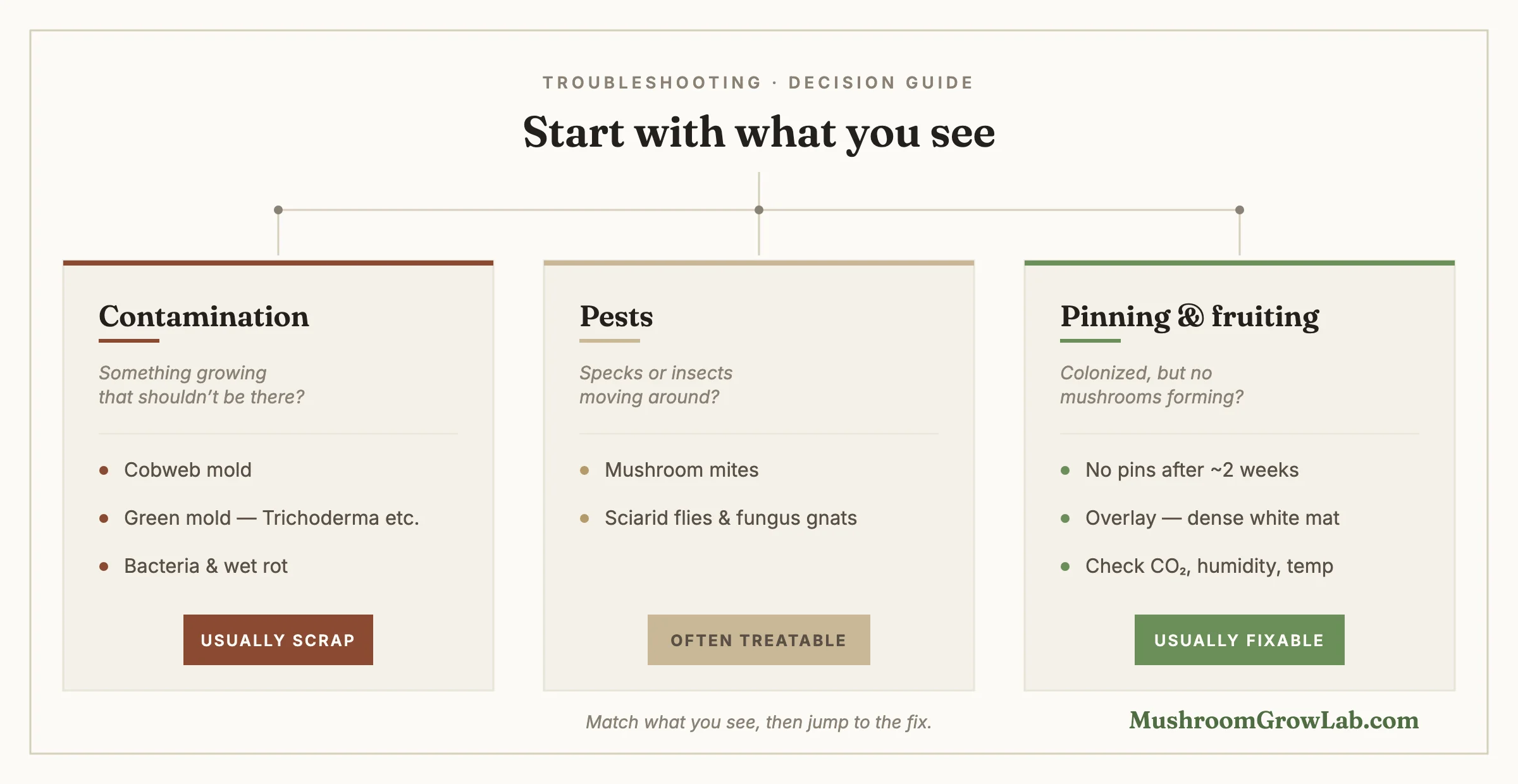
The hardest call in troubleshooting is whether to fight a problem or cut your losses. A useful rule: contamination usually means scrap, pests are often manageable, and environmental problems are almost always recoverable. Scrapping early also protects every other grow in the room, which is the part beginners tend to underweight.
Usually recoverable:
- Pinning failure. Environmental, not biological. Adjust CO₂, humidity, and temperature and the grow typically comes back.
- Sciarid flies and fungus gnats. Bti for the larvae, sticky traps for the adults, and less surface moisture will bring a mild-to-moderate infestation under control.
- Early, localized cobweb mold. Caught before it sporulates, a small patch can sometimes be spot-treated, though it warrants close watching.
Usually a scrap:
- Trichoderma. Aggressive, mycoparasitic, and a prolific sporulator. Once it’s established, saving the grow rarely works and risks spreading it everywhere.
- Bacterial contamination and wet rot. Slimy, foul substrate is compromised beyond recovery. Toss it and fix your sterilization.
- Heavy mite infestation. Fast-reproducing and mobile between grows. A badly infested crop should leave the room.
None of this is a moral failing on your part. Even careful growers lose grows, and the growers who improve fastest are the ones who scrap decisively and then fix the upstream cause, whether that’s a leaky sterilization step, spawn that wasn’t fresh, or a grow space that needs a better clean between runs.
Related guides#
- Why mushrooms won’t pin: causes and fixes — the deep dive on diagnosing a stalled grow
- Mushroom mites: identification and control — telling the four species apart and what actually controls them
- Mushroom substrate: recipes, pasteurization, and sterilization — where most contamination is prevented
- How to grow mushrooms at home — the full workflow these problems fit into
- All-in-one vs. standard grow bags — reducing contamination points in bag culture
- Substrate calculator — get hydration and sterilization right the first time
- Spawn and cultures from North Spore or Out-Grow — a clean start is the cheapest contamination insurance there is
Newsletter
Grow better mushrooms