Shiitake
Lentinula edodes
Also known as: Black Forest Mushroom, Oakwood Mushroom, Sawtooth Oak Mushroom
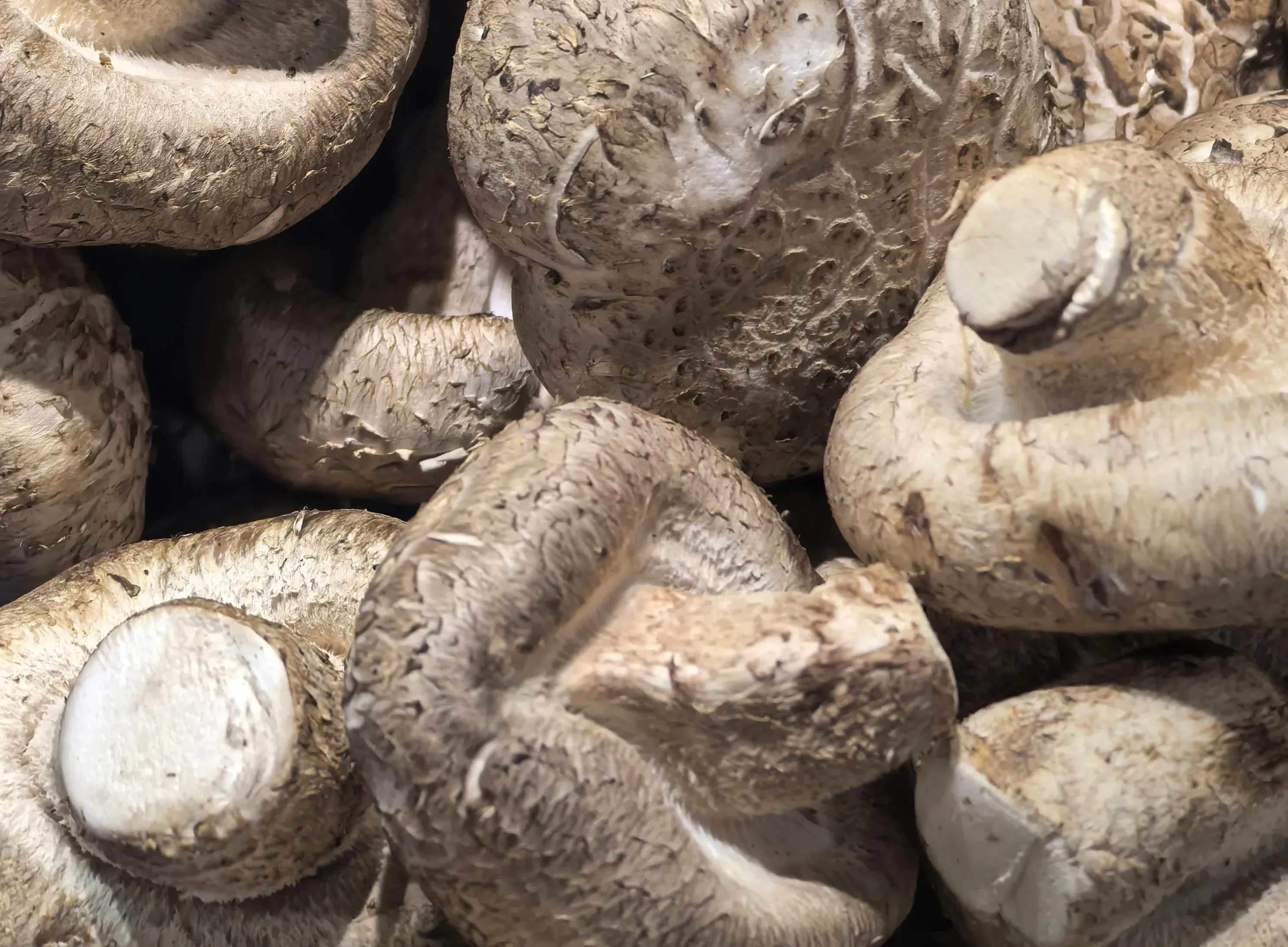
Quick Reference
- Difficulty
- Moderate (3/5)
- Days to harvest
- 5–10 days
- Yield per 5lb block
- 1.2–1.6 lbs per 5 lb block over 2–3 flushes
- Fruiting temp
- 50–75°F
- Humidity
- 80–90%
- Use
- Culinary + Medicinal
- Best substrates
- Hardwood logs (oak, beech, maple), Enriched hardwood sawdust (oak/maple + rice or wheat bran)
- Growing methods
- kit · bag · log
Contents
Why grow shiitake#
Fresh shiitake sells for $12–16/lb at farmers markets, and the flavor difference between a store-bought dried shiitake and one you harvest yourself is stark: smoky, dense, intensely umami in a way that dried-and-rehydrated mushrooms can’t match. Shiitake is also one of the most thoroughly studied medicinal mushrooms, with compounds like lentinan (a beta-glucan used as an adjuvant in cancer therapy in Japan) and eritadenine (documented cholesterol-lowering effects) backed by decades of peer-reviewed research.
Two main paths exist for home growers. Indoor bag culture on enriched hardwood sawdust gets you from inoculation to harvest in 2–3 months. Outdoor log inoculation takes longer, 6–18 months to first fruit depending on log diameter, but a well-managed log yard produces for 3–5 years with minimal ongoing input. Both methods work, and many growers eventually run both.
Shiitake is not a beginner species. We rate it a 3 out of 5, harder than blue oyster or lion’s mane. The colonization phase is forgiving, but shiitake requires a specific “browning” stage before fruiting and often needs a cold shock or physical shock to trigger pinning reliably. Vendors sometimes market shiitake as beginner-friendly because their kits skip these steps for you, but if you’re making your own blocks or inoculating logs, expect a learning curve.
Shiitake mushroom substrate#
Shiitake is a primary wood decomposer, meaning it needs actual hardwood: not straw, not coffee grounds, not coir. Trying to grow shiitake on non-sterile, non-wood substrates is one of the most common beginner mistakes; the mycelium gets outcompeted by more aggressive species before it can establish. This is a consistent source of frustration for people coming from oyster mushrooms who expect the same substrate flexibility.
- Hardwood logs (oak, beech, hickory, maple). The traditional substrate and still the gold standard for flavor and texture. Oak is king. Logs should be fresh-cut (within 2–4 weeks of felling), 3–6 inches in diameter, and 3–4 feet long. According to Ohio State University Extension, sugar maple and red oak consistently outperform other species.
- Enriched hardwood sawdust. Oak or maple sawdust supplemented with 10–20% rice bran or wheat bran. This is the standard for indoor bag culture and commercial production. Biological efficiency runs 60–100% depending on supplementation rate and strain.
- Agricultural residues (cottonseed hulls, corn cobs). Viable but lower-yielding. Research from Journal of Fungi (Desisa et al., 2023) documents successful cultivation on these substrates, but yields trail hardwood sawdust significantly.
When you’re ready to weigh out your own batches, the substrate calculator can help with ratios.
How to grow shiitake mushrooms#
Growing shiitake mushrooms from a kit#
Best for: first-time shiitake growers who want to see the fruiting process before investing in equipment.
- Order a pre-colonized shiitake fruiting block from North Spore, Fungi Ally, or Far West Fungi.
- The block arrives fully browned, so the hard part is done for you.
- Soak the block in cold water (below 50°F) for 12–24 hours to trigger fruiting.
- Remove from water, place on a plate or tray in indirect light at 55–75°F.
- Mist twice daily and maintain humidity with a loose plastic tent or humidity dome.
- Pins should appear within 5–10 days. Harvest when the caps are 70–80% open with edges still slightly curled.
Expect harvest about 2–3 weeks after soaking. A good kit will produce 2–3 flushes with a rest and re-soak between each.
Shiitake bag culture (supplemented sawdust)#
Best for: growers ready for year-round indoor production with higher yields.
- Mix hardwood sawdust (oak or maple fuel pellets work well) with 10–20% wheat or rice bran and water to 55–60% moisture content.
- Load into filter-patch grow bags (Unicorn 14A or 3T).
- Pressure sterilize at 15 PSI for 2.5 hours in a pressure cooker.
- Cool overnight, then inoculate with grain or sawdust spawn in front of a still-air box or flow hood.
- Incubate at 70–80°F. Full colonization takes 8–12 weeks, significantly longer than oyster species.
- Once fully colonized, the block enters the browning phase. Leave the block sealed and wait for the white mycelium to develop a tough, brown skin. This process takes 2–4 weeks and is the step that trips up most new growers. The block will look dark and leathery. This is correct, not contamination.
- Look for “popcorning”, bumpy white mycelial knots on the surface, as the signal that browning is complete. Popcorning is the most reliable indicator that the block is ready.
- Cold-shock the browned block by placing it in the refrigerator for 24 hours, then remove the bag and place the block in a fruiting environment.
Expect total time from inoculation to first harvest of 3–4 months. The browning phase is where patience matters most.
Shiitake logs — outdoor log cultivation#
Best for: growers with outdoor space who want years of production from a single investment of time.
For the full method, see our shiitake log cultivation guide: tree species ratings by region (Northeast, PNW, Southern hot/humid), the cold-shock fruiting schedule, moisture management, and a step-by-step inoculation walkthrough. The quick version:
- Source fresh-cut hardwood logs; oak is ideal. Cut in late winter or early spring while the tree is dormant. Logs should be 3–6 inches in diameter and 3–4 feet long.
- Let logs rest 2–4 weeks after cutting to allow natural antifungal compounds to dissipate. Don’t wait longer than 6 weeks or competitor fungi move in.
- Drill holes in a diamond pattern: 3 inches apart along the length of the log, with 3–4 inches between rows around the circumference. Match the number of rows to the log’s diameter in inches, so a 4-inch log gets 4 rows, for a minimum of 30–40 holes total. Use a 5/16” bit for plug spawn or a 7/16” (12mm) bit for sawdust spawn, with a depth-stop collar set to 1–1¼ inches.
- Fill holes with plug spawn (hammer in) or sawdust spawn (palm inoculator). Field & Forest Products carries the widest strain selection for log work, with strains categorized by fruiting temperature: cold-weather, warm-weather, and wide-range.
- Seal each inoculation point with melted soy wax or cheese wax using a dauber or brush.
- Stack logs in a shaded area with good air circulation; a “log crib” lean-to pattern works well.
- Keep logs moist during dry spells. Water deeply once a week during summer if rainfall is insufficient.
- Wait. Colonization takes 6–18 months depending on log diameter, spawn rate, and temperature.
To trigger fruiting on colonized logs, soak them fully submerged in cold water for 12–24 hours. Some growers also use the “slap method,” physically striking the logs to simulate a fallen tree, which Field & Forest Products notes can help trigger pinning. A well-managed log produces 3–5 years of seasonal harvests.
One important note on vendor timelines: many sellers claim logs fruit in 6–12 months. Growers frequently report 18–24 months for larger diameter logs. Plan for the longer timeline and be pleasantly surprised if it’s faster.
Shiitake plugs and dowels#
Log inoculation comes down to one main choice: plug spawn (also sold as dowel spawn, hardwood dowels pre-colonized with shiitake mycelium) or sawdust spawn (loose inoculated sawdust packed into slightly larger holes). Both end up sealed under wax in the same drilled logs, and both produce mushrooms. The difference is speed, cost, and what gear you need to own.
Plugs are simpler for small batches. You drive them flush with a hammer after drilling 5/16” holes, with no inoculator tool required. Plug spawn stores six months to a year in the fridge, so a single 100-count bag from North Spore or Field & Forest Products covers a weekend’s inoculation with some left for next year. For roughly 10 logs or fewer, plugs are the lower-overhead choice.
Sawdust spawn wins on scale. According to Cornell’s Best Management Practices for Log-Based Shiitake Cultivation, sawdust spawn costs slightly less per log, colonizes the sapwood somewhat faster, and runs significantly faster during inoculation once you have a palm or thumb inoculator. Field & Forest’s brass palm inoculator is the durable two-handed option; their Okuda one-handed inoculator costs more but lets you hold and turn the log with your free hand, a real difference across a full day of work. Past about 20 logs, the time savings pay for the tool.
How many plugs per log. A 4-inch diameter × 3-foot log works out to roughly 44 plugs at the spacing from step 3 above. A 100-plug bag inoculates about two of those logs; a 500-plug bag handles ten. For sawdust, one 5 lb bag covers 20 to 25 logs at 4–6” × 36”.
Drill bit match. Plug spawn seats in a 5/16” hole drilled 1 to 1¼ inches deep, and a brad-point bit with a depth-stop collar gives clean, consistent holes. Sawdust spawn takes a larger 7/16” (or 12mm) bit. Don’t mix them. Plugs driven into oversized holes dry out before the mycelium establishes, and sawdust packed into undersized holes won’t seat below the bark where the mycelium needs to be.
Sealing the holes. After each plug is flush, cover it with hot food-grade wax. Cheese wax is the common pick: flexible across winter temperatures, widely available, and certified for organic production by some brands. Beeswax seals fine but can crack in hard freezes. Paraffin works mechanically but may disqualify your mushrooms from organic certification. Cornell’s BMP specifies heating wax to 350–400°F until it’s lightly smoking; if it turns white on contact with the log, it’s too cold and won’t form an airtight seal.
The rest of the log-cultivation procedure (sourcing logs, stacking, shading, first-summer watering, cold-water soaking to trigger fruiting) doesn’t change between spawn types. The log section above covers the full walkthrough.
Shiitake fruiting conditions#
Temperature. Shiitake strains fall into three broad categories: cold-weather (40–60°F), warm-weather (60–80°F), and wide-range (50–75°F). Most kits and generic spawn use wide-range strains. Matching your strain to your local climate matters. Trying to force a cold-weather strain in summer is a common cause of zero yield. Field & Forest Products provides the most detailed strain-to-temperature matching of any supplier we’ve reviewed.
Humidity. 80–90% during fruiting. Higher humidity (closer to 90%) helps during pin formation; dropping slightly to 75–80% during cap expansion reduces the risk of bacterial blotch, a surface infection that thrives in standing moisture. Ohio State and Penn State extensions both recommend this stepdown approach.
Fresh air exchange. Moderate. Less demanding than blue oyster, but stagnant air leads to leggy stems. Standard fanning or a light fan cycle is sufficient for most setups.
Light. Indirect natural light or a low-wattage LED on a 12-hour cycle. Shiitake requires light to form normal cap morphology; total darkness produces pale, elongated, malformed fruit.
Cold shock. The primary fruiting trigger for shiitake. Soak fully colonized and browned blocks or logs in cold water (below 50°F) for 12–24 hours. This simulates the autumn temperature drops that trigger fruiting in wild populations. For indoor blocks, 24 hours in the refrigerator before soaking is the standard approach. Without some form of temperature shift, many shiitake blocks simply won’t fruit.
Harvesting shiitake mushrooms#
When to harvest. Pick shiitake when the cap is 70–80% open, edges still slightly curled inward, with the partial veil just beginning to separate from the stem. Harvesting at this stage maximizes shelf life. Over-mature shiitake drop heavy spore loads that can cause respiratory irritation in enclosed spaces.
The highest-quality shiitake, the thick-fleshed and deeply cracked “donko” caps prized in Japanese cuisine, develop at lower fruiting temperatures (below 60°F) where growth is slower and caps are denser.
How to harvest. Twist and cut at the base with a sharp knife. Clean-cut the stem flush with the substrate or log to avoid leaving stumps that invite contamination.
Yield. For a 5 lb sawdust block, expect 1.2–1.6 lbs of fresh mushrooms across 2–3 flushes. The first flush accounts for the bulk of the yield. Biological efficiency on enriched sawdust typically falls between 60% and 100%, according to research published in Journal of Fungi. Logs produce less per flush but fruit seasonally for years, and total lifetime yield from a single well-managed oak log far exceeds what any number of blocks can match.
Triggering subsequent flushes. After harvesting, rest the block for 7–10 days with no misting. Then soak again in cold water for 12–24 hours to trigger the next flush. Most blocks give 2–4 productive flushes. For logs, repeat the cold-water soak after each harvest period.
Shiitake flavor and culinary uses#
Shiitake has one of the most distinctive flavors in cultivated mushrooms: intensely umami with smoky, woody, and nutty notes that deepen when dried. The compound lenthionine, a cyclic sulfur molecule that forms during drying, is responsible for the concentrated flavor of dried shiitake and gives them an almost broth-like intensity when rehydrated. Fresh shiitake is milder but still rich, with a clean “meaty” quality that doesn’t taste like any other mushroom.
Best cooking methods. Sauté caps in butter or sesame oil over medium-high heat until the edges crisp. Shiitake holds its structure well in stir-fries, soups, and braises; it doesn’t turn to mush the way oyster mushrooms can. The stems are fibrous and tough; remove them and save for stock. Dried shiitake is a staple in East Asian cooking and rehydrates in 20–30 minutes in warm water, and the soaking liquid itself is a foundational dashi ingredient.
Medicinal properties. Shiitake is among the most researched medicinal mushrooms. Lentinan, a beta-1,3-glucan, has documented immunomodulatory properties and is used as an adjuvant therapy in oncology in Japan (Lindequist, 2024). Eritadenine shows cholesterol-lowering effects in multiple studies. L-ergothioneine, a potent antioxidant, is found in shiitake at some of the highest concentrations of any dietary source (Baral, 2025). That said, eating shiitake is not a substitute for medical treatment. The medicinal angle is a genuine bonus backed by real research, not a cure-all.
Storage. Fresh in the fridge in a paper bag: 7–10 days (notably longer shelf life than oyster species). Dried in airtight jars: indefinitely, and the flavor actually improves with drying. Slice before dehydrating for faster, more even drying.
Common shiitake growing problems#
The problems below are shiitake-specific. For the broader ones, like contamination, green mold, and stalled pinning, see our mushroom growing problems guide.
Confusing browning with contamination#
The most common point of failure for new shiitake growers. After full colonization, sawdust blocks develop a brown, leathery skin. This is the normal “barking” or browning phase, not Trichoderma (green mold) or bacterial contamination. Green patches are contamination; uniform browning is exactly what you want. Our contamination identification guide shows what the real thing looks like if you’re unsure. According to FreshCap’s shiitake growing series, the barking stage is where most beginners panic and discard perfectly healthy blocks.
Premature pinning#
Blocks that pin inside the bag before browning is complete produce deformed mushrooms and increase contamination risk. This happens when the block is exposed to light or temperature fluctuations too early. Keep bags in consistent, dark conditions during colonization and browning. If pins do form early, let them abort naturally; don’t open the bag.
Logs not fruiting after the first year#
Usually caused by dehydration during summer. Logs need to maintain internal moisture, so water deeply once a week during dry spells, or consider a soaker hose on a timer for a larger log yard. If a log hasn’t fruited after 18 months, try a full 24-hour cold-water soak followed by a physical strike (“slapping” the log against the ground or with a mallet). Check the cut ends for white mycelium to confirm the log is still colonized. If you see green or orange competitor fungi, that log may be lost.
Trichoderma at first harvest#
Green mold appearing specifically when you open the bag for the first fruiting, often caused by excess moisture on the block surface. Ensure the block surface is firm and dry to the touch before cutting the bag open. Soggy blocks invite contamination.
Wrong strain for your climate#
Cold-weather strains (like Field & Forest’s “Snow Cap”) won’t fruit in summer heat, and warm-weather strains won’t respond to a winter cold shock. Identify your strain type before deciding when to fruit. If you don’t know what strain you have, try forcing at 55–65°F, the wide-range sweet spot where most strains will respond.
Where to buy shiitake spawn#
Four suppliers in our directory carry shiitake spawn, cultures, or kits.
North Spore offers the most beginner-friendly entry point. Their Spray & Grow shiitake kit ships pre-browned and ready to fruit. They also carry grain spawn, sawdust spawn, and plug spawn in multiple strains including “Wide Range” and “Cold Weather” variants. Pricing is mid-to-premium, but their educational resources and customer support are consistently well-reviewed.
Field & Forest Products is the authority for log cultivation. Their strain catalog is the most detailed in the industry, with each variety categorized by fruiting temperature range (e.g., “West Wind” for warm weather, “Night Velvet” for cold). If you’re doing log inoculation, this is where to start.
Out-Grow has the best prices on liquid cultures and grain spawn for DIY growers who want to make their own blocks. Their shiitake strains are reliable and well-suited to indoor bag culture.
Fungi Ally specializes in commercial-grade fruiting blocks that are accessible to hobbyists. Their shiitake block is a solid kit alternative if you want a larger format.
A few suppliers worth mentioning that aren’t yet in our directory: Fungi Perfecti (founded by Paul Stamets) sells Grain Master bags intended for spawn expansion, high quality but with long lead times (6–8 weeks) and premium pricing. Mushroom Mountain (Tradd Cotter) carries high-yielding commercial strains with deep expertise in genetics. Myyco offers USDA Certified Organic liquid cultures with fast shipping, a good option for growers who want to inoculate their own grain.
Equipment for growing shiitake#
For kit growing, all you need is a spray bottle, a container large enough to soak the block in cold water, and a hygrometer to monitor humidity.
For bag culture, the substrate sterilization step requires a pressure cooker. The Presto 23-quart handles four quart jars and is the standard starter recommendation. You’ll also need filter-patch grow bags, an impulse sealer, and a still-air box or flow hood for clean inoculation. A digital scale helps nail the 55–60% moisture target for your substrate mix.
For log inoculation, the essential tools are a high-speed drill (low-speed drills tear wood fibers and slow colonization), a 5/16” or 12.5mm drill bit with a depth stop, plug spawn or a palm inoculator for sawdust spawn, and soy or beeswax with an applicator for sealing.
Regardless of method: a digital hygrometer for monitoring, 70% isopropyl alcohol for sanitizing, and a sharp harvest knife for clean cuts.
Related guides#
- How to Grow Mushrooms at Home — Beginner Guide
- Substrate Calculator — dial in sawdust-to-bran ratios
- Pressure Cooker Buying Guide — essential for bag culture
- Oyster Mushroom Growing Guide — the best first species family before tackling shiitake
- Lion’s Mane Growing Guide — another hardwood species at a slightly lower difficulty
- Maitake Growing Guide — a more demanding hardwood species to graduate to, also suited to logs and outdoor beds
Newsletter
Grow better mushrooms