Techniques
Mushroom Spawn: Types, How to Choose, and What It Costs
Published July 30, 2026 · By MushroomGrowLab
Contents
- What mushroom spawn actually is
- Where spawn fits in the growing process
- Pick the right spawn for your grow
- Grain spawn
- Sawdust spawn
- Plug and dowel spawn
- Liquid and stick spawn
- Should you buy mushroom spawn or make it?
- Where to buy mushroom spawn
- How to tell good spawn from bad
- How long mushroom spawn keeps
- Why spawn loses vigor over generations
- Common mushroom spawn mistakes
- Related guides
Buying the wrong spawn is the kind of mistake you discover weeks later. Grain spawn packed into a drilled log will not colonize it. A bag of dowel plugs is useless next to a tub of coir. The carrier matters as much as the species, and there are five of them on the market suiting genuinely different grows.
What mushroom spawn actually is#
Spawn is a carrier material that has been colonized by the mycelium of a chosen fungus. Grain, sawdust, wooden dowels, and liquid broth all do the same job: carry a living culture into a much larger batch of substrate.
You need a carrier because growing mushrooms is a race. Bacteria and mold are already in the substrate or arrive soon after, and whichever organism claims the material first usually keeps it. Spawn stacks that race in your favor, starting you off with a large mass of mycelium that is already growing and spreading it through the substrate at many points instead of a few.
Spores, culture, and spawn are three different products, and conflating them is what sends beginners home with the wrong thing.
- Spores are reproductive units, sold as prints or syringes. A germinating spore does not grow straight into a mushroom-producing culture. It produces a monokaryon, mycelium carrying half the genetics, which cannot fruit on its own. In most cultivated species, two compatible monokaryons have to meet and mate first, and only the mated result fruits.
- Culture is actively growing mycelium on agar or in liquid broth. Live genetics, but nowhere near the volume needed to take over a bulk substrate.
- Spawn is culture already grown onto a carrier, at volume. It is the bridge between the two.
That explains why injecting a spore syringe straight into bulk substrate usually fails. Expanding to a clean culture first and then to spawn gives you a cheap sterile stage where contamination shows up before it reaches expensive substrate. Our guide to making spawn from spores walks that route from print to grain.
Grain spawn is a fairly recent invention. Commercial growers ran on unreliable manure-derived spawn into the 1930s, until James Sinden at Pennsylvania State College tried wheat in flasks, found the mycelium “grew very vigorously and in a manner entirely different than anything I had previously seen,” and patented the method in August 1932. His own account of the discovery is preserved in Penn State’s history of the industry, and the university’s assessment of where it ended up is that “almost all commercial spawn is now produced by this method.”
Where spawn fits in the growing process#
The sequence runs spores or clone → culture (agar or liquid) → spawn → bulk substrate or logs → fruiting. Knowing which stage you are in tells you what to do next.
- Culture origin. Spores germinated on agar, or tissue cloned from a fruitbody. Produces the founding genetics.
- Culture expansion. That culture grown out in broth or across more agar, until there is enough mycelium to inoculate grain.
- First grain spawn. Sterilized grain inoculated from the culture. This becomes your master jar, and the point later generations get counted from.
- Redistribution. Shaking a partly colonized jar to fragment the mycelium and spread it through the rest of the grain.
- Multiplication. Moving colonized grain into fresh sterilized jars. The distinction from step 4 matters: shaking redistributes within a jar, transferring moves between jars.
- Conversion to wood. Sawdust spawn made from grain spawn, for logs and outdoor beds.
- Deployment. Finished spawn mixed into bulk substrate, starting the spawn run.
Colonization time varies more by species and carrier than by stage. Grain spawn took 28–36 days to run in most studies covered by a 2026 systematic review of mushroom spawn in Agronomy, against 12–13 days for stick and liquid spawn, and king oyster needed 32–38 days where other oyster species finished in roughly 18–25.
Pick the right spawn for your grow#
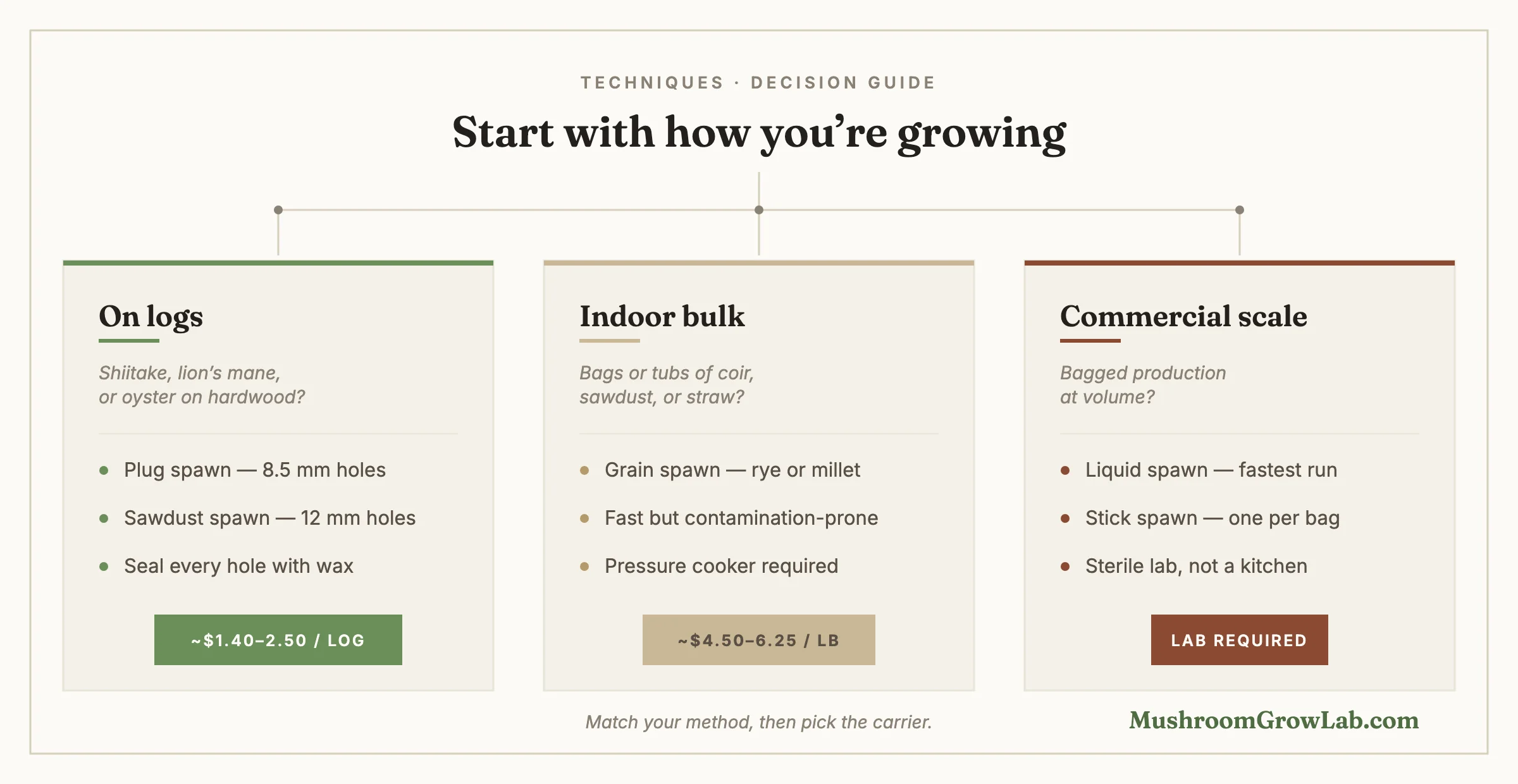
| If you’re growing | Use | Why |
|---|---|---|
| Shiitake, lion’s mane, or oyster on logs | Plug or sawdust spawn | Built to colonize dense wood outward from discrete points |
| Indoor bulk substrate in bags or tubs | Grain spawn | Nutrient-dense and fast to establish in loose, rich substrate |
| Wine cap or oyster in outdoor beds | Sawdust spawn | Suits wood chips; grain works for straw and compost beds |
| Bagged production at commercial volume | Liquid spawn | Faster and uniform, but needs lab equipment |
Oyster mushrooms are the most forgiving of these, performing across grain, sawdust, stick, and liquid spawn alike. Their biological efficiency ranges from 5.18% to 173.38% depending on species and substrate, which is a fair reminder that the carrier is one variable among several.
Grain spawn#
Rye, wheat, millet, wild bird seed, or popcorn. This is the default for indoor growing and the form most home growers will ever handle.
Grain is nutritionally rich, which is both the appeal and the catch. It drives fast, vigorous growth, and it is the most contamination-prone carrier on the list because everything else in the room also wants to eat it.
Sawdust spawn#
Supplemented hardwood sawdust, and the standard product for logs and outdoor beds.
Lower nutrition than grain makes it more forgiving of a lapse in technique, which is why it is the friendlier starting point for outdoor work where sterility is impossible anyway.
Plug and dowel spawn#
Hardwood dowels roughly a pencil’s diameter and an inch long, hammered into drilled holes.
The two log carriers differ mainly in what they ask you to own. Plugs go in with a hammer. Sawdust spawn needs a wider drill bit and a spring-loaded inoculation tool to pack the hole, which is a purchase in itself. Either way every hole gets sealed with wax, and a single 4-foot log takes 40-plus of them, so the labor is much the same once you are set up. Our shiitake log cultivation guide covers the drilling, filling, and waxing in full.
So plugs are the simpler start if you do not already own the plunger tool, and more expensive per log. They also keep far longer in storage, which makes them the practical choice if you are inoculating across several weekends rather than all at once.
Liquid and stick spawn#
Neither is sold retail to home growers, but both are worth knowing because they explain what you give up by working in jars.
Liquid spawn is mycelium grown in nutrient broth, usually sugar or starch for energy with yeast extract or peptone for nitrogen. It colonizes faster than any solid carrier, cutting the spawn run to under half of grain’s, and it tends to yield more as well. The barrier is capital, not biology. Liquid spawn needs expensive equipment and a strictly sterile room, which is why it dominates at scale.
The scaled-down version is well within reach at home, though. A flask, a stir bar, and a pressure cooker will make enough liquid culture to inoculate dozens of grain jars, and our liquid culture recipe covers the broth and the timings. What home growers don’t have is the sterile room that makes it viable as a production carrier.
Stick spawn uses sticks of wood, corn stalk, or corn cob with cereal bran filling the gaps. Because one stick inoculates a whole substrate bag, it is far less labor-intensive than loose grain. It cuts oyster spawn run to 12.22 days, and it is standard for king oyster production in China.
What you give up by working in jars is speed and labor rather than capital. Solid spawn is cheap to get started with, then slow to run and contamination-prone in use. Liquid spawn puts the cost the other way round: expensive to set up and strict about sterility, then faster to colonize and far less work to install.
Should you buy mushroom spawn or make it?#
Purchased spawn arrives ready to use from a supplier running a dedicated sterile lab. That removes the equipment floor and most of the contamination risk from your first grows, and it isolates one variable while you learn everything else.
Making your own is cheaper per pound in materials and adds a pressure cooker, a clean workspace such as a still-air box, sterile technique, and a tolerance for losing batches while you get there. A pressure cooker is not optional for grain. Pasteurization only knocks the microbial load down rather than eliminating it, and cooked grain is rich enough that whatever survives will outgrow your mycelium, so grain has to be sterilized outright. The substrate pillar covers when to sterilize and when to pasteurize across the bulk recipes.
The material saving is real, but the equipment cost is the actual gate, and the honest math depends on your local grain price rather than a national average. Price rye by the sack where you live, divide by your hydrated yield, and add jars or filter-patch bags plus the energy to run the cooker.
Cornell Small Farms’ research on indoor growers is worth borrowing here. It found neither making nor buying inherently cheaper, and argued for producing in-house on a different basis: labor is a cost you can get better at, while the price of what you buy in is not yours to change. That is a point about which lever you control, not about which one costs less today.
So: buy for your first grows, make your own once you are running consistently and want control over genetics and timing, and look at liquid spawn rather than more grain jars if you reach commercial volume.
Where to buy mushroom spawn#
Grain and sawdust sell by weight, plugs by count, which makes the forms awkward to compare until you convert to a common unit. For anything going into wood, that unit is the log: a 5 lb bag of sawdust spawn and a 1,000-count bag of plugs each cover about 20 logs at 4 inches by 40 inches. Here is Field & Forest Products’ list pricing at the time of writing, worked through on that basis.
| Form | Package | Single bag | At volume | Works out to |
|---|---|---|---|---|
| Grain spawn | 4 lb | $25.00 | $18.00 (16–50 bags) | $6.25/lb → $4.50/lb |
| Sawdust spawn | 5 lb | $28.00 | $18.00 (16+ bags) | $5.60/lb → $3.60/lb, or $1.40/log |
| Plug spawn | 1,000 count | $50.00 | $40.00 (16–50 bags) | $2.50/log → $2.00/log |
Retail grain spawn runs roughly $4.50 to $6.25 a pound depending on volume, a good deal less than the $10 to $20 figure that circulates in growing forums. Plug spawn’s premium over sawdust is real but modest, so the choice between them usually comes down to whether you own the plunger tool rather than the price.
North Spore lists species grain spawn at $29.99 a bag, and Out-Grow and Fungi Ally both carry grain and sawdust. Prices move, so treat the table as a snapshot.
How to tell good spawn from bad#
The Agronomy review describes what good spawn looks and smells like:
High-quality spawn would be white or light cream-coloured specimens with a mushroomy or earthy odour, without brown, black, and yellow spawns or those with mouldy or sour odours. The texture should be consistent with cotton and be snow-like without any visible sign of contamination.
Colonization should also look even. Patchy growth is a signal to investigate rather than a diagnosis, since weak genetics and poor conditions during the spawn run produce the same appearance.
Inspect a bag before it goes near clean air. The Specialty Mushroom Farm Book recommends checking the corners and top specifically, spraying with alcohol before it enters the airflow, and notes a useful tell: when contamination came in with the spawn, “typically one can see the contaminant jumping off of the grains or pieces of spawn into the new substrate.” For anything you cannot identify, our contamination identification guide covers what the common colors and textures actually are.
How long mushroom spawn keeps#
Field & Forest’s stated limits are up to 3 months refrigerated for grain spawn, up to 3 months for sawdust, and up to 6 months for plugs, at a recommended 34–42°F.
The species exceptions matter more than the averages. Pink oyster grain spawn cannot be refrigerated at all and should be used within two weeks. Almond agaricus sawdust spawn also cannot be refrigerated, but keeps at room temperature for up to 6 months.
Two handling rules matter as much as the timeline. Mississippi State Extension advises refrigerating spawn the day it arrives and never freezing it, and letting a cold bag come back to room temperature before you open it.
Why spawn loses vigor over generations#
Every time you propagate from the last batch rather than from a stored original, the culture degrades a little. Growth rate slows first, then yield drops, then fruiting fails. It is a strategic concern rather than a technique detail, because the fix is a habit rather than a step.
The mechanism is oxidative damage. Researchers cloned straw mushroom through 19 rounds, each time cutting a piece of tissue from a fresh fruiting body to start the next generation, and found hydrogen peroxide 8.6 times higher at the 19th round than at the start, while the antioxidant enzymes that should have cleared it lost most of their activity. Degeneration became visible after 12 successions, and the 19th generation “completely failed to grow fruiting bodies.”
Two different things stop you transferring forever, and growers tend to blame the wrong one. The first is contamination. Every transfer is another chance for something to get in, and the deeper into a lineage you go the harder it is to catch before it spreads. Cleaner technique genuinely helps with that one.
The second is the culture wearing out, what mycologists call senescence, and it is the oxidative damage described above. Technique does nothing for it. So if your transfers keep failing and your sterile work is genuinely good, an aging culture is the likelier explanation than anything you did at the bench.
The habit that solves both is keeping a master culture in storage and starting new runs from it rather than from your most recent jars. The straw mushroom work found lineages kept under four transfers actually improved in production capacity, which is a stronger argument for low generation counts than simply avoiding decline.
Common mushroom spawn mistakes#
Buying the wrong carrier for the method. Grain mycelium is adapted to colonizing loose nutrient-rich material, not dense lignin; plugs are built for slow colonization outward from fixed points in wood. Neither transfers to the other job. Match the carrier before the species.
Going from spore syringe straight to bulk. You are asking monokaryotic mycelium to out-compete established organisms while it is still looking for a mate. Expand to a culture first, then to spawn.
Stretching the spawn too thin. Fewer inoculation points means a longer colonization window, and the contamination race is decided by how fast the substrate gets occupied. This is an old objection: at a 1932 hearing on Sinden’s new grain spawn, a commercial spawn maker’s complaint was precisely “that you stretch it too far.”
Using old or badly stored spawn. Warm storage burns through the carrier, freezing damages the mycelium, and time gives anything already present a chance to establish. Refrigerate on arrival, never freeze, and let bags reach room temperature before opening.
Propagating from the last batch indefinitely. Without a stored master culture to return to, oxidative damage accumulates until the strain stops performing, and you will read it as bad luck rather than as generation count.
Related guides#
- Mushroom substrate: recipes, materials, and how to pick one — the other half of every grow. Substrate is what you inoculate; spawn is what you inoculate it with.
- Shiitake log cultivation — the full outdoor log method that plug and sawdust spawn feed into.
- How to grow mushrooms at home — start here if this is your first grow.
- Contamination identification — what the colors and textures on a failed bag actually are.
- Substrate calculator — ingredient weights and sterilization times for the standard bulk recipes.
- Grow bags and pressure cookers — the hardware that decides whether making your own spawn is realistic.
Newsletter
Grow better mushrooms