Oyster Mushroom
Pleurotus ostreatus
Also known as: Pearl oyster, Phoenix oyster, Italian oyster, Tree oyster, Pleurotus pulmonarius
Quick Reference
- Difficulty
- Beginner (1/5)
- Days to harvest
- 4–10 days
- Yield per 5lb block
- 1.5–2.5 lbs per 5 lb block (2–3 flushes)
- Fruiting temp
- 55–75°F
- Humidity
- 85–95%
- Use
- Culinary + Medicinal
- Best substrates
- Wheat straw, Master's Mix (hardwood + soy hull pellets), Supplemented hardwood sawdust, Coffee grounds, Cardboard
- Growing methods
- kit · bag · bucket · log · outdoor-bed
Contents
- Why grow oyster mushrooms
- Oyster mushroom varieties
- Which oyster should I grow first?
- Oyster mushroom substrate
- How to grow oyster mushrooms
- Oyster mushroom fruiting conditions
- Harvesting oyster mushrooms
- Oyster mushroom flavor, texture, and uses
- Common oyster mushroom growing problems
- Where to buy oyster mushroom spawn and kits
- Equipment for growing oyster mushrooms
- Related guides
Why grow oyster mushrooms#
Oyster mushrooms are the most forgiving mushrooms you can cultivate at home. They colonize aggressively, tolerate temperature swings, fruit on almost any cellulose substrate, and reward you with dense clusters within two weeks of pinning. If you’ve never grown a mushroom before, the oyster family is where we’d start you.
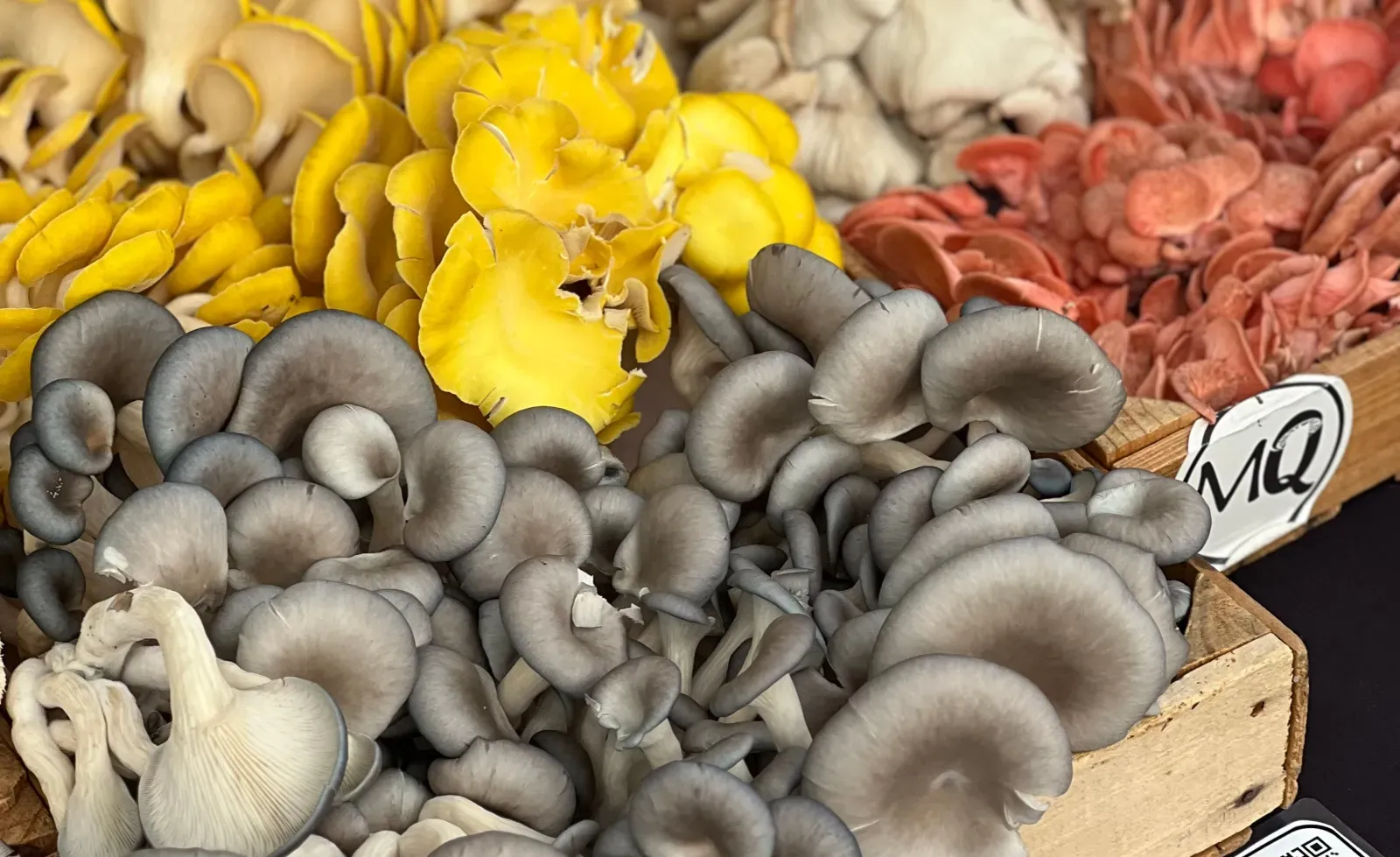
Five oyster varieties cover almost all home cultivation: blue, pearl, pink, golden, and phoenix. All sit in the Pleurotus genus, though pink (P. djamor) and golden (P. citrinopileatus) are distinct species rather than forms of P. ostreatus. Their cultivation profiles overlap heavily, so the substrate, spawn, and method instructions on this page apply to all of them with mostly temperature adjustments. Where they differ is fruiting temperature, color, and flavor. The varieties table and the decision guide below help you pick one, and each variety links to a dedicated guide where we’ve published one.
The other thing that makes oysters beginner-friendly is speed. From opening a kit to harvesting your first flush takes about three weeks, which is short enough to keep you engaged through the patience-testing parts of the process. By the time most other species have finished colonizing, oysters are already on their second flush.
Oyster mushrooms are also heavy spore producers, and a fully-mature flush in a poorly ventilated space can irritate sensitive lungs. Pink oysters release even heavier spore loads than the rest. For a single block on a kitchen counter the risk is minimal. For a sealed grow tent or any setup where flushes are left to fully open and shed, it’s worth taking basic precautions.
Oyster mushroom varieties#
Five varieties cover almost all home cultivation in North America. They share a cultivation profile and differ mainly in fruiting temperature, color, and flavor.
| Variety | Scientific name | Fruiting temp | Timeline (kit to harvest) | Notes |
|---|---|---|---|---|
| Blue oyster | P. ostreatus var. columbinus | 50–80°F (warm strain); 35–50°F (cold strain) | ~3 weeks | Cobalt caps, dense clusters, forgiving. Comes in warm and cold strains; the cold strain fruits through winter outdoors. See the full guide. |
| Pearl oyster | Pleurotus ostreatus | 60–75°F | ~3 weeks | The “standard” oyster. Cultivation is essentially identical to blue, with pale grey-brown caps instead of cobalt. Everything below applies directly. |
| Pink oyster | Pleurotus djamor | 75–85°F | ~2 weeks | The fastest oyster and a different species. Thrives in warm climates, slows below about 68°F and stalls in sustained cold. Short fridge life (2–3 days fresh). Turns bacon-like when fried. Heaviest spore producer of the five. See the full guide. |
| Golden (yellow) oyster | Pleurotus citrinopileatus | 70–84°F | 2–3 weeks | Bright yellow caps, mild nutty flavor. Fragile once fruited, so handle gently and eat or dry within a day of harvest. Warm-tolerant like pink but less temperature-fussy. A naturalized invasive in North America, so grow it indoors. See the full guide. |
| Phoenix (Italian) oyster | Pleurotus pulmonarius | 65–80°F | ~3 weeks | Warm-tolerant summer variety in temperate climates. Cultivation profile closely matches blue with a slightly wider fruiting temperature ceiling. Often sold as “Italian oyster” by North American suppliers. |
Looking for king oyster? It’s a different species (Pleurotus eryngii) with a materially different cultivation profile: it fruits in a monotub, needs a casing layer, and produces thick edible stems instead of dense cap clusters. One hybrid does bridge the two. The black pearl oyster is an interspecific cross of pearl and king oyster that grows by these oyster methods while carrying king oyster’s meaty, thick-stemmed flesh.
Which oyster should I grow first?#
The right first oyster depends on your space and climate more than your skill, since all of them are beginner-friendly. A quick guide:
- A normal room at home, first grow ever: blue oyster (warm strain) or pearl. They’re the most forgiving and the most widely stocked, and they fruit at ordinary indoor temperatures.
- An unheated basement, garage, an outdoor log grow, or a winter grow: blue oyster cold strain, which fruits where warm-climate varieties stall.
- A warm room or summer heat, and you want the fastest result: pink oyster. It’s the quickest to fruit and yields strongly on straw, with the trade-offs of a 2–3 day shelf life and the heaviest spore load.
- Warm-tolerant but milder on the plate: golden oyster, forgiving of warmth and gently nutty, just fragile once harvested and best kept to indoor grows.
- Summer growing in a temperate climate: phoenix, which holds up at the higher end of the oyster temperature range.
Whichever you pick, the substrate, spawn, and growing methods below are the same. Only the fruiting temperature changes.
Oyster mushroom substrate#
Oysters will eat almost anything cellulose-based, which is part of why they’re so forgiving. The trade-off is yield. The substrate you pick determines how much you actually harvest, not whether you harvest at all.
Wheat straw is the workhorse and the most-cited substrate in both university extension publications and commercial production literature. It’s cheap, easy to pasteurize with hot water or hydrated lime, and produces reliably for the bucket and bag methods. For maximum yield in a sterilized bag setup, Master’s Mix (50% hardwood fuel pellets, 50% soy hull pellets) is the standard upgrade. It pushes biological efficiency well above straw and produces denser, meatier clusters.
- Wheat straw. The workhorse. Cheap, easy to prepare, and the most-validated substrate for oysters in both research and commercial production. Best for bucket and bag tek.
- Master’s Mix. 50/50 hardwood pellets and soy hull pellets. Highest yields for sterilized bag culture, and the standard for serious grow rooms.
- Supplemented hardwood sawdust. Oak, beech, or maple plus 10–20% wheat or rice bran. Slightly lower yields than masters mix but easier to source in some regions.
- Coffee grounds. Works well as a partial substrate when mixed 50/50 with straw or sawdust. Covered in depth below.
- Cardboard. Lowest yields, but viable for ultra-budget setups or as a way to rescue a culture.
One specific watch-out: target around 61% moisture for sterilized bags. Wesley from Southwest Mushrooms calls anything wetter “schlog,” over-hydrated substrate that won’t fully colonize and turns into a bacterial contamination factory. Squeeze a handful of mixed substrate; if more than a few drops come out, it’s too wet.
All five varieties take the same substrates and recipes. The differences between them are in fruiting temperature, not in what they eat, so pick your substrate by your method and budget and set temperature by your variety using the table above.
When you’re ready to weigh out your own batches, the substrate calculator pre-fills for masters mix.
Growing oyster mushrooms on coffee grounds#
Spent coffee grounds are the most accessible free substrate for home growers. A café producing espresso drinks typically throws away 5–15 pounds of grounds per day, and most will hand them over in exchange for a five-minute conversation. Grounds are already pasteurized by the brewing process (195°F+ water passes through them), which means you can skip the bucket or pressure cooker entirely for smaller grows.
Pure coffee grounds are nitrogen-rich and low in structure. They compact, retain too much water, and produce smaller flushes than straw or Master’s Mix. The standard community recipe is 50/50 coffee grounds and pasteurized straw or 50/50 grounds and supplemented hardwood sawdust. The straw or sawdust adds structure and air gaps while the grounds boost nutrition.
Use fresh-from-the-café grounds (same day ideally, no older than 24 hours). Older grounds grow their own contamination. Target roughly 65% moisture after mixing. Coffee grounds arrive wet, so you’ll typically add dry straw rather than water. Inoculate at a 5:1 substrate-to-spawn ratio and colonize in a standard grow bag or bucket. Expect biological efficiency around 50–80%, which is lower than Master’s Mix but excellent value for a free substrate.
How to grow oyster mushrooms#
Oysters work with almost every cultivation method except monotub tek. They need significantly more fresh air exchange than a sealed tub provides, and trying to fruit them in one usually produces leggy, malformed clusters. Skip monotub for this species family and pick from the methods below. The steps are the same for every variety; only the fruiting temperature changes, so set it from the varieties table.
Growing oyster mushrooms from a kit#
Best for: absolute beginners, first-time growers, anyone who wants harvest in three weeks with zero substrate prep.
- Order a pre-colonized oyster mushroom kit from North Spore or Out-Grow in whatever variety suits your climate.
- Cut a 5-inch X through the plastic at the front of the bag.
- Mist the cut area twice a day with a fine spray bottle, moist but not dripping.
- Stand the bag upright in indirect light at the fruiting temperature for your variety (see the varieties table).
- Pins should appear within 5–10 days.
- Harvest by twisting the cluster off at the base just before the caps fully flatten.
Expect first pins in about a week and total time to harvest of 14–21 days from opening the kit.
Bucket tek#
Best for: growers ready to move past kits without buying lab equipment.
- Pasteurize chopped wheat straw, either with hot water (160°F for an hour) or cold cement-mixer style with hydrated lime.
- Drain to roughly 65% moisture (squeeze test).
- Mix the straw with grain spawn at about a 5:1 ratio.
- Pack the inoculated straw into a food-grade 5-gallon bucket with quarter-inch holes drilled in a grid pattern.
- Cover the holes with micropore tape during colonization.
- Once the bucket is fully colonized (14–21 days), peel off the tape and move to a humid, well-ventilated area.
- Mist the holes twice daily until fruiting bodies emerge.
Expect first pins 10–14 days after inoculation and total time to harvest around 3–4 weeks.
Bag culture (Master’s Mix)#
Best for: growers ready to invest in sterilization equipment and chase consistent yields.
- Mix 50% hardwood fuel pellets, 50% soy hull pellets, and water to ~61% moisture.
- Load filter-patch grow bags (Unicorn 14A or 3T are the standards).
- Pressure sterilize at 15 PSI for 2.5 hours in a pressure cooker.
- Cool overnight, then inoculate with grain spawn in front of a flow hood or still-air box.
- Incubate at 70–75°F until the block is fully white, then wait an extra 4–5 days. This “over-incubation” trick is widely used by experienced growers and produces firmer blocks and stronger first flushes.
- Cut a 5-inch X in the bag and move to a humid fruiting environment with strong air exchange.
Expect colonization in 14–21 days, pinning 5–7 days after introducing fresh air, and harvest 4–9 days after pinning.
Oyster mushroom logs — outdoor log cultivation#
Best for: growers with a shaded yard and access to fresh-cut hardwood logs who want a grow that produces for years with minimal further input.
Oysters are aggressive log colonizers and prefer softer hardwoods than shiitake. Poplar, willow, cottonwood, and soft maple are the standard choices in North America, though oak and beech also work (colonization is slower on denser woods). Cornell Small Farms recommends logs 3–8 inches in diameter and 3–4 feet long, cut from living trees in late winter or early spring when sugar content is highest. Let logs rest for 2–3 weeks after cutting so the tree’s natural antifungal compounds dissipate, but don’t wait more than 2–3 months or wild fungi will colonize first.
- Drill holes in a diamond pattern: 1-inch deep, 5/16-inch diameter, spaced 6 inches apart along the log and 2 inches between rows.
- Insert sawdust spawn or oyster plug spawn into each hole. Plug spawn is fastest for beginners; tap the plug in flush with the bark.
- Seal each hole with melted food-grade cheese wax, using a small brush or dauber. Seal the log ends too if they’re exposed.
- Stack the logs in a shaded outdoor spot: under a deciduous tree canopy, against a north-facing wall, or in a dedicated log yard with 60–80% shade cloth.
- Keep logs moist through dry months, watering weekly in summer if rainfall is light.
Expect first fruiting in 3–6 months after inoculation (faster on softer woods, slower on oak), with peak production in years 2–3 and a typical productive life of 2–4 years on soft hardwoods, up to 5+ years on oak. Logs fruit naturally in response to spring and fall rains, or you can shock fruit them by soaking fully-colonized logs in cold water for 24 hours. Many growers do this in late summer to trigger an extra fall flush.
For outdoor bed culture as an alternative to logs, layer pasteurized straw and grain spawn in a shaded, mulched area and keep moist. Beds fruit faster than logs (8–12 weeks) but have a shorter productive life (1–2 seasons).
Plug spawn for oyster logs is available from Field & Forest Products and North Spore.
Oyster mushroom fruiting conditions#
Fruiting is where the varieties differ most, and the difference is mostly temperature. Humidity, light, and fresh air exchange are essentially identical across all five.
Temperature. Cool-fruiting varieties (pearl, phoenix, and the warm strain of blue) fruit comfortably around 55–75°F, which suits a typical indoor space. Warm-climate varieties, pink and golden, want 75–85°F and stall when it gets cool. Blue oyster is the most temperature-flexible of the group because it’s sold in distinct cold and warm strains; the full breakdown is in the blue oyster guide. Set your target from the varieties table and hold it steady. Swinging temperature mid-flush is a common cause of aborted pins.
Humidity. Keep humidity at 85–95% during fruiting. A simple grow tent with a humidifier on a timer is enough; for a single bucket or kit on a counter, twice-daily misting works. Below ~80%, pins abort or dry out before they develop into harvestable mushrooms.
Fresh air exchange. This is the single most common thing that goes wrong with oyster mushrooms. They need significantly more FAE than most other cultivated species, and manual fanning is almost always insufficient at scale. If you’re growing in a sealed environment, you’ll get long stems and tiny caps. The fix is automated air exchange: a small inline fan on a timer pulling fresh air through the chamber for a few minutes every hour. Cornell’s commercial cultivation guidance puts the target for oysters below about 800 ppm of CO₂; that’s the number to aim for when sizing a fan and setting its timer.
Light. Indirect natural light or a low-wattage LED on a 12-hour cycle is enough. Total darkness produces deformed clusters; direct sun dries them out.
Variety-specific triggers. A few varieties respond to their own cues. Blue oyster’s cobalt color deepens if you cold-shock the colonized block before fruiting; that and the cold/warm strain split are covered in the blue oyster guide. Pink and golden need no cold-shocking; their pigments develop regardless.
Harvesting oyster mushrooms#
When to harvest. Pick oyster mushrooms before the caps fully flatten. The visual cue is simple: caps should still be slightly cupped or curled at the edges. Once they go fully flat or start to upturn, the mushroom has begun releasing spores in earnest. Quality drops, shelf life shortens, and you significantly increase the spore load in your grow space.
This is the most important harvest window of any species we cover. Harvest a day early rather than a day late. Experienced growers consistently advise picking oysters when caps are still cupped, specifically to limit spore release. Taste and shelf life are also better at this stage. Pink oysters especially: their fridge life is only 2–3 days even at best, and a day of maturity on the block costs you meaningful shelf life after harvest.
How to harvest. Twist the entire cluster off at the base in one motion. Don’t cut, and don’t try to pick individual mushrooms. Twisting takes the whole cluster cleanly and leaves the substrate intact for the next flush. A sharp harvest knife is useful for trimming the base block off afterward.
Yield. Expect 1.5–2.5 lbs of fresh mushrooms per 5 lb fruiting block, spread across 2–3 flushes. The first flush is the largest (typically 60–70% of total yield), the second is smaller, and the third is often barely worth the wait. Biological efficiency for masters mix typically lands between 75% and 150% depending on substrate quality, hydration, and strain.
Triggering subsequent flushes. After harvesting the first flush, soak the block in cold water for 4–8 hours, drain, and return it to the fruiting environment. Most blocks will produce a second flush within 7–10 days.
Spore management for indoor grows. Harvest before caps fully flatten and ventilate the room during fruiting. That handles the baseline for a single hobbyist block. When you’re processing a heavy flush or running a dehydrator, do it in a lower-traffic area of the house if you can: a basement, garage, spare room, or anywhere with good airflow. The point isn’t that one block is dangerous; it’s that reducing repeat exposure in your everyday living space is a sensible default. A P100 respirator adds another layer if you want it, and becomes more useful the more volume you’re processing.
A note if you’re scaling toward commercial production. Oyster mushrooms produce significantly heavier spore loads than most other cultivated species, and pink oysters produce the heaviest loads of any variety covered here. That doesn’t matter much for a hobbyist running one or two blocks, but it compounds fast at commercial volume. There’s a documented case on r/MushroomGrowers where a grower running roughly 100 lbs per week, with in-house dehydration and flushes left to fully open and shed for two days before harvest, developed hypersensitivity pneumonitis serious enough to require hospitalization. The pattern matters: it wasn’t a single block on a counter, it was high-volume production plus drying plus over-mature mushrooms releasing spores in an enclosed space. If your grow looks anything like that, dedicated ventilation, a P100 respirator, and a strict harvest-before-flat policy are non-negotiable.
Oyster mushroom flavor, texture, and uses#
Blue and pearl oysters have a mild, savory flavor with a faint anise scent when raw, not overpowering but distinct enough that you’ll notice it the first time you cut into a fresh cluster. Cooked, that anise note disappears and the texture turns meaty and tender, holding shape well in stir-fries, soups, and pasta. They crisp up beautifully when sautéed in butter or fried, and several growers compare the flavor of well-browned oysters to seafood, with umami in the same family as scallops or oyster meat. The blue oyster guide goes deeper on blue specifically.
Pink oyster is the one worth calling out separately on flavor. Fried crisp in butter or oil until the edges brown and the flesh dries slightly, pink oyster develops a smoky, bacon-like quality that’s genuinely distinct from blue or pearl. It’s a common reason growers add pink to their rotation even in cooler climates where it’s harder to fruit.
Golden oyster is the mildest of the five: faintly nutty, delicate, and prone to going limp if overcooked. Best quickly sautéed or roasted whole in small clusters.
Phoenix oyster tastes much like blue but is often described as slightly earthier. Treat it as a direct substitute in any blue oyster recipe.
Best cooking methods. Sauté over medium-high heat in butter or oil until the edges crisp. Avoid boiling; they go limp. They also dry well for long-term storage and rehydrate in 15 minutes for soups and risottos.
Medicinal value. Pleurotus mushrooms, including blue, pearl, pink, golden, and phoenix oysters, are studied for cholesterol-lowering and dietary health properties attributed largely to the natural statin compound lovastatin. They also contain ergothioneine (a sulfur-containing antioxidant rare in the diet) and beta-glucans (immune-modulating polysaccharides common across edible mushrooms). Concentrations vary by strain and growing conditions, so treat the medicinal angle as a bonus, not the reason to grow them. The primary reason is that they taste good and they’re easy.
Storage. Fresh in the fridge: 5–7 days in a paper bag for blue, pearl, and phoenix; 2–3 days for pink; 3–5 days for golden. Dried in airtight jars with desiccant: indefinitely. Freezing raw produces mush; sauté lightly before freezing if you need to store a large flush.
Common oyster mushroom growing problems#
The issues below are specific to oysters. For the problems every grower runs into, from contamination and mold ID to stalled pinning and whether to fix or scrap, start with our general mushroom growing problems guide.
Leggy stems with tiny caps#
The classic FAE problem. Oysters need more fresh air exchange than nearly any other cultivated species, and manual fanning is almost never enough. Add an inline fan on a timer pulling air through the fruiting chamber for a few minutes per hour. Automated FAE is the only consistent fix.
Aborted pins#
Humidity dropped below ~80%, temperature spiked above the variety’s range, or both. Pins start forming, then dry out and brown before developing. Fix: raise humidity, drop temperature into the correct range for your variety, and check that your hygrometer is actually accurate. If pins keep aborting or won’t form at all, our guide to stalled and aborting pins works through every trigger.
Spore-related lung irritation#
Oyster mushrooms are heavy spore producers, and a flush left to fully open and shed in an enclosed space can irritate the lungs of sensitive people. Pink oysters are the worst offenders, with spore loads noticeably heavier than the rest. Hobbyists growing one or two blocks at a time rarely run into problems with basic precautions. Risk scales fast with production volume; the commercial scaling note under Harvesting oyster mushrooms covers what changes past hobby scale. Standard precautions for hobby grows: harvest before caps flatten, ventilate the grow area, and process heavy flushes or dehydrate dried mushrooms in a lower-traffic part of the house when you can.
Bacterial contamination (“schlog”)#
Caused by substrate that’s too wet, usually above 65% moisture. The block develops slimy, bad-smelling patches that won’t colonize, one of several wet-substrate contaminants that look similar. Fix: target 61% moisture next time, and squeeze-test before bagging.
Wet rot in liquid culture grain bags#
A common issue specifically when injecting liquid culture into pre-made grain bags. The bags retain too much condensation and bacteria outcompete the mycelium. Switch to grain spawn from a reputable supplier, or use solid agar transfers instead of liquid culture for grain inoculation.
Cold temperatures stalling pink or golden grows#
Pink oyster (P. djamor) is a tropical species that slows below about 68°F and stalls in sustained cold. Golden slows significantly below 60°F. If your grow space drops cool overnight, keep a small seedling heat mat under the block or move the grow to a warmer room. Blue, pearl, and phoenix are far more tolerant of cooler temperatures and are better picks for unheated basements and garages, blue’s cold strain especially.
Where to buy oyster mushroom spawn and kits#
What you buy depends on your method: grain spawn for bag and bucket tek, sawdust spawn for bulk, plug spawn for logs, and pre-colonized kits for beginners. Here’s where we send readers for each.
Grain spawn and sawdust spawn. North Spore carries the widest gourmet oyster selection in North American home cultivation: blue, pearl, pink, golden, and phoenix in both grain and sawdust spawn formats. Out-Grow is the go-to for liquid cultures and DIY-focused growers, with reliably good prices on syringes and grain spawn and multiple oyster strains including the columbinus blue variant and a couple of commercial isolates. Fungi Ally discloses named strains on their spawn, which is unusual for direct-to-consumer suppliers and useful if you want to compare cultivation notes with growers using the same cultivar.
Plug spawn for log inoculation. Field & Forest Products is the standard for plug spawn if you want to inoculate logs, and they carry blue, Italian (phoenix), pink, and king oyster plugs. North Spore also sells plug spawn for oysters but with a narrower variety selection.
Pre-colonized kits. North Spore’s Spray & Grow oyster kit is the most beginner-friendly entry point we’ve found across the varieties we’ve tested. Midwest Grow Kits offers the widest variety range in kit format: blue, pink, pearl, golden, and several proprietary strains all in the same price band. Out-Grow also carries blue oyster kits at competitive prices.
For blue specifically, including how to pick a warm versus cold strain when you order, see the blue oyster guide.
Equipment for growing oyster mushrooms#
For kit growing, you don’t need anything beyond a fine-mist spray bottle and a hygrometer.
For bucket tek, you’ll need a food-grade 5-gallon bucket, a power drill with a quarter-inch bit, and either a large pot for hot-water pasteurization or hydrated lime for cold pasteurization.
For bag culture, the substrate sterilization step requires a pressure cooker. The Presto 23-quart is the standard beginner choice, and the All American 921 is the long-term workhorse upgrade. You’ll also need filter-patch grow bags (Unicorn 14A or 3T), an impulse sealer, and either a flow hood or a still-air box for clean inoculation.
For log cultivation, you’ll need a drill with a 5/16-inch bit (an angle grinder adapter speeds up larger runs), food-grade cheese wax, and either a small brush or a wax dauber for sealing holes.
A few universal essentials regardless of method: a digital hygrometer for monitoring humidity, 70% isopropyl alcohol for sterile work, a sharp harvest knife, and for indoor grows specifically a P100 respirator for handling heavy flushes or dried mushrooms.
Related guides#
- Blue Oyster Growing Guide — the cobalt variety, warm vs. cold strains, and how to get the deepest color
- Pink Oyster Growing Guide — the fast, tropical, bacon-flavored oyster for warm spaces
- Golden Oyster Growing Guide — the bright-yellow, warm-tolerant oyster
- How to Grow Mushrooms at Home — Beginner Guide
- Substrate Calculator — pre-fill for masters mix or pasteurized straw
- Pressure Cooker Buying Guide — sterilization for bag culture
- Lion’s Mane Growing Guide — natural next species after you’ve mastered oysters
- Shiitake Growing Guide — for log inoculation overlap
Newsletter
Grow better mushrooms