Troubleshooting
Mushroom Not Pinning? How to Diagnose and Fix a Stalled Grow
Published July 21, 2026 · By MushroomGrowLab
Contents
What “not pinning” actually looks like#
Your block or bag is fully colonized. Solid white, firm, no green or slime, and it’s been sitting like that for a week or two with nothing happening. No little bumps, no baby mushrooms, just a flat wall of mycelium. That waiting stage is where most growers start to worry they’ve done something wrong.
Usually you’re looking at one of two surfaces. Either a colonized block that looks finished but stalled, or a dense, sometimes crusted mat of aerial mycelium sitting on top called overlay (some growers call it a “rind”). Overlay is thick and fuzzy or leathery, with no little knots forming in it. Neither one shows the off-colors or sour smell of contamination, which is the good news: a block that’s simply not pinning is almost always fixable, and the fix is usually environmental rather than biological.
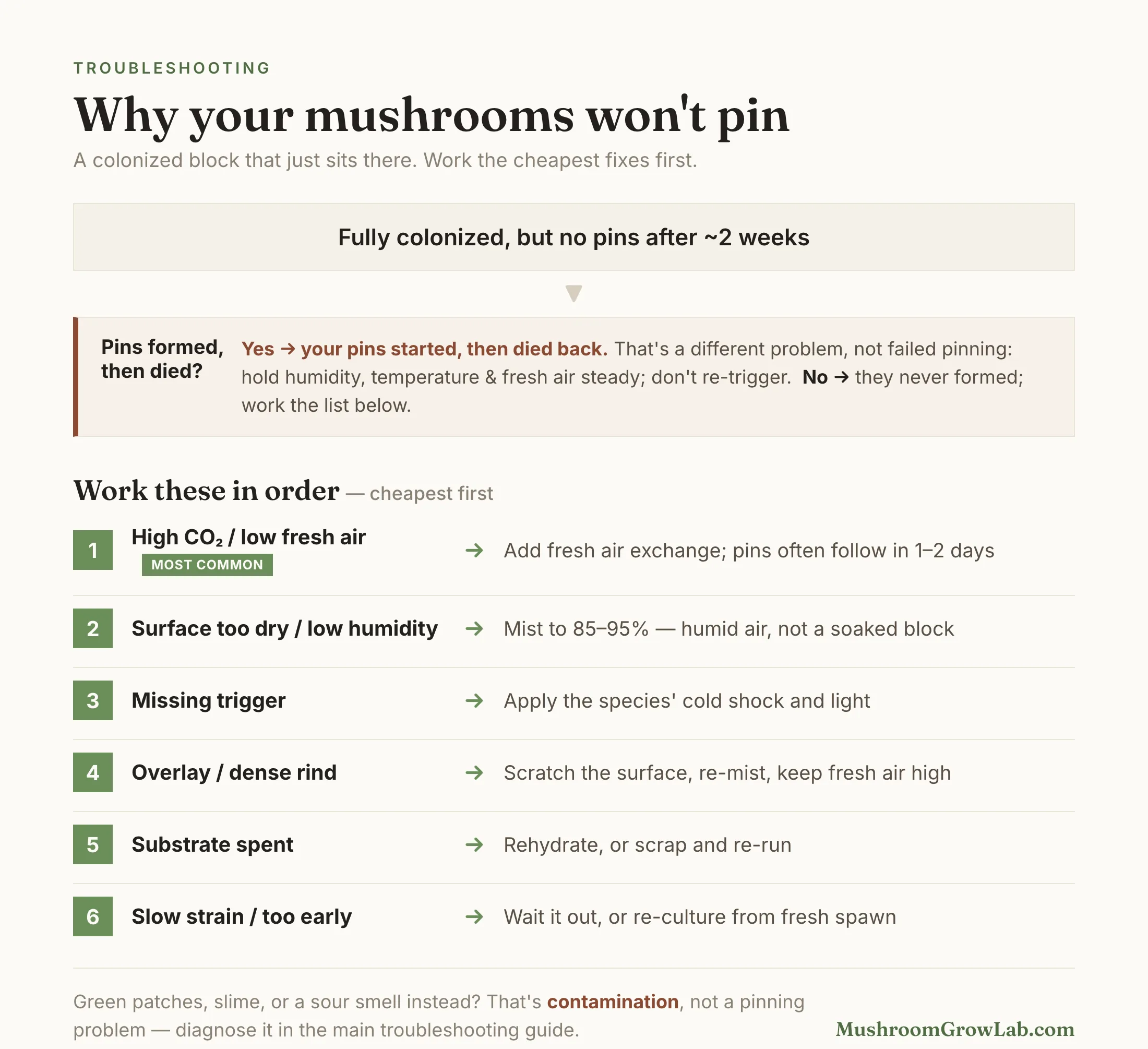
One thing to separate out before you go further. “It won’t pin” and “it pinned and then the pins died” are different problems with different fixes. If you saw tiny mushrooms form and then yellow, shrivel, or turn watery, skip down to pinned, then aborted. If the surface never formed anything, keep reading.
What causes mushrooms not to pin#
Pinning is the switch from vegetative growth to making mushrooms, and the fungus only flips it when the environment tells it to. A 2018 review of fruiting in mushroom-forming fungi in Fungal Biology Reviews found that for most cultivated species, three signals drive that switch: a drop in temperature, a drop in carbon dioxide, and nutrient cues. When a grow stalls, one of those signals is usually missing. Here are the causes, most common first, with how to confirm each one.
- Too much CO₂ / not enough fresh air. The single most common cause. Mycelium exhales CO₂, and in a closed bag or tub it builds up fast. High CO₂ suppresses cap formation and keeps the fungus in vegetative mode, so instead of pins you get more flat mycelium (or, later, leggy stems with tiny caps).
- Confirm it: pins appear within a day or two of you adding more fresh air exchange.
- Surface too dry, or humidity too low. Primordia are fragile and need a humid surface to form and survive. A dry, tight, slightly crusted surface can physically block pinning.
- Confirm it: the surface looks and feels dry, and pins follow once you raise humidity.
- A missing temperature or light cue. Many species won’t start without a nudge — a drop in temperature (a “cold shock”), and for several species some light.
- Confirm it: you never applied a temperature drop, or you’re fruiting a light-requiring species in the dark.
- Overlay (a dense rind). When conditions stay just vegetative for too long, the surface mycelium thickens into a mat that pins struggle to push through.
- Confirm it: thick, knot-free mat on top, block otherwise healthy.
- The substrate is spent. If a block already gave you one or more flushes and now won’t re-pin, it may simply be out of the specific nutrition pinning requires — flushing ends when outgrowing primordia use up a nutrient the mycelium can’t easily replace.
- Confirm it: pins stopped after earlier flushes, and the block is lighter, shrunken, or discolored.
- A slow or temperamental strain, or just too early. Strains genuinely differ in how readily they pin, and some species take longer than beginners expect.
- Confirm it: a sister block under identical conditions pinned and this one didn’t, or you simply haven’t waited out the species’ real timeline.
If instead you see green or blue-green patches, slime, or a sour smell, that’s contamination, not a pinning problem. Head to the main troubleshooting guide to identify it.
How to fix a grow that won’t pin#
Work these in order. The first three are cheap, fast, and fix the large majority of stalled grows, so try them before you touch the substrate or blame the strain.
- Increase fresh air exchange first. Open the bag, fan a tub several times a day, or move the grow into a chamber with real air exchange. Because high CO₂ is the most common cause, this alone triggers pins on a lot of blocks that looked dead. A monotub or fruiting chamber with adequate air exchange solves a large share of pinning problems on its own.
- Raise humidity at the surface. Get the fruiting surface to roughly 85–95% relative humidity with fine misting of the air and walls, not by soaking the block. Standing water invites bacteria; humid air is what you want. Keep this up alongside the extra fresh air — the two work together.
- Give the species its trigger. Apply the temperature drop the species expects (see the table below), and provide indirect light for species that need it. A cold shock plus more fresh air is the classic one-two that starts a stalled gourmet block.
- Break up overlay if it’s formed. If a dense rind has set in, disrupt it. The 2018 review notes that mechanical injury or scratching of the surface mycelia induces fruiting in several species (in Japanese cultivation this is called kinkaki), and the same idea underlies the long-standing “ruffling” of the casing layer in button-mushroom growing. Scratch or roughen the surface, then re-mist and keep the fresh air high. How aggressively to scratch is a judgment call growers develop by feel, so go gentle the first time and give it a few days before doing more.
- Decide whether the block is spent. If it already flushed and won’t re-pin, it may be done. Rehydrating a dried-out block by soaking it is common grower practice between flushes, though I haven’t found a published study that quantifies it, so treat it as a stopgap rather than a guarantee. If the block is light and tired, the better move is often to scrap it and start fresh.
- Rule out the strain, and be patient. If everything above is right and a sister block pinned but this one won’t, you may have a slow strain — give it more time under correct conditions, and if a strain repeatedly under-pins, re-culture from fresh spawn (from a supplier like North Spore or Out-Grow) next round.
Pinning targets by species#
Generic advice hides real differences. The temperature, CO₂, and light a species needs to pin vary a lot, and a “stalled” grow is often just a grow held at the wrong numbers for that species. Check your conditions against the targets below before you assume something is broken.
| Species | Pinning temperature | Cold shock? | Humidity at pinning | CO₂ for pinning | Light |
|---|---|---|---|---|---|
| Oyster (blue, pearl) | Induction ~50–60°F (10–16°C); fruiting ~68–77°F (20–25°C) | Yes — drop to ~50–61°F (10–16°C) once colonized, a ~9–18°F (5–10°C) drop | ~85–95% | Needs more fresh air; high CO₂ gives long stems, small caps | Needs light (~200–640 lux); in the dark it grows all-stem “coral” |
| Pink oyster | Fruits ~77–82°F (25–28°C); range ~70–85°F | No — tropical; below ~68°F (20°C) it stalls | ~80–90% | Needs more fresh air; high CO₂ gives long stems | Needs light |
| Lion’s mane | Primordia ~54–64°F (12–18°C); fruit body ~59–68°F (15–20°C) | Cool window, not a sharp shock | 80–85% rising to 85–95% | Low — below about 0.08%; the CO₂-sensitive one | ~200–600 lux |
| Shiitake | Induced by a temperature drop | Yes — cold shock is the classic trigger | High | Reduce; the general CO₂ rule applies | Light needed to start primordia |
| Reishi | ~70–90°F (21–32°C); warm, optimum ~75–85°F (24–29°C) | No — warm-fruiting, no cold shock | 80–90% | Inverted — below ~1,000 ppm for a flat conk, above ~2,000 ppm for antlers | Indirect; antlers grow toward the light |
A few of these differences trip growers up:
- Oyster gets called “forgiving,” but that’s about substrate, not pinning. It still needs a real cold shock and light — the step a stalled oyster grower has usually skipped.
- Pink oyster is the exception to that cold shock. It’s tropical, so a cold snap sets it back rather than triggering it; a pink block that colonized well but won’t pin is usually just too cold.
- Lion’s mane is the CO₂ canary. Stunted, coral-like clumps instead of a spined fruit body almost always mean the CO₂ is too high.
- Reishi inverts the goal. High CO₂ gives the slender “antler” form many growers actually want, so a reishi that won’t cap up may be doing exactly what you asked, not failing.
These per-species targets come from published cultivation research; the linked species pages carry the full ranges and sources.
Pinned, then aborted?#
If small pins formed and then died, that’s a different situation from a grow that never started, and diagnosing it the same way will send you chasing the wrong fix.
Some pin loss is normal. Mushrooms routinely start far more pins than they finish, and plenty of primordia abort even under good conditions, so a few shriveling isn’t a mistake on your part.
Mass abortion is the signal to act on. When most or all of your pins die at once, the usual cause is a swing during pin development rather than a failure to start: a humidity crash that dried them out, a CO₂ spike, or a heat spike. The fix targets stability, not re-triggering. Hold humidity, temperature, and fresh air steady through pinning rather than letting them lurch, and keep new pins out of direct airflow that can desiccate them. Bacterial blotch and pest damage on existing pins are separate issues — the main troubleshooting guide covers those.
How to prevent pinning problems next time#
- Match conditions to the species from the start. Set fresh air, humidity, temperature, and light to the species’ targets before you expect pins, not after it stalls. The table above is the starting point; the individual species pages carry the full ranges.
- Fruit in something with real air exchange. A closed bag is a CO₂ trap. A fruiting chamber or monotub with proper air exchange prevents the most common cause outright, and for many species you can fruit straight from well-designed grow bags with a filter patch.
- Don’t skip the trigger. For cold-shock species like shiitake and oyster, actually apply the temperature drop. It’s the step most often left out.
- Get hydration right at mix time. A substrate that’s too wet drives bacteria and a too-tight surface; too dry and it won’t hold pins. The substrate calculator helps you hit the right water content for your recipe from the start.
Related problems#
- How to diagnose and fix mushroom growing problems — the full triage guide, including contamination and pests
- Mushroom substrate: recipes, pasteurization, and sterilization — where overlay-prone and spent-substrate problems are prevented
- How to grow mushrooms at home — the full workflow pinning fits into
- Fresh spawn and cultures from North Spore or Out-Grow — the fix for a strain that repeatedly under-pins
Newsletter
Grow better mushrooms