Reishi
Ganoderma lucidum
Also known as: Lingzhi, Mannentake, Youngzhi, Mushroom of Immortality
Quick Reference
- Difficulty
- Easy (2/5)
- Days to harvest
- 30–60 days
- Yield per 5lb block
- 0.5–1.5 lbs fresh per 5 lb block (1–2 flushes)
- Fruiting temp
- 70–90°F
- Humidity
- 80–95%
- Use
- Medicinal
- Best substrates
- Hardwood sawdust (oak, maple, beech) + 10-20% wheat or rice bran, Hardwood logs (oak, maple, plum), Agricultural byproducts (wheat straw, rubber wood sawdust)
- Growing methods
- bag · log · outdoor-bed
Contents
Why grow reishi#
Reishi is the laziest mushroom you can grow, and one of the most visually striking. In its antler form, you can harvest a full crop without ever opening the bag. Leave the sealed block in a warm spot with indirect light, and over 2–3 months the mycelium pushes finger-like antlers through the filter patch or any available gap. No misting, no fanning, no fruiting chamber. For growers who want a genuinely low-maintenance species, nothing else comes close.
The real draw, though, is medicinal. Reishi is one of the most extensively studied medicinal mushrooms in the world. Its beta-D-glucans have documented immunomodulatory properties, and over 100 distinct ganoderic acids (triterpenoids) are responsible for its characteristic bitter taste and are being researched for anti-inflammatory and hepatoprotective effects, according to a 2025 review in Molecules. Growing your own means you know exactly what’s in your extract: no fillers, no starch, no ambiguity about whether the product contains actual fruiting body or just mycelium-on-grain.
Reishi is slow. Where blue oyster goes from inoculation to harvest in 4–6 weeks, reishi occupies your grow space for 3–4 months. Commercial growers at Southwest Mushrooms note that this long cycle time makes reishi one of their highest-cost crops per square foot. If you’re growing for personal use rather than profit that’s fine, but set your expectations for a patient grow, not a fast turnaround.
Reishi mushroom substrate#
Reishi is a hardwood decomposer that thrives on the same substrates as shiitake, with oak, maple, and beech the top choices. Supplementation with wheat or rice bran boosts yields significantly on sawdust.
- Hardwood sawdust supplemented with 10–20% wheat or rice bran. The standard for indoor bag culture and the substrate used in most commercial operations. Oak and maple sawdust perform consistently well. Biological efficiency typically runs 15–35%, which sounds low compared to oyster species but reflects reishi’s dense, woody growth habit.
- Hardwood logs (oak, maple, plum). The traditional method, especially for outdoor growers. Logs produce high-quality conks and can fruit for multiple seasons. Fresh-cut logs (within 2–4 weeks of felling) are ideal.
- Agricultural byproducts (wheat straw, rubber wood sawdust). Viable alternatives documented in research from International Journal of Medicinal Mushrooms, though yields tend to trail supplemented hardwood.
When you’re ready to mix your own batches, the substrate calculator can help with ratios.
How to grow reishi mushrooms#
Growing reishi mushrooms from a kit#
Best for: first-time reishi growers who want to see a full antler or conk cycle without building their own blocks.
- Order a pre-colonized reishi fruiting block from North Spore or another established supplier. Most reishi kits ship as already-colonized sawdust blocks rather than the pre-browned shiitake-style kits, because reishi fruits without a separate browning phase.
- Keep the bag sealed and place it in a warm spot (75–85°F) with indirect light if you want antlers. No misting, fanning, or humidity management required; the mycelium pushes antler-shaped fruiting bodies through the filter patch over 6–10 weeks.
- For conks instead, cut the top of the bag open and place the block in a fruiting chamber with 80–90% humidity and strong fresh air exchange (CO2 below 1,000 ppm). CO2 level controls morphology from the start, so a fully-colonized block in a high-FAE environment will form conks directly without passing through an antler stage. Mist the surrounding area rather than the block surface to maintain humidity.
- Harvest antlers when they’re firm and 4–8 inches long. Harvest conks just before the white growing margin disappears and the cap begins to harden, to avoid the heavy spore dump that follows full maturity.
Expect roughly 6–12 weeks from unboxing to first harvest, depending on whether you’re growing antlers or conks. A kit is the lowest-risk way to verify your space can sustain the temperature and humidity reishi needs before investing in pressure cookers and substrate.
Reishi antler-form bag culture#
Best for: beginners and anyone who wants the simplest possible mushroom grow.
- Prepare hardwood sawdust supplemented with 10–20% wheat bran at 60–65% moisture content. Some hobbyists skip the bran entirely; unsupplemented hardwood pellets reduce contamination risk on reishi’s long colonization timeline, at the cost of slightly lower yields.
- Load into filter-patch grow bags (Unicorn 14A or 3T).
- Sterilize at 15 PSI for 2.5 hours in a pressure cooker.
- Cool overnight, then inoculate with grain spawn or liquid culture in front of a still-air box or flow hood.
- Seal the bag and incubate at 75–82°F. Colonization takes 2–4 weeks.
- Once fully colonized, leave the bag sealed. Place it in a warm area (75–85°F) with indirect light. The mycelium will push antler-shaped fruiting bodies through the filter patch or any gap in the bag.
- Wait. Antlers grow slowly over 6–10 weeks. No misting or FAE management is needed while they’re developing inside or emerging from the sealed bag.
Expect total time from inoculation to harvest of roughly 3–4 months. This is the method several growers on Reddit describe as “set it and forget it.”
Reishi conk-form bag culture#
Best for: growers who want the classic fan-shaped reishi shelf for tea or tincture, or who want to harvest spores.
- Follow steps 1–5 above.
- Once fully colonized, cut the bag open to expose the top of the substrate block.
- Place the block in a fruiting chamber with 80–90% humidity, temperatures of 75–85°F, and strong fresh air exchange (CO2 below 1,000 ppm).
- Mist the surrounding area (not the block surface directly) to maintain humidity.
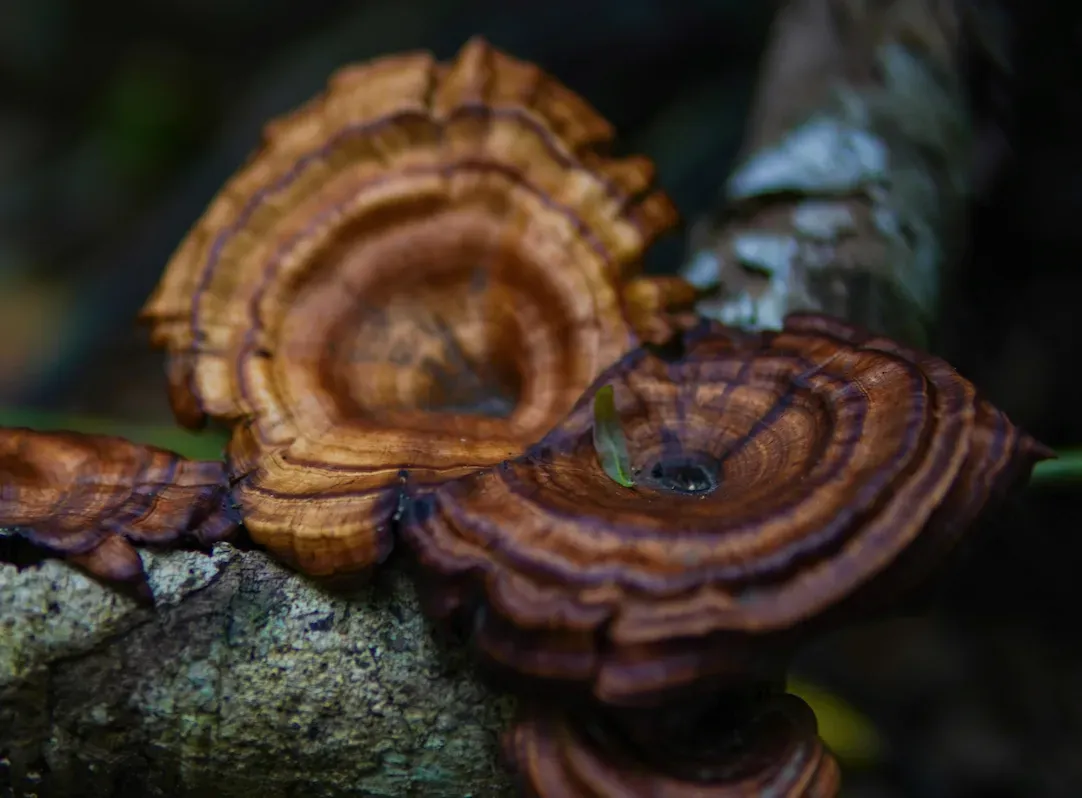
- The mycelium will form antler primordia first, then, with sufficient FAE, the antlers flatten and develop the characteristic fan-shaped cap with concentric red and brown bands.
- A mature conk develops a white growing edge. When that edge disappears and the surface begins to harden, the mushroom is approaching spore release.
Conk formation adds 2–4 weeks beyond the antler timeline. Managing the transition from antler to conk is the trickiest part. It requires genuinely high FAE, which is the main reason this method has a steeper learning curve.
Reishi log inoculation#
Best for: outdoor growers with access to fresh hardwood who want a perennial reishi patch.
- Source fresh-cut hardwood logs; oak is ideal. Cut in late winter or early spring. Logs should be 3–6 inches in diameter and 3–4 feet long.
- Let logs rest 2–4 weeks after cutting to allow antifungal compounds to dissipate.
- Drill holes in a diamond pattern: every 6 inches along the length, rows 2 inches apart around the circumference. Use a 5/16” bit with a depth stop.
- Fill holes with plug spawn (hammer in) or sawdust spawn (palm inoculator). Field & Forest Products carries plug and sawdust spawn specifically for log work.
- Seal each inoculation point with melted beeswax or cheese wax.
- Bury logs halfway in a shaded trench or lay them in contact with moist soil under a canopy of woodchips. The Oregon State University Extension guide recommends the trench method for consistent moisture retention.
- Keep the area moist during dry spells. Logs colonize over 6–12 months.
Expect first fruits the summer after inoculation if conditions are warm enough. Logs can produce for 2–4 seasons.
Outdoor reishi bed (spent block burial)#
Best for: growers who’ve finished an indoor bag grow and want to squeeze more life out of the block.
- After your indoor harvest, take the spent substrate block outdoors.
- Dig a shallow trench in a shaded area and bury the block under 2–3 inches of hardwood woodchips or soil.
- Water the bed during dry spells to keep it consistently moist.
- Wait. Reishi conks may appear in the warm months following burial, sometimes months later.
Growers report that burying spent blocks is one of the most reliable ways to get surprise outdoor conks with zero additional effort. Yields are unpredictable, but the cost is essentially zero.
Reishi fruiting conditions#
Temperature. Standard commercial reishi strains fruit between 70–90°F, with 75–85°F as the optimum range. However, hobbyists on Reddit consistently report healthy (though slower) fruiting at 60–65°F, and Finnish research documents cold-adapted boreal strains that fruit at 50–65°F. If you’re growing in an unheated space, seek out a cold-tolerant strain rather than trying to heat your way to 80°F.
Humidity. 80–90% during active fruiting for conk development. Antler growers working with sealed bags can largely ignore humidity; the sealed bag maintains its own microclimate. For open-air conk fruiting, a humidity tent, Martha setup, or regular misting is necessary.
Fresh air exchange. This is where reishi gets interesting. CO2 level is the primary lever controlling mushroom shape. Above ~2,000 ppm CO2, reishi grows as elongated antlers. Below ~1,000 ppm (high FAE), it forms the flat, fan-shaped conk. You can deliberately manipulate this: keep the bag sealed for antlers, or open it in a well-ventilated chamber for conks.
Light. Indirect natural light or a low-wattage LED. Reishi uses light as a directional cue: antlers grow toward the light source, which some growers exploit to “steer” growth for aesthetic purposes. A point light source from one direction produces straighter, more uniform antlers.
Harvesting reishi mushrooms#
When to harvest antlers. Pick antlers when they’re firm and have reached your desired length, typically 4–8 inches. There’s no single visual cue like cap curl; it’s a judgment call based on size and firmness. Longer antlers aren’t necessarily better; the active compound concentration is similar regardless of length.
When to harvest conks. Wait for the white growing margin at the edge of the cap to disappear and the surface to begin hardening and darkening. You want to avoid the spore dump, because mature conks release massive amounts of fine brown spore powder that coats everything nearby, so harvest just before the cap fully matures. FreshCap recommends using garden pruners rather than a knife, since the fruiting body is dense and woody enough to dull a blade.
How to harvest. Cut or twist the fruiting body from the substrate. Use pruning shears for thick conks. The base is tough; don’t expect a clean snap.
Yield. For a 5 lb supplemented sawdust block, expect 0.5–1.5 lbs fresh (roughly 0.25–0.5 lbs dried). Reishi is extremely dense and woody, and only loses 50–60% of its weight when dried, compared to 90% for fleshy species like oyster mushrooms. Biological efficiency runs 15–35%, which is low by oyster standards but normal for reishi.
Flushes. Expect 1–2 productive flushes. The first flush consumes the vast majority of the substrate’s nutrients. A second, much smaller flush may follow after a 75–90 day rest period if the block is kept moist.
Reishi flavor and culinary uses#
Reishi is not a culinary mushroom. The fruiting body is corky, woody, and physically impossible to chew: think tree bark, not food. The taste is intensely bitter, driven by the high concentration of ganoderic acids (triterpenes) that also happen to be its most researched medicinal compounds.
Processing methods. All reishi consumption starts with extraction. Hot water extraction (simmering sliced or powdered reishi for 1–2 hours) pulls out the water-soluble beta-glucans and polysaccharides. Alcohol extraction (soaking in high-proof ethanol for 4–6 weeks) pulls out the alcohol-soluble triterpenes. A “dual extract” combines both and is considered the most complete preparation. Many growers dry and powder their harvest for capsule filling.
Medicinal compounds. Beta-D-glucans are the most documented bioactive, with immunomodulatory properties referenced across decades of peer-reviewed literature. The triterpenoid profile, over 100 distinct ganoderic acids, is studied for anti-inflammatory, hepatoprotective, and antihistamine effects. Ergosterol, a vitamin D2 precursor, is also present. The NCBI Bookshelf monograph on reishi provides one of the most comprehensive summaries of the clinical evidence. That said, research is promising rather than conclusive for most claims; “well-studied” is not the same as “proven to treat.”
Storage. Dried reishi stores indefinitely in airtight containers. Slice fresh conks before dehydrating; the woody flesh dries slowly and unevenly if left whole. Tinctures keep for years at room temperature.
Common reishi growing problems#
These are reishi-specific. For the problems any grow can hit (contamination, mold ID, stalled pinning), start with our mushroom growing problems guide.
Mycelium climbing the bag#
The most frequently reported issue on r/MushroomGrowers. Instead of pinning on the substrate surface, the mycelium follows moisture up the inside walls of the bag, sometimes reaching the filter patch. This usually happens when there’s an air gap between the substrate and the bag wall. Packing the substrate more tightly and folding any excess bag material down against the block reduces the problem. Some growers flip to “bottom fruiting,” cutting the bag at the bottom rather than the top, when climbing is severe.
Antlers instead of conks (or vice versa)#
This is a CO2 management issue, not a defect. If you want conks but keep getting antlers, your fruiting environment doesn’t have enough fresh air exchange, so CO2 is staying too high. Increase ventilation, add a small fan, or move the block to a more open space. Conversely, if you want antlers, keep the bag sealed and resist the urge to open it for air.
Spore dump coating everything#
Mature reishi conks release enormous quantities of fine brown spores that settle on every surface in the grow area. The spore load is heavy enough to cause respiratory irritation in enclosed spaces. Harvest conks before full maturity (when the white growing edge is still barely visible), or if you’re growing conks to full maturity for spore collection, isolate them in a separate space with easy-to-clean surfaces.
Slow growth and premature give-up#
Reishi is slow. Full colonization takes 2–4 weeks, and fruiting bodies develop over another 6–10 weeks, sometimes longer. Beginners frequently suspect contamination during what is actually normal, healthy growth. If the mycelium is white and the block smells earthy (not sour), it’s probably fine. Green, black, or orange patches are contamination; uniform white growth that seems to be “doing nothing” is just reishi being reishi.
Orange metabolites or coral-like primordia#
Orange or amber liquid on the substrate surface can indicate stress (metabolites the mycelium excretes when fighting off competitors) or early-stage contamination like Mycogone (wet bubble disease). Wipe the metabolites with a clean paper towel dampened with hydrogen peroxide. If the orange is accompanied by misshapen, coral-like blobs instead of normal pins, the block may have Mycogone; isolate it from healthy blocks immediately.
Where to buy reishi spawn#
Two suppliers in our directory carry reishi spawn, kits, or cultures.
North Spore is the most accessible entry point. Their organic reishi fruiting block ($29.99) ships pre-colonized with a 100% grow guarantee, ideal for a first grow. They also carry plug spawn for log inoculation and liquid culture for growers making their own blocks. Shipping is fast and customer support is consistently well-reviewed.
Field & Forest Products is the strongest option for log cultivation, with plug spawn, sawdust spawn, and grain spawn all available. Their pricing is competitive and they offer free shipping on orders over $200, useful if you’re buying spawn in bulk for a log yard.
Equipment for growing reishi#
For antler growing in sealed bags, you genuinely don’t need any equipment beyond the bag itself. This is the simplest equipment profile of any species we cover.
For conk growing, you’ll need a humidity management setup, either a simple humidity tent (a clear plastic tote over the block) or a Martha-style fruiting chamber with a humidifier. A digital hygrometer helps you verify you’re hitting the 80–90% range.
For making your own substrate blocks, you’ll need a pressure cooker for sterilization (the Presto 23-quart is the standard beginner pick), filter-patch grow bags, and a still-air box or flow hood for clean inoculation.
For log inoculation, the tooling is the same as for shiitake: a drill with a 5/16” bit and depth stop, plug spawn or a palm inoculator, and beeswax or cheese wax for sealing.
Related guides#
- How to Grow Mushrooms at Home — Beginner Guide
- Substrate Calculator — dial in sawdust-to-bran ratios for reishi blocks
- Pressure Cooker Buying Guide — essential for bag culture
- Turkey Tail Growing Guide — another medicinal hardwood species with a similar growing profile
- Shiitake Growing Guide — shares the same substrates and log-inoculation workflow
- Maitake Growing Guide — a meaty culinary hardwood species grown on the same supplemented sawdust
Newsletter
Grow better mushrooms