Troubleshooting

Diagnose and fix what goes wrong: contamination, mold, pests, and pinning problems.

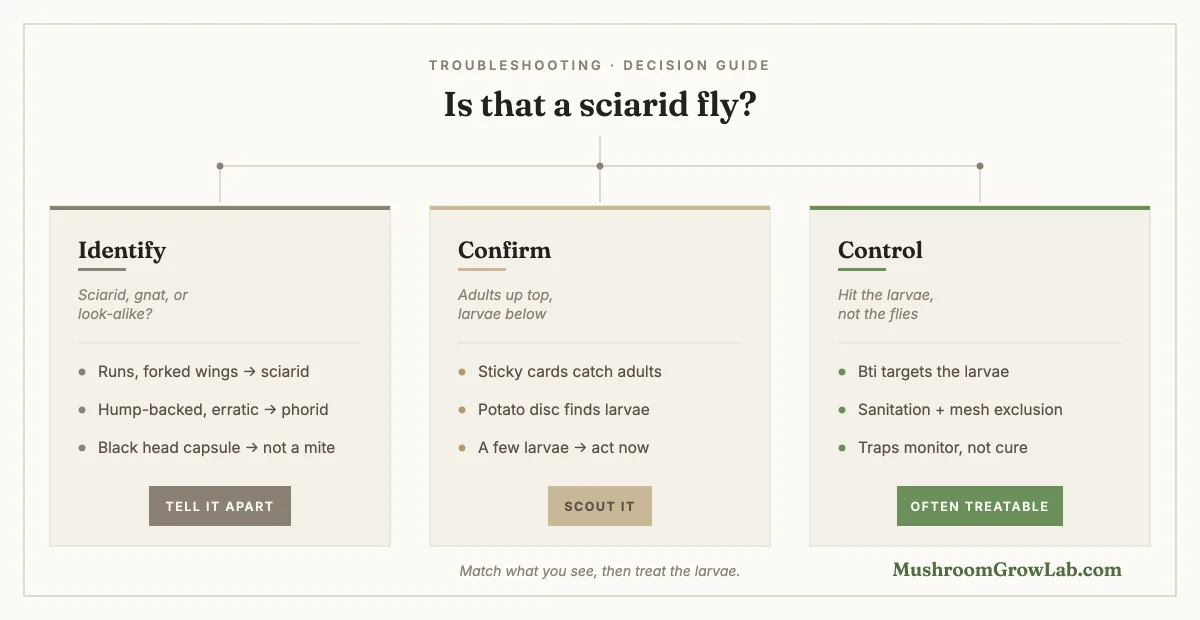
Decision chart for sciarid flies and fungus gnats in three steps. Identify: a fly that runs with forked wings is a sciarid, hump-backed and erratic is a phorid, and a larva with a black head capsule is a fly rather than a mite. Confirm: yellow sticky cards catch the adults and a potato disc finds the larvae. Control: Bti targets the larvae, sanitation plus fine-mesh exclusion prevent them, and sticky traps only monitor rather than cure.

Troubleshooting

Sciarid Flies and Fungus Gnats — Identify and Control Them in Mushroom Grows

How to identify sciarid flies and fungus gnats, tell the larvae from mites, and control an infestation with Bti, nematodes, and exclusion.

Troubleshooting

Mushroom Contamination Identification — The Non-Green, Non-Cobweb Catalog
Identify non-green mushroom contamination by sight and smell: bacterial wet rot, pin mold, Aspergillus niger, yeast, and sour rot, plus when to scrap or save.

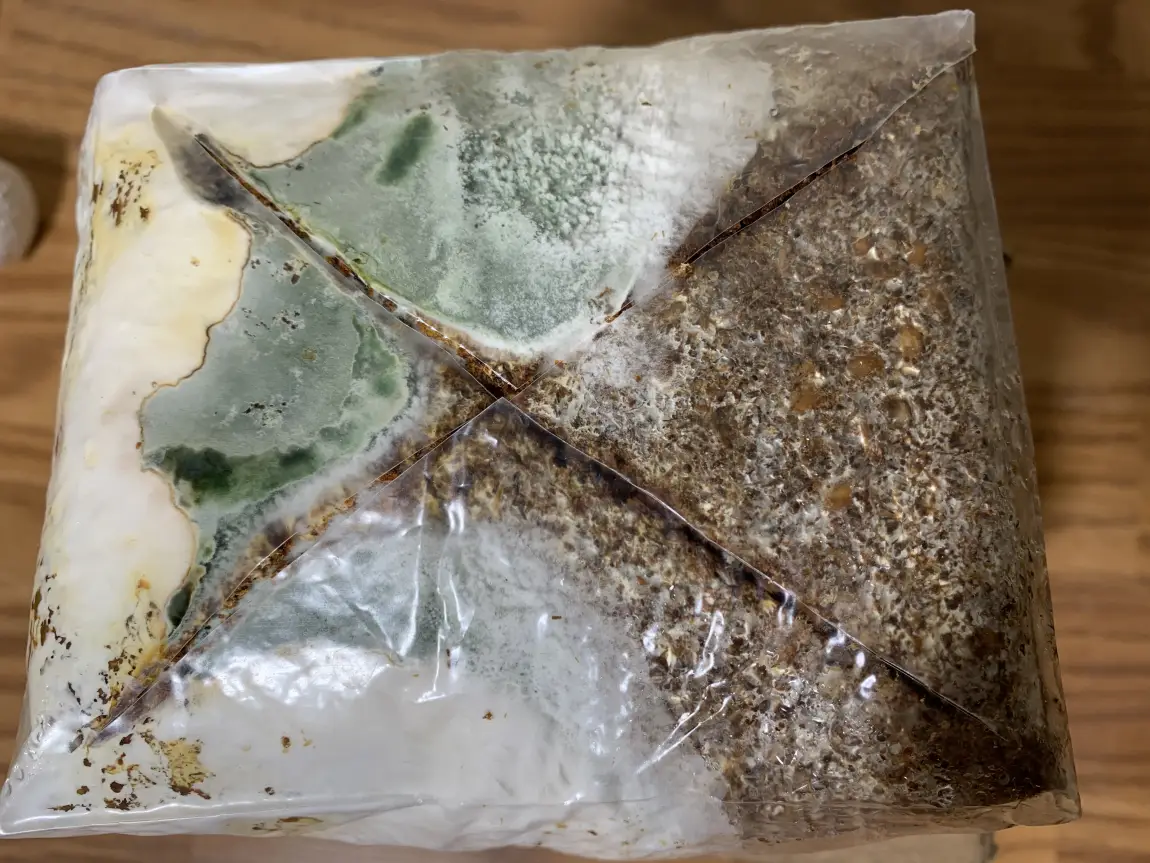
Top-down view of a blue oyster grain block in a plastic bag, the left half overtaken by forest-green Trichoderma sporulation with a white advancing frontier, the right half still brown, healthy substrate.

Troubleshooting

Green Mold on Mushrooms — Which One Is It and What to Do
Green mold on a grow could be Trichoderma, Penicillium, Aspergillus, or Cladosporium. How to tell them apart, confirm the genus, and decide scrap or save.

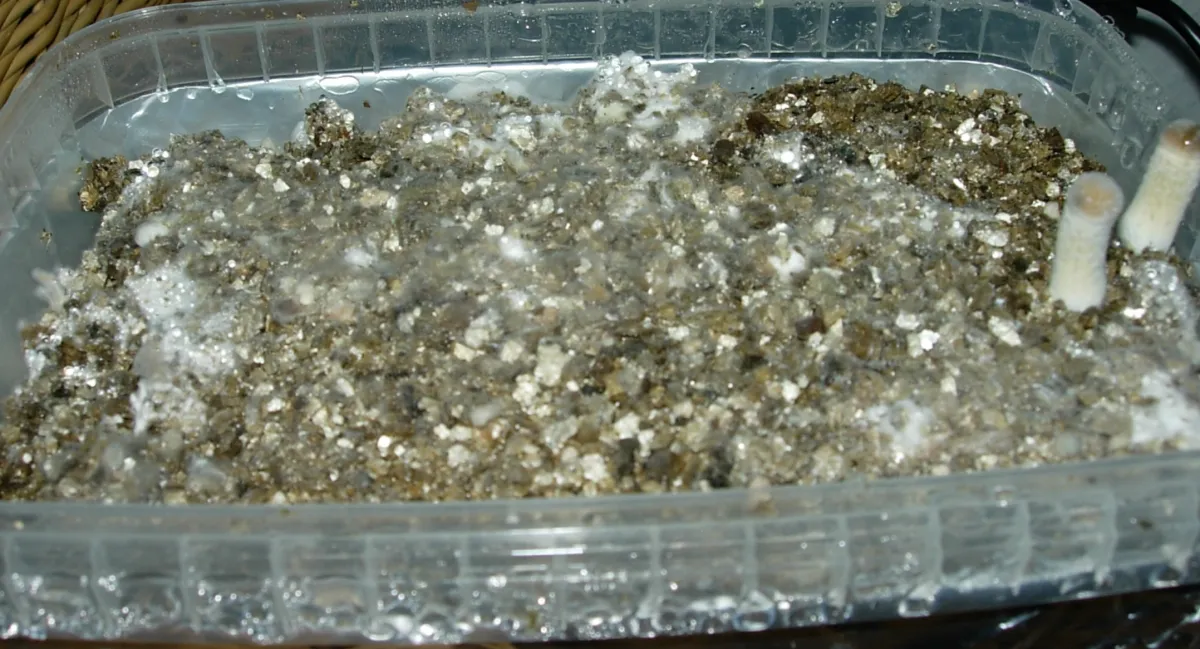
Wispy grey-white cobweb mold spreading across the damp vermiculite casing of a clear plastic grow tub, with heavy condensation beading on the walls and two small mushroom pins at the right edge.

Troubleshooting

Cobweb Mold vs. Mycelium — How to Tell Them Apart and What to Do
Cobweb mold looks a lot like healthy mycelium at first. How to tell them apart, confirm it with the peroxide test, and stop it before it spreads.

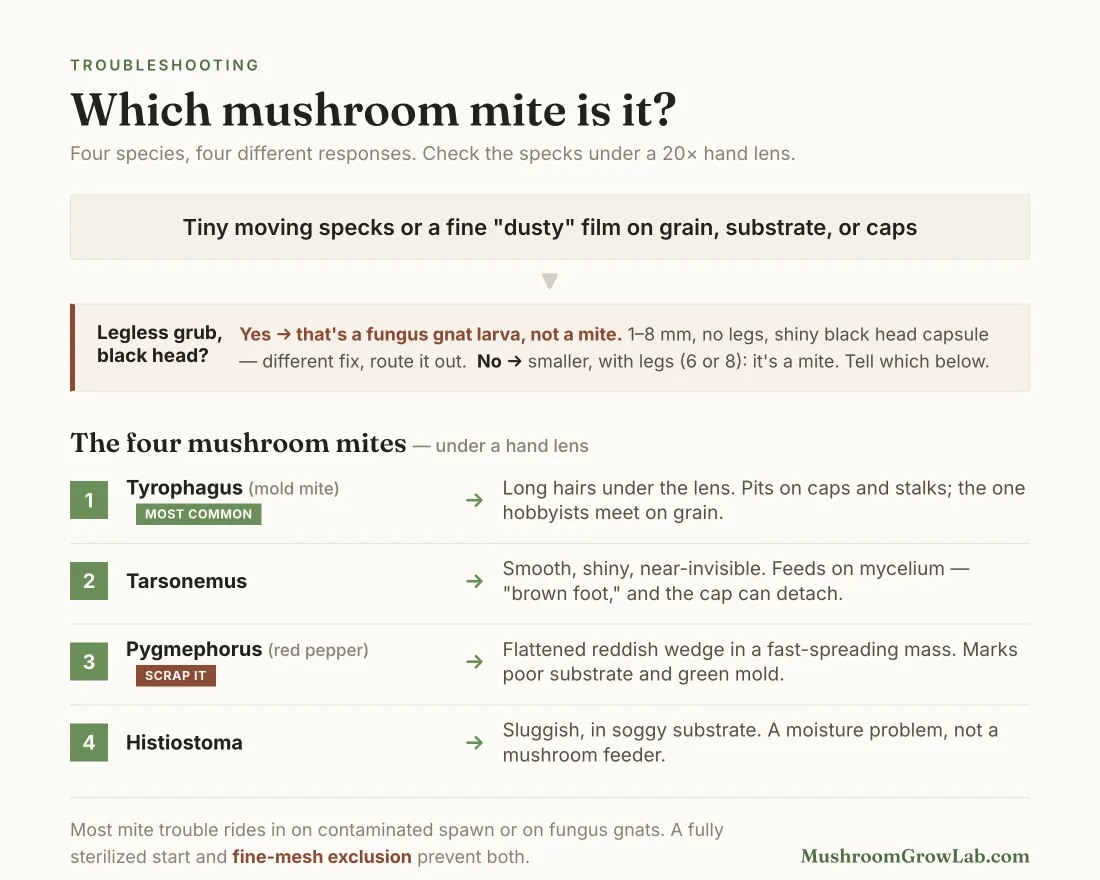
Decision chart for identifying mushroom mites: from tiny moving specks or a dusty film, first rule out fungus gnat larvae (1–8 mm, legless, shiny black head capsule), then tell the four mites apart under a hand lens — Tyrophagus mold mite (long hairs, pits on caps, most common), Tarsonemus (smooth and shiny, causes brown foot), Pygmephorus red pepper mite (flattened reddish wedge, a signal to scrap the grow over poor substrate and green mold), and Histiostoma (sluggish, in soggy substrate, a moisture problem).

Troubleshooting

Mushroom Mites: Identification, Damage, and What to Do
The four mushroom mites, how to tell them apart under a hand lens, how to separate them from fungus gnats, and what actually controls an outbreak.

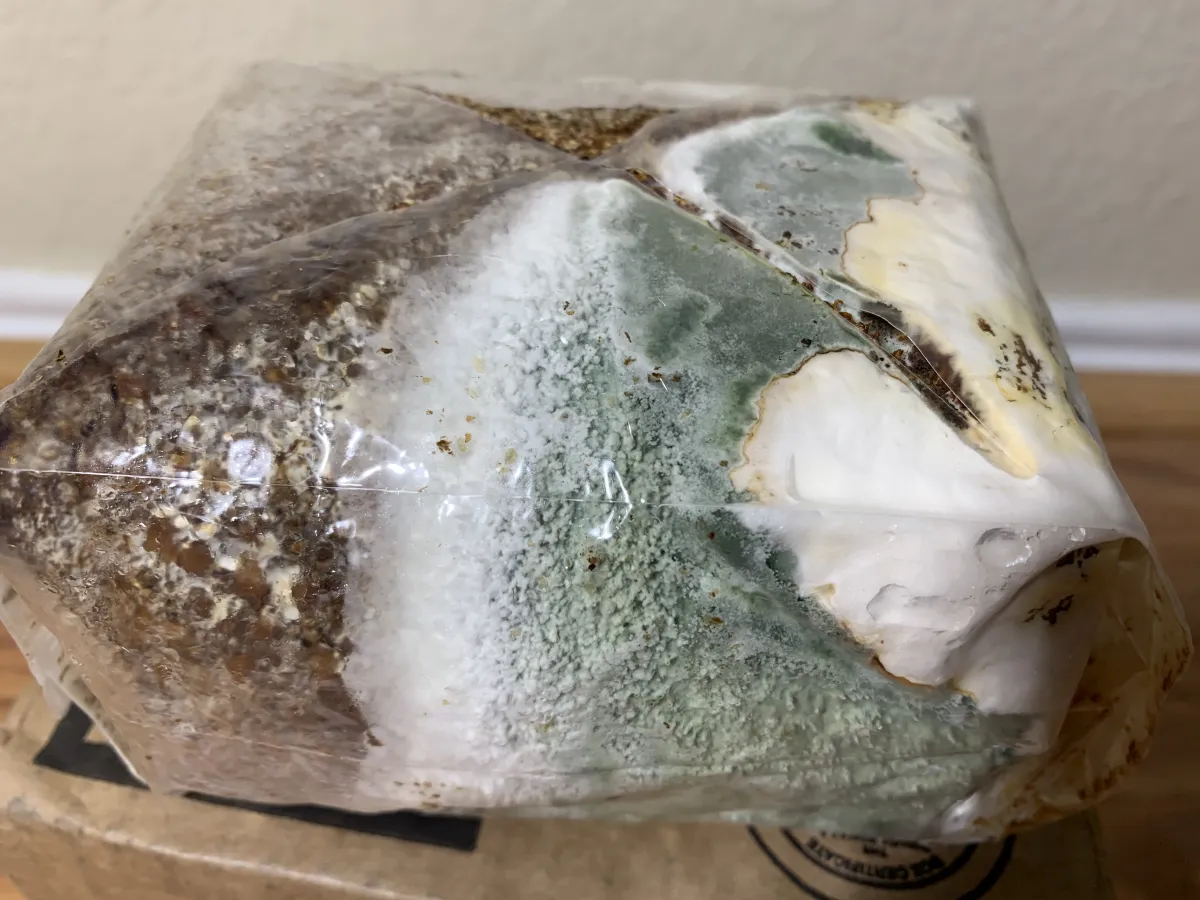
Trichoderma green mold sporulating across a blue oyster fruiting block, with a fuzzy white advancing edge where it overtakes the mushroom mycelium.

Troubleshooting

Trichoderma Identification — Spotting and Stopping Green Mold
How to identify Trichoderma green mold at every stage, confirm it, and decide whether to save or scrap the grow, plus prevention that actually holds.

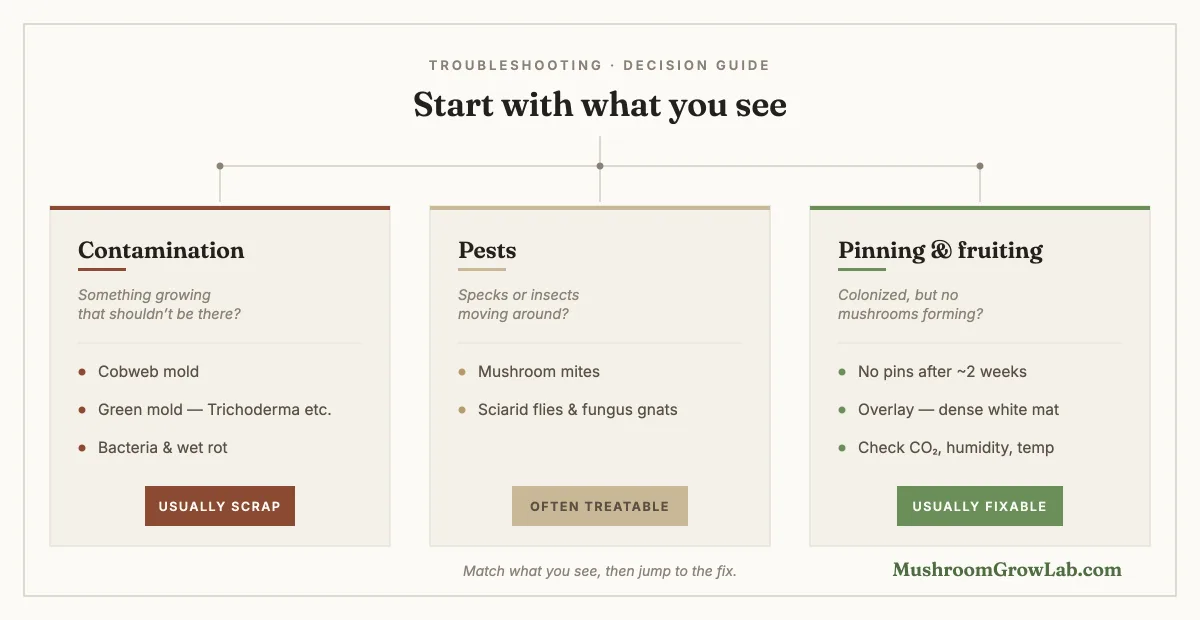
Decision flowchart for diagnosing mushroom growing problems, branching into contamination (usually scrap), pests (often treatable), and pinning failures (usually fixable).

Troubleshooting

How to Diagnose and Fix Mushroom Growing Problems
A symptom-by-symptom triage guide to the most common mushroom growing problems: contamination, pests, and pinning failures, and whether to fix or scrap.

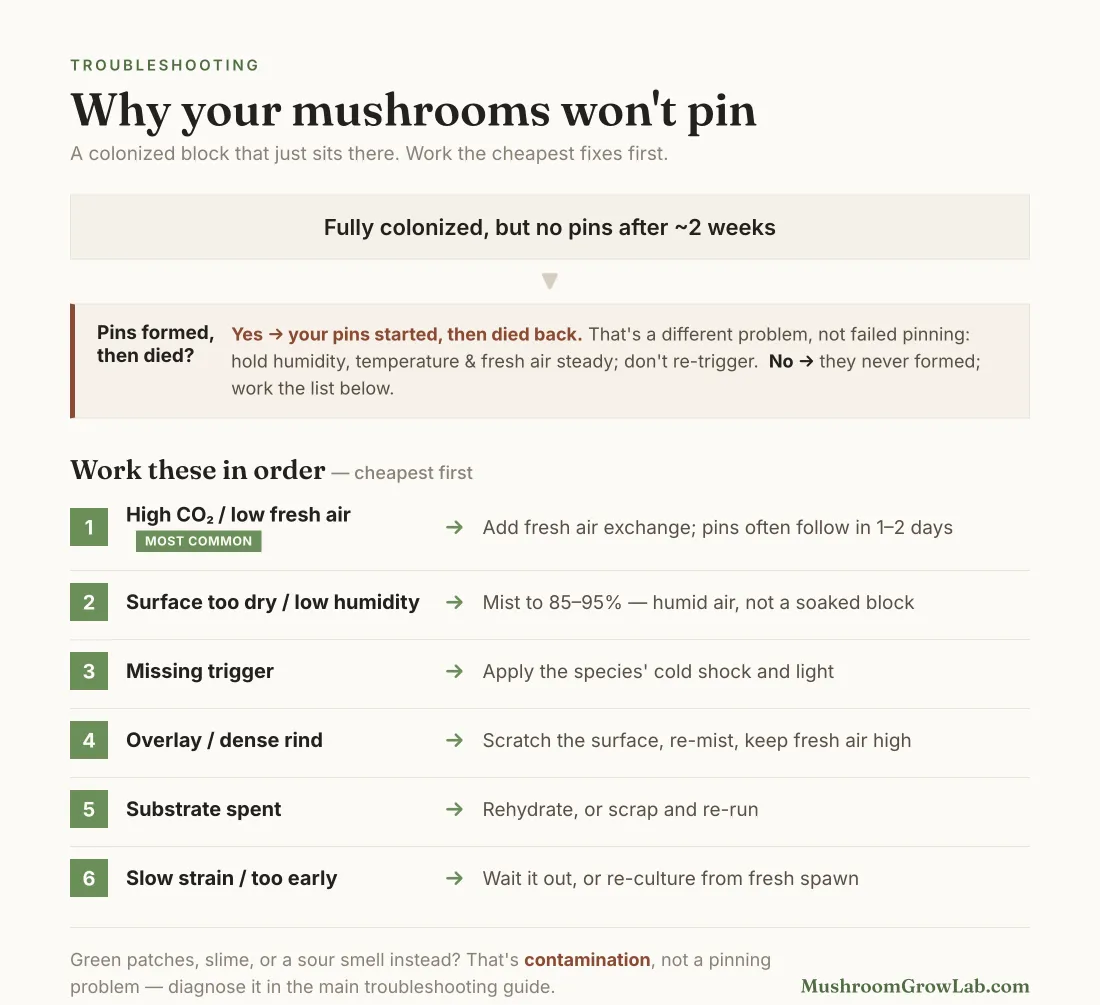
Flowchart for diagnosing a mushroom that won't pin: first check whether pins formed and aborted, then work six causes cheapest-first — high CO₂ and low fresh air, dry surface, missing cold or light trigger, overlay, spent substrate, or a slow strain.

Troubleshooting

Mushroom Not Pinning? How to Diagnose and Fix a Stalled Grow

Your substrate is fully colonized but won't pin. How to tell which of six causes is responsible, the specific fix for each, and pinning targets by species.