Troubleshooting
Cobweb Mold vs. Mycelium — How to Tell Them Apart and What to Do
Published July 24, 2026 · By MushroomGrowLab
Contents
Cobweb mold vs mycelium: how to tell them apart#
A few days into your grow, a fine, hazy grey-white growth starts creeping across the surface faster than anything you’d expect from healthy mycelium. Before you panic and toss the whole grow, slow down. Cobweb mold and healthy mycelium genuinely do look alike in the first day or two, and that resemblance is exactly what makes cobweb one of the most misidentified problems in indoor growing.
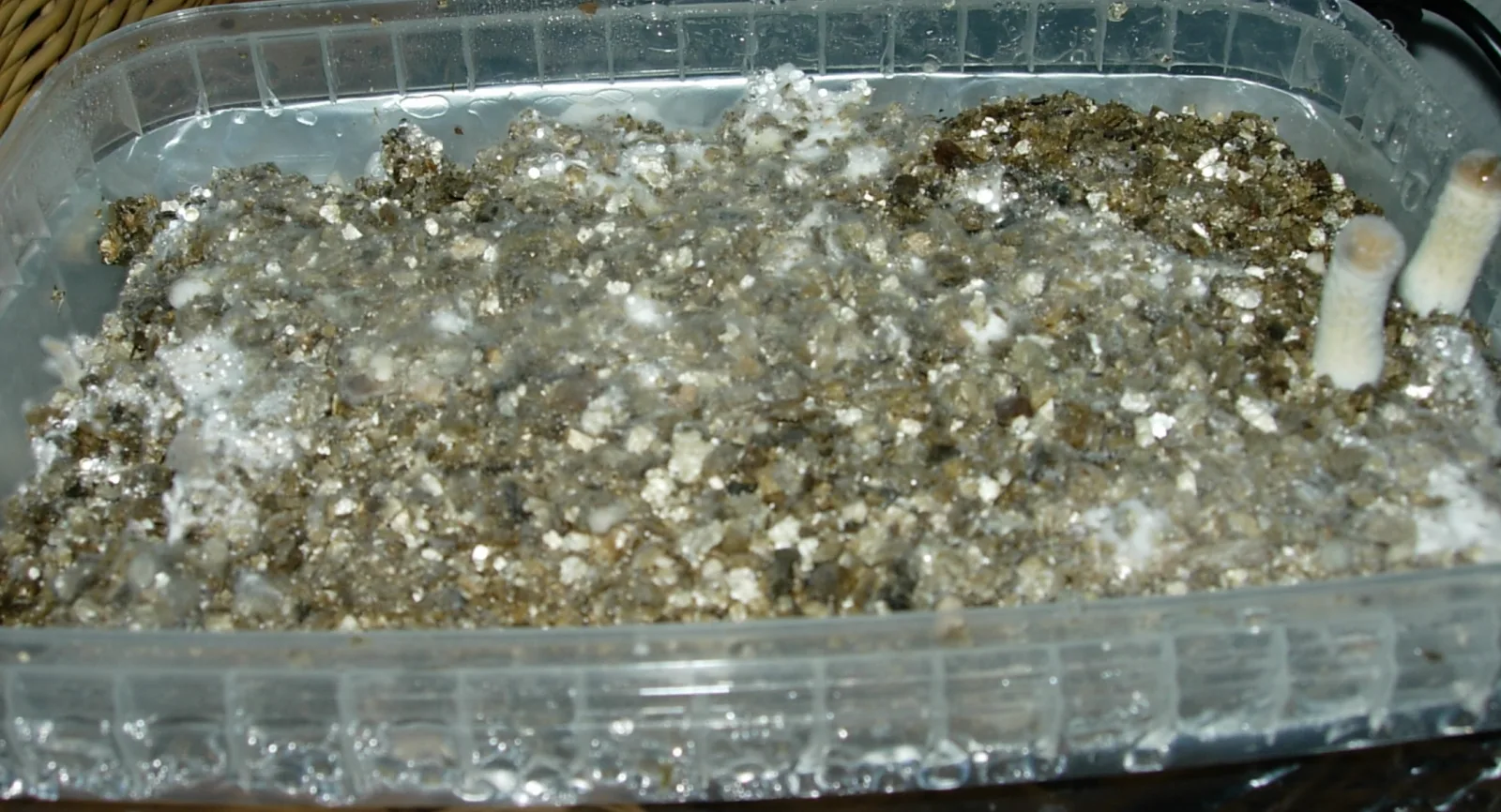
Here’s the core difference. Healthy mycelium is dense and it clings to the substrate, growing as either thick, ropey strands (rhizomorphic) or a flat, cottony mat (tomentose), and it advances at a steady, unremarkable pace. Cobweb mold is wispy, loose, and lifts off the surface, throwing up long aerial hyphae that give it the grey, gauzy look of a spider web draped over the bed. It usually starts as small white circular patches that spread into a fine grey-white web.
The most reliable tell is speed. In lab measurements, a 2014 study by Kim et al. clocked cobweb growing 20 to 30 mm a day on agar — roughly an inch, enough to visibly expand a patch overnight. Healthy mycelium creeps along steadily and does not balloon like that from one day to the next. If you marked the edge of the growth yesterday and it has jumped a finger-width by this morning, that’s a strong cobweb signal.
What it looks like depends on where you catch it:
| Stage | Healthy mycelium | Cobweb mold |
|---|---|---|
| Grain spawn | Thick and white, binds the grains firmly | Diffuse, translucent grey, races across the grains |
| Bulk colonization | Dense white, grows into the substrate | Thin wispy layer sitting on top of the surface |
| Casing layer | Uniform white overlay that knots up into pins | Fine grey filaments that sheet across the surface and swallow pins |
| Pinning and fruiting | Firm pins, clean caps | Web engulfs pins; caps develop soft, watery rot and spotting |
A couple of secondary cues help. Healthy mycelium tends to be a uniform, opaque white, while cobweb often reads more translucent or grey. Some cobweb strains give off a faint camphor-like or musty odor that healthy growth doesn’t, though this varies enough that you shouldn’t rely on smell alone.
One quick rule-out: if the growth is turning green, that isn’t cobweb. That’s Trichoderma (green mold), which starts white and then greens up from the center as it sporulates, and it calls for a different response. Cobweb stays grey-white and wispy the whole time. If you’re not sure which problem you’re looking at, start with our broader triage guide to mushroom growing problems.
The 3% hydrogen peroxide test#
The fastest way to separate cobweb from a harmless patch of fluffy aerial mycelium is a spritz of ordinary 3% hydrogen peroxide, the same drugstore concentration you’d use on a cut. Mist a little directly onto the suspicious growth and watch for a minute or two. Cobweb’s loose, delicate hyphae collapse and dissolve almost on contact. Healthy mycelium mostly shrugs it off — it may bubble or foam, but it stays put.
The reason it works comes down to enzymes. Established mushroom mycelium produces catalase and peroxidase, which break hydrogen peroxide down into water and oxygen, and that tolerance is the whole basis of the well-known peroxide method of cultivation. Cobweb’s thin, airy web carries far less tissue to absorb the same oxidative hit, so it just melts.
This is a field test that growers rely on, not a lab-validated diagnostic. No published study has tested the peroxide spray specifically for telling Cladobotryum apart from mushroom mycelium; it rests on the general, well-documented catalase principle rather than a study of this exact use.
A few things to keep in mind when you run it:
- Use fresh peroxide. The 3% stuff degrades in the bottle over time, so an old, flat bottle can give a weak reaction.
- Mist, don’t drench. A fine spray on a localized patch is enough. Soaking the bed just adds the surface moisture cobweb loves and can splash spores around.
- It’s less reliable on old growth. A dense, mature cobweb colony reacts less dramatically than a fresh wispy one, so a muted response on an established patch isn’t a clean all-clear.
When the peroxide result is ambiguous, fall back on the growth-rate check above, or look at the growth under a hand lens or cheap microscope. Cobweb produces whorled (verticillate) spore-bearing structures and chains of septate spores that healthy mycelium simply doesn’t have.
What cobweb mold actually is#
Cobweb isn’t one organism but several closely related fungi in the genus Cladobotryum, the asexual form of fungi in the genus Hypomyces. For decades the disease was pinned on a species called Dactylium dendroides, but modern DNA work has shown that the most common culprit in cultivation today is Cladobotryum mycophilum. Other species like C. dendroides, C. varium, and C. multiseptatum show up too.
The important word is mycoparasite. Cobweb doesn’t just compete with your mushrooms for space and food the way some contaminants do — it’s a necrotroph that actively kills and feeds on mushroom tissue. That’s why an advanced infection doesn’t just crowd the bed, it rots the mushrooms themselves, leaving cap spotting and soft, brown decay. It hits cultivated crops like button mushrooms (Agaricus) and oyster mushrooms (Pleurotus) especially hard.
It spreads through spores called conidia, which the fungus produces in enormous numbers. They’re dry and light, so they lift off at the slightest disturbance and ride air currents, water splashes, and your hands and tools to fresh surfaces. Combine that easy dispersal with the fast growth rate and you get a problem that can go from one small patch to a whole room in a few days if it’s ignored — which is exactly why catching it early matters so much.
What causes cobweb mold#
Cobweb is an environmental problem before it’s a hygiene problem. It thrives in the warm, wet, still conditions that also happen to be good for fruiting, which is why it so often turns up right when your crop does.
- High humidity and stagnant air. Cobweb takes off above 90% relative humidity, and it germinates fastest above about 97% — the kind of saturated, still air you get with too little fresh air exchange. Poor airflow and standing condensation on the casing or on caps give spores the wet surfaces they need to take hold.
- Warm temperatures. It grows across roughly 68 to 77°F and moves fastest near 77°F. Below about 63°F, spread slows to a crawl.
- How it gets in. Casing is the thin top layer of moist peat, often mixed with lime, that some growers spread over a fully colonized substrate to trigger pinning. In grows that use it, contaminated casing is the most common entry point, because spores ride in on the casing material far more readily than on spawn (spawn and compost are usually pasteurized and clean enough not to be the source). Plenty of grows skip casing, though, and cobweb still reaches them. Its spores are dry and airborne, so they travel just as easily on tools, hands, clothing, and air drifting from an earlier infected grow.
- Gaps between flushes. The disease shows up most during pinning and fruiting, and especially in the lull between flushes when sanitation slips and leftover spores get a second chance.
The environment that favors cobweb is the same one you’re deliberately creating inside a sealed, humid monotub, so tubs run with too little fresh air exchange are a classic setting for it.
How to get rid of cobweb mold#
First, confirm it with the peroxide test above so you’re not overreacting to normal aerial mycelium. Once you know it’s cobweb, how you respond depends entirely on how far it’s spread.
For a small, localized patch, the order of operations matters more than any single product:
- Don’t disturb it dry. Never salt, water, or wipe bare cobweb. Disturbing a dry patch launches a cloud of spores and turns one spot into ten.
- Cover it first. Gently drape the patch with a damp (or better, alcohol-dampened) paper towel. The wet cover pins the spores down so they can’t go airborne while you work.
- Then salt over the towel. Cover the towel generously with plain salt, or a 50/50 mix of salt and gypsum or hydrated lime. The salt dehydrates the colony underneath the cover. Do this at the first sign of disease, and only on isolated patches, since salt will also kill any healthy mycelium it touches.
To pull a single infected mushroom without seeding the rest of the bed, drape it with a damp paper towel as above, then push a plastic bag inside-out over a gloved hand, close it around the mushroom, and lift so the spores stay sealed in the bag. Treat the spot it came from with salt, tie the bag off, and bin it inside a second sealed bag. Picking a diseased mushroom bare-handed all but guarantees you’ll spread it.
Know when to cut your losses. If cobweb has sheeted across a large area or is clearly sporulating (going dusty and dense rather than fresh and wispy), spot-treating stops making sense and starts risking the rest of your grows. Bag the whole block or tub where it sits, seal it, and remove it from the room before you open anything up. A single heavily sporulating block can dose an entire space, so getting it out intact beats trying to save it.
Once it’s out, disinfect the surfaces and tools it touched. After a scrap, rebuild clean rather than reusing anything questionable: run a fresh batch through the substrate calculator and start over with new spawn from a supplier like North Spore or Out-Grow.
A note on what doesn’t work, despite showing up constantly in grower forums. You can’t drown cobweb by cranking humidity or misting harder, since it loves wet, still air. Undiluted household bleach splashed on the bed does more damage to your mycelium than to the mold and doesn’t address the conditions that invited it. And hydrogen peroxide, useful as it is for diagnosis, is not a real cure: at the mild 3% strength that’s safe around mushrooms it won’t kill mold living down in the substrate, and it breaks down fast on contact with organic matter, so any knockdown is cosmetic and temporary.
How to prevent cobweb mold next time#
Because cobweb is driven by environment, prevention is mostly about air and moisture, not chemicals.
- Move more air. Increase fresh air exchange so the surface isn’t sitting in saturated, stagnant air, and keep humidity from pinning at the ceiling — aim below 90% during casing and pinning rather than the 95%-plus that cobweb prefers.
- Kill condensation. Wipe down standing water on tub lids and manage airflow so droplets aren’t forming on the casing or on caps. Dry surfaces don’t give spores a foothold.
- Pasteurize your casing, if you use one. Where casing is used it’s a common entry route, so heat-treat the material before you apply it. A pressure cooker or canner handles small batches; the goal is to knock out dormant spores without sterilizing away every beneficial microbe. If you don’t case, the equivalent step is sourcing clean spawn and keeping your work area and tools sanitized.
- Sanitize between flushes. Clear spent substrate promptly and disinfect surfaces, tools, and containers before the next round, so leftover spores don’t seed a new infection during that vulnerable gap.
Reaching for fungicides while leaving the room hot, wet, and still rarely fixes anything, because the conditions just re-invite the problem. Get the environment right and cobweb has a much harder time getting started.
Related problems#
- How to diagnose and fix mushroom growing problems — the broader triage guide if you’re not yet sure what you’re looking at.
- Mushroom not pinning? — cobweb on the casing layer can smother pins before they form, so a stalled grow and a contamination problem sometimes travel together.
- Oyster mushrooms — one of the crops cobweb hits hardest, with species-specific growing notes.
- Mushroom contamination identification — pin mold is the contaminant most often mistaken for cobweb; this catalog covers the pin-head tell that separates them, plus the other non-green contaminants.
Newsletter
Grow better mushrooms