Troubleshooting
Trichoderma Identification — Spotting and Stopping Green Mold
Published July 24, 2026 · By MushroomGrowLab
Contents
A patch of green on your grain or substrate is the outcome most growers dread, and Trichoderma is usually the reason. Often called green mold, it starts out looking almost identical to healthy mycelium, then turns a vivid green as it takes over. By the time the color shows, it has generally spread further than it looks.
Below is how to tell Trichoderma apart from healthy growth at each stage, how to confirm it, and how to decide whether to scrap or save, plus why it’s so hard to beat once it’s established.
What Trichoderma green mold looks like#
Trichoderma changes appearance dramatically over its life cycle, which is exactly why it fools people. Catching it depends on knowing what each stage looks like.
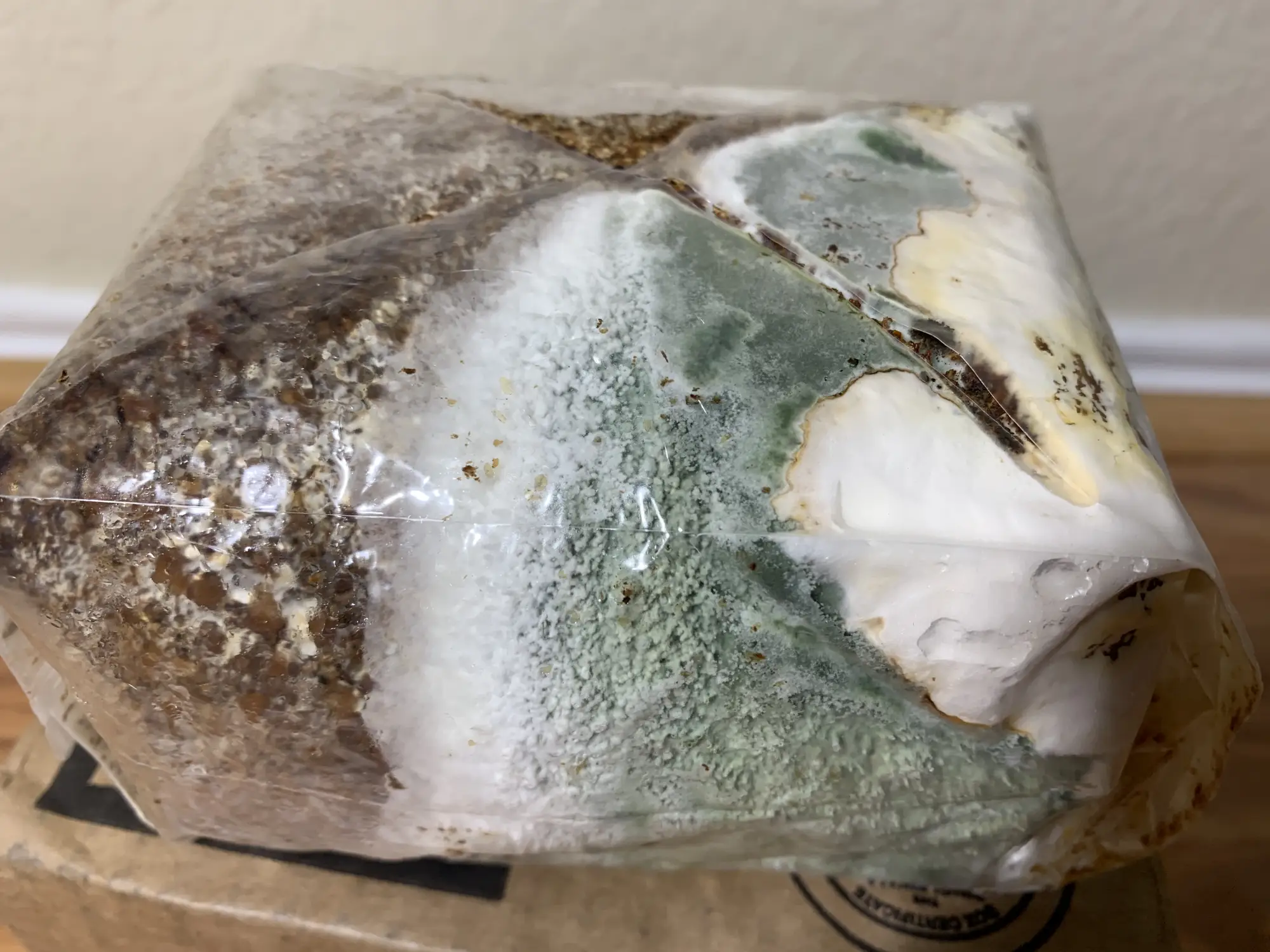
Early stage, before it sporulates. It first appears as a dense, bright white, pillowy or cottony growth. At this point it’s frequently mistaken for healthy mushroom mycelium, which is where most missed diagnoses happen. It also tends to grow faster and denser than the host, looking stark, opaque, and disorganized rather than showing the rhizomorphic (stringy) or fine fluffy structure of healthy Agaricus or Pleurotus mycelium.
Mature stage, once it sporulates. As the colony matures it turns its characteristic green as it pumps out huge numbers of conidia (spores). Sporulation usually starts at the center of a patch and spreads outward.
Color isn’t a reliable species cue. The shade ranges from blue-green through yellow-green to dark forest-green, but it shifts with the strain, the growth medium, and the colony’s age, so color alone won’t tell you which species you have. In a lab, growth at 95°F (35°C) is a more dependable discriminator: T. harzianum still grows and sporulates at that temperature, while the aggressive T. aggressivum and T. atroviride barely grow. A 2009 Phytopathologia study recorded near-zero T. aggressivum growth at 95°F, and relays the earlier Mycologia finding that T. harzianum, unlike its look-alikes, still thrives there.
Where it shows up depends on the stage of your grow:
- Grain spawn: white patches that rapidly turn green, often clumping the grain together.
- Bulk substrate: distinct circular patches on the surface or inside the substrate.
- Pinning and fruiting: it can grow on the casing layer, around pin sites, and even on caps and stems, where Penn State Extension reports small pins turning brown and lytically degrading.
Why Trichoderma is so aggressive#
Most competitor molds simply race your mushroom for food. Trichoderma does that too, but its real threat is that it’s an active mycoparasite: it attacks and feeds on the mushroom mycelium directly. That biology is what separates it from a nuisance mold and makes it so destructive.
The attack runs in a sequence, described in a 2024 review in Microbial Ecology. Trichoderma hyphae recognize the host fungus and coil around its hyphae, then penetrate the cell wall using structures resembling appressoria. It secretes a toolkit of cell wall-degrading enzymes, chitinases, glucanases, and proteases, that break down the host’s structural walls. Once the wall is breached, it consumes the cell contents.
On top of the physical attack, Trichoderma produces antifungal secondary metabolites, including gliotoxin, viridin, harzianic acid, peptaibols, and volatile compounds like 6-pentyl-α-pyrone, that suppress the host and inhibit its growth. The combination of fast growth, direct parasitism, a heavy spore load, and these compounds is why Trichoderma is uniquely dangerous compared with other molds.
Not every green Trichoderma is equally bad. A handful of species turn up in cultivation, and they differ in host preference and how hard they hit.
| Species | Main hosts | Notes |
|---|---|---|
| T. aggressivum | Button mushroom (Agaricus) | The worst. Named for its aggression, it drove the “green mold epidemic” in commercial Agaricus. The North American form is f. aggressivum; the European form is f. europaeum. |
| T. harzianum | Agaricus, oyster, shiitake | Now recognized as a species complex; most strains are harmless biocontrol agents, but certain members are genuine mushroom pathogens. |
| T. atroviride | Oyster (Pleurotus) | A common oyster green mold, often carrying a coconut-like odor from 6-pentyl-α-pyrone. |
| T. viride, T. asperellum, T. virens | Various | Frequently isolated from contaminated substrates, with aggression that varies by host and conditions. |
The genus as a whole sits in the family Hypocreaceae and is, in the wild, a beneficial soil fungus and decomposer. The same mycoparasitic talent that makes it useful in agriculture is what makes it a menace in your grow room.
What causes Trichoderma contamination#
Trichoderma spores are everywhere, so an outbreak is less about exposure and more about giving spores a foothold your mushroom can’t out-compete. A few conditions and mistakes account for most cases.
Temperature that favors the mold. Aggressive strains grow best at 77–86°F (25–30°C), a range documented for T. aggressivum f. europaeum in a 2009 Phytopathologia study. That overlaps almost exactly with the incubation temperature many cultivated mushrooms prefer, so a warm spawn run helps both organisms at once. High substrate moisture and slightly acidic conditions add to the advantage.
Breaks in the sterility chain. This is the usual culprit. The common weak points:
- Under-sterilized grain spawn.
- Spawn from a contaminated source.
- Bulk substrate that wasn’t pasteurized or sterilized adequately.
- Hygiene gaps during inoculation and spawning.
- Poorly sealed bulk containers that let airborne spores in.
Over-rich substrate. Substrates loaded with simple carbohydrates or high nitrogen can tip the balance toward fast-growing molds over slower mushroom mycelium. Disciplined supplementation matters, and our substrate calculator helps you keep ratios sane rather than eyeballing it.
Timing. Trichoderma most often shows up during the spawn run in the first week or two when the grain was already contaminated, or shortly after spawning to bulk if the bulk material or the mixing step was compromised.
How to confirm it’s Trichoderma#
Visual ID gets you a strong suspicion. Confirming the genus, and especially the species, takes a closer look.
Hand lens or low-power microscope. This is the most accessible confirmation. Trichoderma shows highly branched conidiophores and flask-shaped phialides arranged in clusters, which set it apart from other green molds such as Penicillium or Aspergillus. A cheap loupe is often enough to see the branching pattern.
The smell test. Some species, notably T. atroviride and T. viride, give off a distinct coconut-like aroma from 6-pentyl-α-pyrone, noted across the cultivation literature. A strong coconut smell is a good indicator, but its absence proves nothing, since not every species or strain produces the compound in noticeable amounts.
Culture morphology. Growing an isolate on potato dextrose agar or malt extract agar lets you read colony color, growth rate, and microscopic structures. It’s useful, but the 2002 Mycologia work makes clear that telling closely related species apart on morphology alone is genuinely difficult.
PCR sequencing. The academic gold standard is sequencing genetic markers such as the ITS region or a multi-gene phylogeny using translation elongation factor 1-alpha, the approach a 2021 study in Agronomy used to sort mushroom-farm isolates to species. It gives an unambiguous ID and is how researchers track specific aggressive biotypes. For a home grower it’s overkill, but it’s worth knowing where the certainty ceiling is.
The pitfall to watch for is the early white stage. Because pre-sporulation Trichoderma looks so much like healthy mycelium, the most common diagnostic error is a false negative, calling contaminated growth clean. When something looks a little too dense, too fast, and too stark-white, treat it as suspect and isolate the container.
Can you save a Trichoderma-infected grow?#
Once Trichoderma is established and sporulating, the honest answer for almost every home grow is to scrap it. It’s not what anyone wants to hear, but chasing a save usually spreads the problem.
Why containment usually fails. A sporulating colony releases millions of microscopic spores that travel on air currents, water splashes, and contact. Worse, the visible green is only the center of the infection. The aggressive white mycelium has typically pushed much further into the substrate already, actively consuming your mushroom’s mycelium where you can’t see it.
The rare exceptions. If you catch it extremely early, before any green sporulation, and it’s a small, localized patch on bulk substrate, you can sometimes cut out the infected area with a wide margin around it. Be clear-eyed about this: the failure rate is high, and it only has a chance in that narrow pre-sporulation window.
What does not work, despite being widely suggested:
- Spot-treating with bleach or hydrogen peroxide. It may kill surface spores but rarely reaches the established mycelial network, and spraying often scatters more spores than it kills.
- Burying the patch under fresh substrate. The mold simply grows through it.
Disposing of it properly. When you scrap, seal the contaminated material in a bag before it leaves the grow area so you don’t broadcast spores through the house on the way to the bin. Then sanitize the space, steaming or chemical disinfectants, before the next cycle. Expect some lingering risk. If spores aren’t fully cleared from the environment, the next grow can pick up where this one left off.
How to prevent Trichoderma next time#
Prevention is the only strategy that reliably works, and it comes down to keeping the sterility chain intact and not building a substrate that favors mold.
Sterility chain. Sterilize grain thoroughly, source spawn from clean labs, and keep inoculation genuinely clean. Grain is typically sterilized under pressure at 250°F (121°C), with time scaled to jar size; our pressure cooker guide covers the sizing and process rather than a one-size number. For the inoculation step itself, working inside a still air box or flow hood is the single biggest hygiene upgrade most growers can make. Sourcing matters too: clean, well-reviewed spawn from suppliers like North Spore or Out-Grow removes one of the most common contamination entry points.
Substrate side. Pasteurize or sterilize bulk substrate to clear resident competitor spores, and keep moisture and supplementation in check so you’re not handing fast molds an easy meal.
Skip the lime myth. A persistent belief is that pushing pH up with extra lime will prevent Trichoderma. It won’t. Trichoderma tolerates a wide pH range, roughly 2.0 to 13.0 per the Microbial Ecology review, even though it prefers slightly acidic conditions. Overdoing lime is more likely to hurt your mushroom than the mold. Good sterile technique beats pH tricks every time.
None of this is unique to any one species. Whether you’re growing oyster mushrooms, which T. atroviride targets, or shiitake, which shows up among the hosts in the harzianum complex, the prevention playbook is the same: clean spawn, clean work, disciplined substrate.
Related problems#
- Green mold on mushrooms — not sure it’s Trichoderma? How to tell it from the other molds that show up green, like Penicillium, Aspergillus, and Cladosporium.
- Cobweb mold vs. mycelium — the other contaminant most often confused with healthy growth, and how to tell them apart.
- Common mushroom growing problems — the broader troubleshooting hub for contamination, pinning, and environment issues.
Newsletter
Grow better mushrooms