Troubleshooting
Green Mold on Mushrooms — Which One Is It and What to Do
Published July 25, 2026 · By MushroomGrowLab
Contents
A patch of green on your grain or substrate almost always means a mold has moved in, but “green mold” isn’t one organism. Four different genera show up green on hobbyist grows, and they don’t all behave the same way or call for the same response. This page helps you narrow down which one you’re looking at, then points you to the right fix.
The four to know are Trichoderma, Penicillium, Aspergillus, and Cladosporium. Trichoderma is by far the most common and the most destructive, so if you can rule it in or out quickly, you’ve done most of the work.
What green mold on mushrooms looks like#
Once a green mold sporulates, color and texture get you most of the way to a genus. The table below is the fast comparison; the sections after it cover the cues that matter before the color even shows.
| Mold | Color | Texture | Where and how it spreads | Smell |
|---|---|---|---|---|
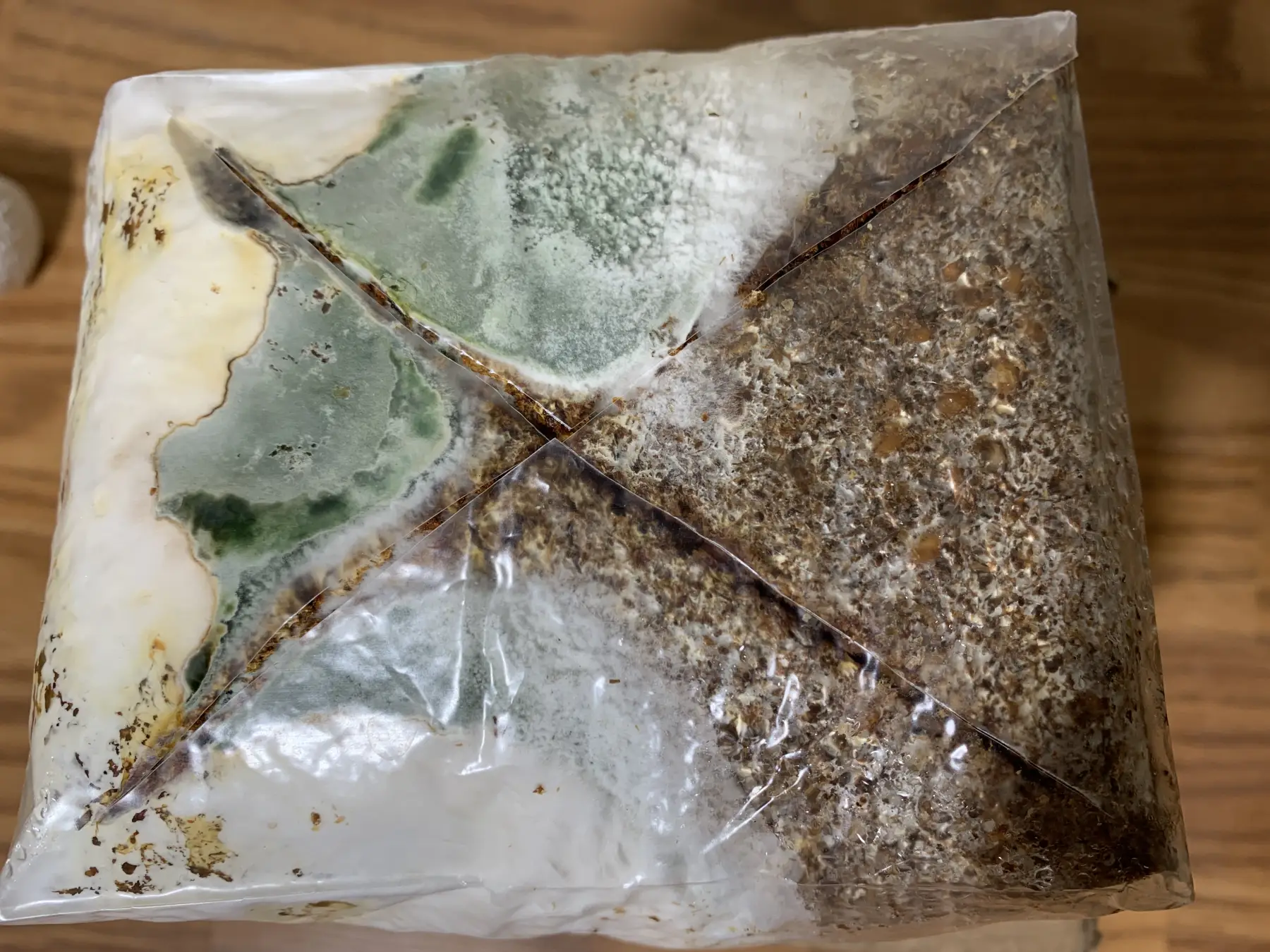
| Trichoderma | Bright forest-green to blue-green, with a stark white advancing edge | Granular, powdery | Fast; in and on the substrate, often deep in the block | Coconut in some species |
| Penicillium | Blue-green to teal | Powdery to velvety | Slower; discrete round colonies, usually on the surface | Musty, not distinctive |
| Aspergillus | Olive to yellow-green | Dusty | On dry or stressed substrate, mostly surface | Musty, not distinctive |
| Cladosporium | Dark olive to nearly black-green | Velvety | On cool, damp surfaces and condensation, not deep in the substrate | Musty, not distinctive |
The single most useful visual is the one in the photo above: a bright white leading edge pushing ahead of the green. That white frontier, racing across the block and turning green behind it, is Trichoderma’s signature. The other three tend to sit as more contained patches rather than overrunning healthy growth.
Why green mold starts white#
All four molds begin as white or off-white fuzz before they sporulate, which is exactly when they’re hardest to call and easiest to catch. By the time you see green, the colony is already mature and shedding spores.
Trichoderma is the one early stage worth committing to memory, because it’s both the most common and the most often mistaken for healthy mycelium. Early on it’s a dense, bright white, pillowy growth that tends to run faster and look starker than the mushroom’s own mycelium. When a white patch is spreading noticeably from one day to the next and looks too thick and too fast, treat it as suspect. Penn State Extension describes the same arc for green mold on cultivated mushrooms: dense white mycelium first, then extensive green sporulation.
For Penicillium, Aspergillus, and Cladosporium, the pre-green tells growers report are subtler and less reliable: Penicillium as slower, discrete, slightly velvety colonies; Aspergillus as cottony growth on substrate that looks dry or stressed; Cladosporium as compact grayish patches tied to condensation. Take these as field hints rather than firm ID. Before the color shows, behavior and location tell you more than the fuzz does.
How to tell which green mold you have#
For a home grow, a genus-level call is usually enough to decide what to do next. Four cheap checks, in rough order of usefulness:
- Timing and location. Green in the first week or two of the spawn run, deep in grain or bulk, points hard at Trichoderma. Patches that appear on the surface after the substrate is already colonized fit Penicillium. Dusty green on dry, stressed substrate fits Aspergillus. Dark green on cool, damp surfaces and bag walls where condensation collects fits Cladosporium, which is more an environmental problem than a substrate one.
- Growth rate. Watch a patch day over day. Visible spread that outruns your mushroom is the strongest live signal for Trichoderma. Penicillium and Cladosporium generally creep rather than sprint.
- Smell. A distinct coconut aroma is a genuine tell for some Trichoderma species, produced by a compound called 6-pentyl-α-pyrone that’s well documented across the Trichoderma literature. Its absence proves nothing, and the other three just smell generically musty, so use smell only to back up what you already suspect.
- Hand lens. Under a cheap loupe, Penicillium shows the brush-like spore clusters that give it its name, Aspergillus shows spores radiating from a swollen head, and Trichoderma shows highly branched spore stalks. It won’t get you to species, but it separates the genera.
If you’ve narrowed it to Trichoderma, that’s where the deeper work lives: our Trichoderma identification guide covers the species that turn up in cultivation, lab confirmation, and the save-or-scrap reasoning in full. A lab DNA test is the only way to be certain of the species, and it’s overkill for most home growers unless a contamination problem keeps recurring.
What causes each green mold#
Spores of all four are effectively everywhere. An outbreak is less about exposure and more about which mold you handed an opening to.
- Trichoderma: breaks in the sterility chain, mainly under-sterilized grain, contaminated spawn, and hygiene gaps at inoculation. Warm, moist conditions in the mushroom’s own preferred range help it along. The full causal picture is on the Trichoderma page.
- Penicillium: airborne spores settling on exposed substrate, often after colonization and frequently tied to over-wet grain or weak spawn.
- Aspergillus: dry or stressed substrate, dusty air, and poor circulation.
- Cladosporium: poor ventilation and temperature swings that leave condensation on walls, ceilings, and bag surfaces. It usually rides in on the environment rather than the substrate.
Scrap or save each green mold#
The right response depends entirely on which mold it is.
Trichoderma — scrap. Once it’s sporulating, the honest answer for almost every home grow is to scrap it. It’s an active parasite of mushroom mycelium, the visible green is only the center of a wider infection, and chasing a save usually spreads spores. The full reasoning, and the narrow pre-sporulation exception, are on the Trichoderma identification guide.
Penicillium — usually scrap, sometimes recoverable early. The window is a little wider than with Trichoderma, but be skeptical of rescue tricks. The commonly repeated method of cutting out a patch and dabbing it with salt or hydrogen peroxide isn’t supported by extension or peer-reviewed sources, and once the colony is green it’s already shedding spores into your space. If a patch is tiny, surface-only, and caught before it colors up, isolating and excising it with a wide margin is worth a try. When in doubt, scrap.
Aspergillus — scrap, and mind the air. Treat an Aspergillus grow as a loss and prioritize not aerosolizing it. One species, Aspergillus fumigatus, can pose a respiratory risk at high spore densities, particularly for anyone immunocompromised. This isn’t cause for alarm at hobby scale, but it’s a good reason to seal the material before it leaves the room and ventilate afterward rather than disturbing a dusty colony indoors.
Cladosporium — often recoverable. Because it typically sits on surfaces rather than colonizing the substrate, superficial Cladosporium can sometimes be wiped away with a sterile swab, provided you also fix the cause: better airflow, less condensation. If it keeps coming back, the environment is the real problem, not that one patch.
Whatever the genus, dispose of a scrapped grow the same way. Seal the contaminated material in a bag before it leaves the grow area, sanitize surfaces and tools, and give the space some downtime before the next cycle so lingering spores can settle and be cleaned up.
How to prevent green mold#
Prevention is genus-specific in its details but comes down to the same discipline: keep the sterility chain intact and don’t build a substrate that favors fast molds.
- Trichoderma: the priority, since it’s the most common. Sterilize grain thoroughly, source clean spawn, and inoculate cleanly. Grain is pressure-sterilized at 250°F (121°C) with time scaled to jar size; our pressure cooker guide covers the sizing, and working inside a still air box or flow hood is the biggest single hygiene upgrade most growers can make. Clean spawn from suppliers like North Spore or Out-Grow closes a common entry point.
- Penicillium: manage grain moisture and use fully colonized, healthy spawn so contaminants have a smaller opening. Good air filtration helps.
- Aspergillus: keep substrate hydrated to spec rather than dry, and control dust and air circulation.
- Cladosporium: manage condensation and airflow, since it’s an environmental mold more than a substrate one.
Two habits cut across all four. Pasteurize or sterilize bulk substrate to clear resident spores, and keep supplementation in check so you’re not feeding molds faster than mushrooms; our substrate calculator and the substrate guide help you keep the ratios sane. The playbook is the same whether you’re growing blue oyster or any other oyster: clean spawn, clean work, disciplined substrate.
Related problems#
- Trichoderma identification — the deep dive on the most common green mold: species, confirmation, and the full scrap-or-save case.
- Cobweb mold vs. mycelium — the grey-white contaminant that isn’t green but gets confused with early mold and healthy growth.
- Mushroom contamination identification — the catalog for the non-green contaminants this page routes around: bacterial wet rot, pin mold, black Aspergillus niger, yeast, and sour rot.
- Common mushroom growing problems — the broader troubleshooting hub for contamination, pinning, and environment issues.
Newsletter
Grow better mushrooms