Troubleshooting
Sciarid Flies and Fungus Gnats — Identify and Control Them in Mushroom Grows
Published July 27, 2026 · By MushroomGrowLab
Contents
What a fungus gnat problem looks like#
You notice the adults first: small, dark, mosquito-shaped flies drifting up off the substrate when you open the chamber, or stuck to the lid, or running across the surface of your grain. They’re weak fliers and tend to run more than they fly. On their own, a few of them look harmless.
They aren’t the problem. The damage is happening below the surface, where the larvae live. Sciarid larvae are translucent to white, legless, and grow to about 6 mm, with one unmistakable feature: a shiny black head capsule at the front end. They sit in the top 2–5 cm of the substrate, tunneling through mycelium, chewing pin sites, and burrowing into developing stems. On a colonizing block you’ll see the mycelium thin out or stall in patches; on a fruiting block you’ll see aborted pins and larvae in the base of the clustering mushrooms.
By the time adults are obvious, the larval population has usually been established for a while. That’s the trap with these pests. The flies you can see are a signal, not the injury.
Sciarid flies vs. fungus gnats vs. phorid flies#
“Fungus gnat” and “sciarid fly” get used interchangeably, and for practical purposes on a mushroom grow they point at the same family: Sciaridae, the dark-winged fungus gnats. But it’s worth knowing which insect is actually on your block, because it tells you where it came from.
The mushroom sciarid. The dominant pest of cultivated mushrooms is Lycoriella ingenua, a roughly 5 mm dark fly with long legs, long antennae, and a distinctive forked-and-crossed vein pattern on the wing that you can see under a hand lens. (Older and North American sources still call this same insect Lycoriella mali — it’s one species with two names in the literature.) This is the one bred in mushroom compost and substrate, and historically it’s been the single most destructive insect in commercial mushroom production.
The houseplant fungus gnat. Bradysia species look almost identical to the naked eye but tend to arrive a different way — in potting soil, bagged compost, or off nearby houseplants. If you keep plants in the same room as an open fruiting chamber, Bradysia is the likely hitchhiker. The damage profile is similar, usually milder at hobby scale.
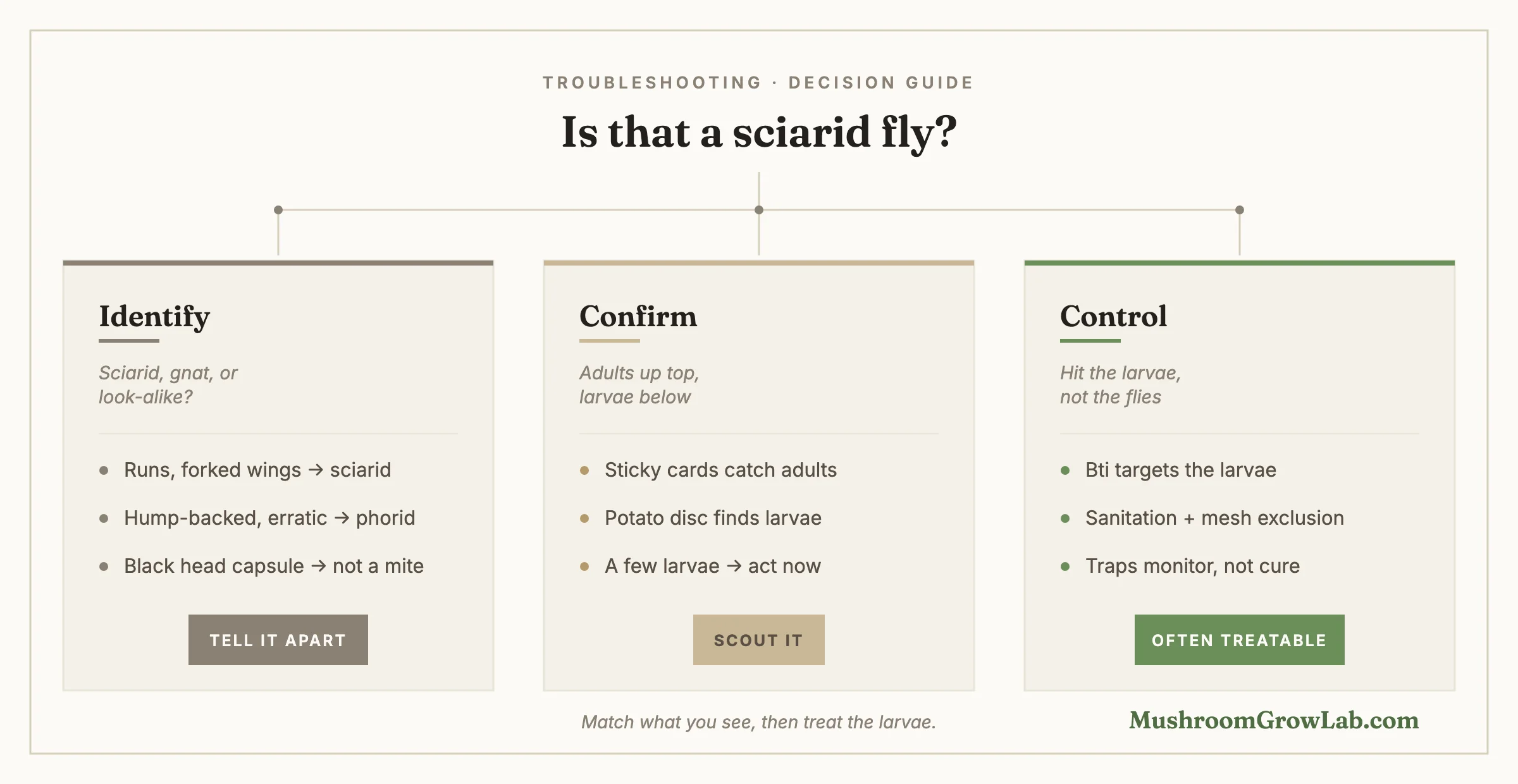
The phorid look-alike. Phorid flies are a different family and a less common mushroom pest, but they show up, and people confuse the two. Phorids are smaller (2–3 mm), have a humpbacked profile, lack the forked wing venation, and move in fast, erratic, jerky darts rather than a steady run. Their larvae are smaller (around 4 mm) and have no head capsule. If your flies are hump-backed and sprint erratically, you’re likely looking at phorids, and the control approach differs a bit; our main troubleshooting guide covers them.
One more mix-up worth heading off: larvae versus mites. A legless white grub with a black head is a fly larva. Mites are a fraction of the size, have legs, and no head capsule — a moving “dust” rather than a worm. The two often occur together, since mites hitchhike on adult sciarids, so it’s common to have both at once. We cover mite ID and control separately in mushroom mites: identification and what to do.
Why the larvae matter more than the adults#
Adult sciarids barely feed; they take a little water and not much else. What they do is reproduce fast and carry things. Mating happens almost immediately after emergence, so a population compounds quickly, and the adults act as a sentinel: seeing them means larvae are already at work under the surface.
The timing is the part that catches growers out. At 65°F (18°C), Penn State Extension’s figures put the life cycle at roughly six days as eggs, about eighteen days as feeding larvae, and six days pupating, for a full generation of about 35–38 days. Warm it up and it compresses fast — closer to 25–28 days at 21°C. Larval feeding runs one to two generations ahead of the adults you notice, which is why the injury is underway before the flies are obvious.
Adults also spread disease. They mechanically carry mold spores, nematodes, and pygmy mites on their bodies, and research has tied them to two specific mushroom pathogens: a 2009 study found sciarid flies vector Verticillium fungicola, the cause of dry bubble, and a 2019 Penn State study confirmed that both adults and larvae of Lycoriella ingenua carry spores of Trichoderma aggressivum, the green mold pathogen. So a fly problem is often the front edge of a green mold problem too.
What causes a sciarid outbreak#
Sciarids want what a mushroom grow provides: warmth, humidity, and a mass of organic matter to lay eggs in. A few conditions reliably tip a grow toward an outbreak.
- Warm, humid conditions. The same fruiting environment your mushrooms like accelerates the fly life cycle. Higher temperatures mean faster generations and steeper population growth.
- Spent or overhydrated substrate. Old blocks left sitting after the final flush are a breeding ground, and waterlogged substrate favors egg survival and larval development. Poor sanitation between grows is the most common underlying cause.
- Open entry points. Adults get in through unfiltered air intakes, on imported compost or casing soil, and through any open fruiting chamber. Once inside, they move freely between grows.
- Nearby houseplants. Potted plants are a Bradysia reservoir. An open tub next to your monstera is an invitation.
Hobbyist setups are especially exposed. Open shotgun-style fruiting chambers, houseplants in the same room, and less environmental control than a commercial farm all make it easier for a small introduction to become an established population.
How to confirm you have them#
Before you treat, confirm what you’re dealing with and how bad it is. Two cheap tests cover most situations.
Yellow sticky cards. Adult sciarids are drawn to yellow. Place yellow sticky cards at canopy level and near air intakes, and read them regularly; this is your early-warning system and your way to watch the trend. Commercial mushroom operations don’t use a single flat threshold for this. The Pennsylvania Mushroom IPM Handbook sets action levels that change with the crop stage: essentially zero tolerance for adults before and in the first few days after spawning, rising to around ten flies per strip per day after spawning, then rising again at casing and pinning. The logic is that flies arriving early do disproportionate damage. For a home grow, treat the appearance of adults during colonization as your cue to act, not something to wait out.
The potato disc test. To confirm larvae in the substrate, lay a raw potato slice flat on the surface and check underneath it after 24–48 hours. Larvae migrate to the potato to feed and collect on the underside, where they’re easy to see. It’s a standard scouting method, though the published recovery data comes from greenhouse fungus gnats in potting mix rather than mushroom substrate — one floriculture study recovered about 17% of larvae at 24 hours and 31% at 48 hours, so even a few larvae under the disc is a real signal, not a full count. Leaving the disc the full 48 hours catches more.
Two misreads are worth avoiding. Don’t assume every small fly is a mushroom sciarid. Bradysia off a houseplant gets treated the same way but tells you to check your plants, and phorids are a different pest entirely. And don’t mistake a cluster of mites on the surface for larvae; the black head capsule is the tell. When an infestation is persistent, unusual, or you need the exact species for a targeted biocontrol, a diagnostic lab can settle it.
Some links in this guide are affiliate links: if you buy through them we may earn a small commission, at no extra cost to you.
How to get rid of sciarid flies#
Control targets the larvae in the substrate, because that’s where the damage is and where the population is vulnerable. Adults are hard to kill and short-lived; knock down the larvae and the emergence stops.
- Bti (the first-line biocontrol). Bacillus thuringiensis subsp. israelensis is a naturally occurring soil bacterium whose toxins are lethal to fly larvae when they eat it, but harmless to mushroom mycelium at label rates. It’s sold as Gnatrol for commercial-scale use and, at hobby scale, as mosquito-larvae products like Mosquito Bits. A 2021 Ohio State and USDA study on oyster mushrooms (Pleurotus) incorporated Bti into straw substrate and saw roughly 40–89% fewer flies emerge compared with untreated blocks, with no measurable slowing of colonization. Apply it to the substrate where larvae are feeding, and reapply, since Bti kills larvae only — it does nothing to adults, and fresh eggs keep hatching. Follow the product label for rate.
- Entomopathogenic nematodes (Steinernema feltiae). These are the other larvae-seeking biocontrol, applied as a substrate drench, and they’re the standard fix for fungus gnats in greenhouses. In mushrooms the evidence is weaker: in that same 2021 oyster study, S. feltiae was generally ineffective on straw substrate compared with Bti. They also want a temperature window of roughly 50–86°F (10–30°C) to stay active. Worth trying as a rotation or where you can’t use Bti, but Bti is the more reliable pick on mushroom substrate.
- Predatory mites (Stratiolaelaps scimitus). Formerly sold as Hypoaspis miles, these soil-dwelling predators eat young sciarid larvae in the top layer of substrate and are a common greenhouse biocontrol. They suppress rather than eradicate, and work best as part of a program. Because they’re a mite, and mites are their own rabbit hole on a mushroom grow, we cover them in depth in the mushroom mites guide.
- Sticky traps, with realistic expectations. Trapping adults removes some breeding individuals and is genuinely useful for monitoring, but the reproductive rate outpaces what traps can remove. Treat them as surveillance and marginal suppression, not as your control method for an established infestation.
When to scrap instead. If larvae have riddled the substrate and pins are aborting across the block, the math often favors cutting your losses over a drawn-out rescue — especially late in a grow with only a flush or two left to gain. When you do scrap, contain the problem: bag the infested substrate and mushrooms airtight, remove them from the grow area immediately, and dispose off-site so the adults can’t disperse to your other blocks. Clean and, if you can, steam-pasteurize the space before starting again.
How to prevent sciarid flies next time#
Prevention is where you actually beat this pest. Exclusion and sanitation cost far less than fighting an established population.
- Exclude the adults. Screen air intakes and vent openings with fine mesh. The tightest spec cited for sciarids is a gauze aperture around 0.3 mm, sold mostly through greenhouse suppliers; a more available option is fine no-see-um insect screen at around 0.6 mm, which is coarser but still a practical barrier on vents and chamber openings. Filter-patch grow bags and well-sealed monotubs keep flies off colonizing substrate; a Tyvek cover works as a barrier on a fruiting chamber. If you work with open cultures, a still air box keeps adults off exposed substrate during transfers.
- Sanitize between cycles. Pull spent substrate promptly after the final flush instead of letting it sit and breed the next generation. Give the room downtime, clean surfaces, and steam-pasteurize the space where you can.
- Don’t overhydrate. Soggy substrate favors egg survival, so hit your target hydration rather than overshooting it. Our substrate calculator helps you mix to the right field capacity instead of guessing.
- Keep houseplants away from open grows, and monitor continuously with yellow cards so you catch an introduction while it’s still a few flies and not a generation.
A couple of myths are worth retiring. “Fungus gnats only come from soil” is wrong; sciarids breed happily in mushroom substrate with no potting mix in sight. And “a few adults don’t matter” misreads the biology: the adults are the sentinel, and their presence means larvae are already feeding below the surface.
Related problems#
- Mushroom mites: identification and what to do — the pest that most often co-occurs with sciarids and rides in on them.
- Green mold (Trichoderma) in mushroom grows — sciarid adults and larvae vector its spores, so the two problems travel together.
- Trichoderma identification — confirm green mold if flies have been in your grow.
- The full mushroom growing problems guide — triage other contamination and pest issues, including phorid flies.
For spawn, Bti, sticky cards, and biocontrols, North Spore and Out-Grow both stock grower supplies; the active ingredients above matter more than any single brand. If flies keep finding your oyster, shiitake, or enoki blocks, the fix is usually exclusion and sanitation rather than a stronger spray.
Newsletter
Grow better mushrooms