Troubleshooting
Mushroom Mites: Identification, Damage, and What to Do
Published July 24, 2026 · By MushroomGrowLab
Contents
What mushroom mites look like#
Mushroom mites are small enough that most growers never see an individual one. What you notice first is movement: a fine, shifting “dust” on the surface of your grain, substrate, or casing that turns out to be crawling when you look closely. Most species run between 0.2 and 0.5 mm, so you need a 20x jeweler’s loupe or hand lens to make out any detail, and a low-power microscope to tell the species apart with confidence.
Early on, mites are scattered individuals and easy to miss. By the time they’re obvious they’ve usually built into swarms or crawling masses, and in the case of the red pepper mite (Pygmephorus) that mass can show up as a reddish-brown or yellowish-brown shimmer across the surface. If you’re seeing that shimmer, the population is already high.
The single most useful confirmation test costs nothing. Tap a handful of colonized grain, substrate, or a suspect mushroom over a sheet of white paper, then watch the paper under your loupe for a few seconds. Mites show up as moving specks against the white background. This “white-paper tap” is how commercial growers scout at low densities, and it works exactly the same on a jar of grain spawn.
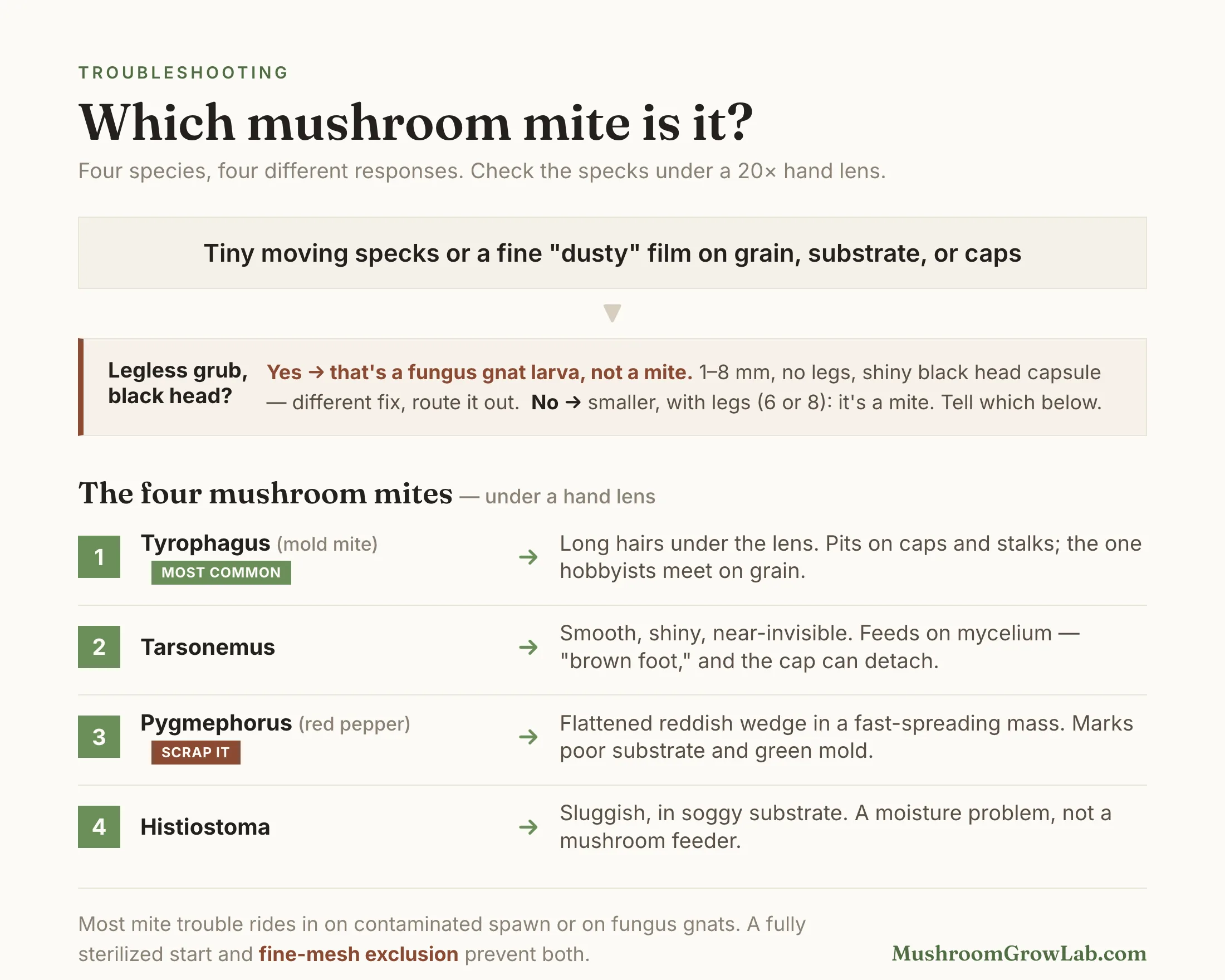
One confusion trips up almost everyone: mites versus fungus gnat larvae (sciarid flies). They get misdiagnosed for each other constantly, but they don’t look alike once you actually look. Sciarid larvae are much larger (1–8 mm), legless, and have a distinct shiny black head capsule with chewing mouthparts. Mites are a fraction of that size, have legs (six as larvae, eight as adults), and no head capsule. If it’s a legless white grub with a black head, that’s a fly problem, and the fix is different. Our main troubleshooting guide covers fungus gnats.
The four mushroom mites and how to tell them apart#
“Mushroom mites” isn’t one pest. It’s an umbrella over several species that look broadly similar to the naked eye but differ in what they eat, what damage they do, and whether they’re even worth panicking about. Getting the species right is what tells you whether to keep the grow or scrap it. Four show up often enough to know by name.
Tarsonemus myceliophagus — the mushroom mite proper. This is the one that feeds directly on mycelium, so it’s the primary pest of the group. It’s also the hardest to see, at roughly 0.15–0.2 mm, and under a hand lens it looks like a pale, translucent, oval mite with a smooth, shiny body. Its mouthparts pierce fungal hyphae and drain them. The tell is what growers call brown foot: the base of the stipe turns reddish-brown, and in a bad infestation the mushroom detaches from the substrate entirely. It completes a full life cycle in about eight days at 24°C (75°F), with a female laying roughly one egg a day, so a small starting population compounds quickly.
Tyrophagus putrescentiae — the mold mite. This is the one home growers on grain meet most often. It’s bigger (0.3–0.5 mm) and, under magnification, noticeably hairy, with long setae sticking out from the body. It’s a generalist that thrives anywhere protein-rich and slightly neglected, and it’s happy feeding on organic debris and competing molds as much as on mushroom mycelium. Its feeding leaves small, irregular pits on caps and stalks that later get colonized by bacteria, which is why the damage can look like bacterial pit disease. If mites showed up on a contaminated grain jar, this is very likely your culprit.
Pygmephorus spp. — the red pepper mite. Yellowish-brown to reddish-brown, flattened, wedge-shaped, and about 0.25 mm long. The key thing about this one is that it does not eat your mushrooms. It feeds on weed molds like Trichoderma (green mold), so its real message is diagnostic: a red pepper mite bloom means your substrate quality is poor or a competing mold has moved in. It also breeds explosively, with a single female laying up to 160 eggs in five days, and it spreads by hitching phoretic adult females onto flies, tools, and clothing to reach new rooms.
Histiostoma feroniarum — the debris feeder. A sluggish mite, 0.3–0.6 mm, that scrapes bacteria and liquid films rather than piercing hyphae. It does little direct damage to healthy mushrooms. What it signals is a wet problem: it flourishes in overly wet substrate or casing and travels with bacterial blotch and decaying matter, so its presence points at excess moisture and poor drainage more than at the mite itself.
Under a hand lens the fastest species split is texture and color. Long visible hairs point to Tyrophagus. A smooth, shiny, near-invisible body points to Tarsonemus. A flattened, reddish, wedge-shaped body in a fast-spreading mass points to Pygmephorus. For anything finer than that, you’re into low-power-microscope territory, and a laboratory extraction method called a Berlese funnel (which drives mites out of a substrate sample down into a collecting vial) is how researchers get real population counts. That’s overkill for a home grow, but worth knowing the term exists.
What causes a mite outbreak#
Mites rarely appear out of nowhere. Something either carried them in or gave them the warm, damp, food-rich window they need to build up. The usual causes, most common first:
- Contaminated spawn or substrate carried them in. The most common entry point. Mites and their eggs ride in on grain spawn from a supplier with hygiene gaps, or on a bag of substrate that was never properly sterilized. This is why a single bad jar can seed a whole shelf.
- Warm and humid conditions let them build. Most mushroom mites do well between 20°C and 30°C (68°F–86°F), which is also where a lot of gourmet grows sit. High humidity especially favors the soft-bodied species like Histiostoma.
- Organic debris gave them a breeding ground. Dead mushrooms left on the block, spilled grain, old stumps, and spent substrate near active grows are all mite nurseries.
- The grow cycle ran long. Stretching a block to four-plus flushes, or a slow spawn run, simply gives mite populations more time to compound between harvests.
- Hygiene gaps between grows moved them around. Shared tools, gloves, and clothing between a “dirty” harvest area and a “clean” work area carry phoretic mites from one grow to the next.
Do mushroom mites spread disease?#
Mite outbreaks get blamed for spreading fungal and viral disease, and this is worth being precise about, because the folklore runs ahead of the evidence and it changes what you should actually treat.
For dry bubble (caused by Verticillium fungicola, reclassified as Lecanicillium fungicola), mites are a minor player. A 2010 review in Molecular Plant Pathology found the disease spreads mainly by water splash and by flies carrying spores. Its sticky spores do stick to arthropods, but for mushroom mites that actually works against transmission: the review notes mites and springtails tend to get stuck on the mucilaginous spore masses rather than ferrying them around. The one mite named as moving spores in the literature is the red spider mite, which isn’t one of the mushroom mites here. So if you’re fighting dry bubble, put your effort into water management, fly exclusion, and sanitation, not mite control.
For the virus diseases sometimes lumped in with mites, La France disease (linked to Agaricus bisporus virus 1) and Mushroom Virus X (a separate virus complex behind “brown cap” discoloration) are two different problems, and both spread primarily through mycelial contact and infected spores. There’s no good published evidence that mites vector either one. Treat a suspected virus problem as its own issue rather than assuming knocking back mites will fix it.
Where mites genuinely do matter for disease is weed molds. Red pepper mites don’t eat mushrooms, but their mobility is associated with spreading green mold (Trichoderma) around a growing space, and the mold mite has been reported carrying several weed fungi. There’s no reliable percentage to put on this, but it’s the practical reason a red pepper mite swarm is a scrapping signal: it’s both a marker of poor substrate and a rider on the green-mold problem underneath it. If you’re seeing green mold, our guide on cobweb mold versus healthy mycelium helps you rule out the look-alikes.
How to deal with a mite outbreak#
Once mites are established at swarm level, there’s no clean spray-and-save for an actively fruiting edible crop. The decision is mostly scrap-versus-contain.
- Scrap early when the signal is bad. If you see a red pepper mite swarm on the surface before a first flush, the green-mold risk it points to usually makes immediate scrapping the right call. A visibly mite-ridden grain jar is the same story: scrap it rather than letting it seed the rest of your grows.
- Isolate and remove infested material from the space entirely. Get spent or infested substrate out of the room immediately and don’t store it anywhere near active grows. Mites walk, and a bin of infested compost by the door reinfests everything.
- Sanitize surfaces thoroughly, and scrub. Disinfect work surfaces and tools with a suitable disinfectant, and scrub as you go — mites shelter in biofilm and debris that a chemical wipe alone can leave untouched.
- Understand what biological control can and can’t do. The predatory mite Hypoaspis miles (now Stratiolaelaps scimitus) is sold for mushroom-house pest control, but its documented target is fly larvae, not pest mites. In trials it hit about 96% control of sciarids at 750 mites per square meter in small-scale tests, though Ontario field trials landed under 30%. As a generalist it may eat some small mites, but its effectiveness against mushroom mites specifically isn’t established, so don’t buy it expecting a mite cure.
- Know that acaricide options are thin. Legal chemical control on edible mushroom crops is limited, and what exists (for example the insect growth regulator diflubenzuron) is aimed at flies rather than mites. Always check current EPA or local label restrictions for edible-crop tolerances before applying anything.
How to prevent mushroom mites next time#
Prevention is where the real leverage is, since the cure is mostly “throw it out.” Almost all of it comes down to what you let into a clean grow and how well you break the chain between grows.
- Start clean at the source. Buy spawn from suppliers with a real hygiene reputation, like North Spore or Out-Grow, and inspect incoming grain before you use it. A white-paper tap on a new bag of spawn takes thirty seconds.
- Sterilize or pasteurize properly, and don’t cut it short. Mites and their eggs die with adequate heat treatment. Grain and supplemented substrate should be fully sterilized in a pressure cooker or canner; bulk substrates that are pasteurized need to actually hold temperature (commercial growers hold 60°C/140°F to kill all life stages). Getting substrate hydration and prep right in the first place helps here, and the substrate calculator takes the guesswork out of the mix.
- Work clean at transfer. Do spawn transfers in front of a still air box or flow hood, keep tools and gloves clean, and don’t move from a contaminated grow to a healthy one without changing up.
- Exclude them physically. Fine mesh (20-mesh or finer) over vents and intakes blocks both mites and the flies they ride on, and filter-patch grow bags keep them out of a colonizing block. Keeping fungus gnats out is half the mite battle, since phoretic mites travel on them.
- Don’t let debris and long cycles do the work for them. Clear dead mushrooms and spilled grain, don’t stockpile spent substrate indoors, and don’t stretch a tired block for one more flush when the risk is building. These are the same habits that keep oyster and shiitake grows clean generally, and they matter as much for fast-fruiting species like enoki where a long, cool cycle gives pests extra time.
Related problems#
- How to diagnose and fix mushroom growing problems — the full triage guide, including fungus gnats and contamination
- Cobweb mold vs. healthy mycelium — telling weed molds from a healthy grow, which is often what a red pepper mite bloom is pointing at
- Mushroom not pinning? — for when a stalled grow is environmental rather than a pest
- Clean grain spawn and cultures from North Spore or Out-Grow — the cheapest mite prevention is not importing them in the first place
Newsletter
Grow better mushrooms