Pink Oyster Mushroom
Pleurotus djamor
Also known as: Pink oyster, Flamingo oyster, Salmon oyster, Pleurotus djamor, Pleurotus flabellatus
Quick Reference
- Difficulty
- Beginner (1/5)
- Days to harvest
- 3–5 days
- Yield per 5lb block
- 1.5–2.5 lbs per 5 lb block across 2–3 flushes, highest on straw
- Fruiting temp
- 70–85°F
- Humidity
- 80–90%
- Use
- Culinary
- Best substrates
- Wheat straw, Master's Mix (hardwood + soy hull pellets), Supplemented hardwood sawdust, Coffee grounds
- Growing methods
- kit · bag · bucket
Contents
- Why grow pink oyster mushrooms
- What makes pink oyster mushrooms different
- How to grow pink oyster mushrooms
- Pink oyster fruiting conditions
- Harvesting pink oyster mushrooms
- Pink oyster flavor and culinary uses
- Common pink oyster growing problems
- How to get started growing pink oysters
- Is pink oyster the same as other oysters?
- Related guides
Why grow pink oyster mushrooms#
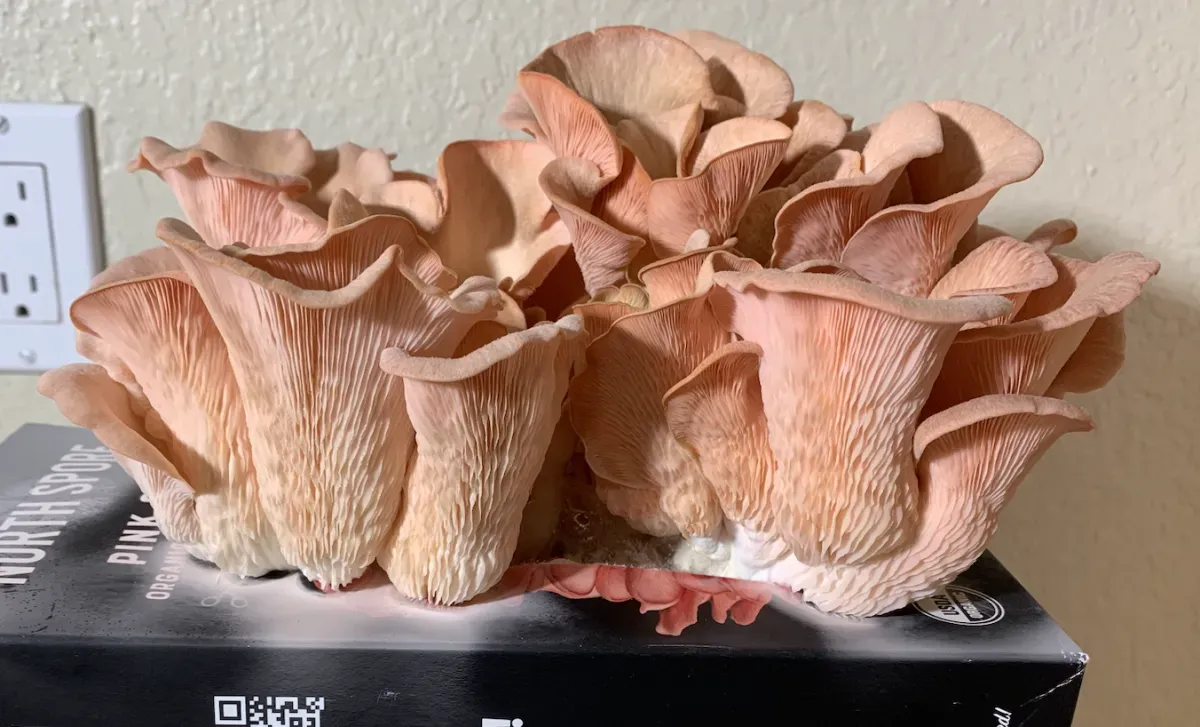
Pink oyster is the fastest and most beginner-proof oyster you can grow, and the one that looks least like a mushroom you’d expect. A mature cluster is a shock of coral-to-salmon pink, and it gets there quickly: from opening a kit to harvest runs about two weeks, quicker than any other oyster we cover. It colonizes aggressively, forgives beginner mistakes, and yields well on cheap straw. On our difficulty scale it’s a 1.
What holds it back isn’t difficulty, it’s climate. Pink is a tropical species, not a temperate one, and it needs real warmth to fruit. In a heated home or a summer grow it’s effortless; in a cool basement or through winter it slows down and may never pin. If your space runs warm, pink is arguably the most rewarding oyster a beginner can pick. If it runs cold, blue oyster is the better first grow.
Two more things are worth knowing before you start. Pink keeps the worst of any oyster once harvested, just two to three days fresh, so it wants to be cooked or dried within a day rather than stored. And it’s the heaviest spore producer of the family. Both are manageable at hobby scale, and both are covered below.
What makes pink oyster mushrooms different#
Most oyster cultivation is generic across the genus, so the substrate, spawn, and method instructions on the main oyster guide apply to pink without changes. Four things genuinely set it apart.
It’s tropical, so warmth makes or breaks it. Pink fruits best at roughly 77–82°F and tolerates a wider 70–85°F band. Heat is as much a limit as cold. Chowdhury’s 2024 cultivation study measured the fastest mycelial growth at 28°C, dropping off sharply by 32°C, and a hot spell in the low 30s Celsius can stop spawn run outright. Below about 68°F (20°C) it slows markedly, and in sustained cold it stalls. That tropical streak is the single biggest difference from blue and pearl.
It needs more fresh air than almost any oyster. Pink is very sensitive to carbon dioxide, and a stuffy chamber produces long, spindly stems and tiny, underdeveloped caps. It’s the variety most likely to punish you for skimping on ventilation, so plan for steady, automated air exchange rather than occasional fanning.
It loves straw and yields strongly. Straw is the highest-yielding substrate for pink, and biological efficiency swings widely with strain, substrate, and climate, from around 30% in tight lab conditions to 70–80% on paddy straw in a good warm-season grow. That’s a strong producer by Pleurotus standards. The “over 100% BE” figures you’ll see in grower forums don’t hold up in the cultivation research.
It’s fast, and it’s a heavy spore producer with a short shelf life. Pink colonizes straw in about 10–15 days and pins roughly 13–18 days from inoculation, tightening toward the low end with steady climate control. It also sheds heavily: many growers notice a thick spore release shortly after the caps expand, and the fresh mushrooms soften within a couple of days. Picking early is how you stay ahead of both.
How to grow pink oyster mushrooms#
Pink grows by the standard indoor oyster methods: a pre-colonized kit, bucket tek, and sterilized bag culture on Master’s Mix or straw. The mechanics are identical to the rest of the genus, so rather than repeat them, the full step-by-step for each method lives on the main oyster guide, along with the substrate options and the equipment you’ll need.
Three pink-specific notes layer on top of those shared instructions:
- Keep it warm. Pink wants fruiting temperatures in the upper 70s to low 80s Fahrenheit. In a cool space, a seedling heat mat under the block or a warmer room is the difference between fast pins and a stalled grow.
- Treat outdoor logs and beds as climate-dependent. Pink fruits well on logs and straw beds only in frost-free tropical or subtropical climates, or as a warm-season grow that’s cleared out before cold weather. In most of North America it won’t survive outdoors year-round, so we keep the recommendation here to indoor kit, bag, and bucket grows.
- Skip the monotub. Like all oysters, and more than most, pink needs far more fresh air than a sealed tub provides, and it will throw leggy, malformed clusters in one. Use a kit, bucket, or bag instead.
From a kit, expect first pins about a week after opening and harvest 14–21 days in. Bag and bucket grows colonize in roughly two weeks at the right temperature before you move them to fruiting conditions.
Pink oyster fruiting conditions#
Colonization is the easy part as long as the substrate stays warm: keep it around 75–82°F in the dark and the mycelium runs fast and aggressively, which is part of why pink resists contamination so well. Fruiting is where its tropical nature shows.
Temperature. Pink fruits best at roughly 77–82°F (25–28°C), with a workable range of about 70–85°F. It needs no cold shock to pin. Below about 68°F it slows down and may refuse to fruit, and sustained cold stops it outright, so an overnight dip in a cool room is the most common reason a pink block stalls. High heat is a limit too: spawn run and fruiting both falter once temperatures sit above the low 30s Celsius.
Humidity. Hold humidity around 80–90% through pinning and fruiting. Pink tolerates slightly drier air than the 85–95% most oysters want, so err toward the high end if your caps are drying or cracking.
Fresh air exchange. This is pink’s make-or-break condition. It’s more sensitive to stale, stuffy air than blue or pearl, and too little fresh air gives long stems and small caps every time. A small inline fan on a timer, pulling fresh air through the chamber for a few minutes each hour, is the reliable fix.
Light. Give developing pins indirect light or a low LED on a daily cycle. It helps form normal caps and brings out the color. Full darkness produces pale, deformed clusters.
Cold shock doesn’t help here. Dropping a colonized block into the fridge is a standard trick for triggering blue and pearl, but pink is tropical and cold sets it back rather than starting it. Bring a fully colonized block straight into warm fruiting conditions instead.
Harvesting pink oyster mushrooms#
Harvest pink oysters early. They mature fast and shed heavily, so pick while the cap edges are still curled rather than flat, often just three to five days after pins first appear. Twist the whole cluster off at the base in one motion; the harvest technique, flush timing, and the spore-load precautions that matter for any oyster are covered in full on the main oyster guide. With pink, harvesting before the caps flatten does double duty: it catches the mushrooms at their best and limits the spore release that follows cap expansion.
Yield swings with substrate and season, but a healthy straw grow is a strong producer, landing in the range the cultivation trials report (roughly 50–80% biological efficiency on straw in the seasonal data, lower in tight lab conditions). In practice, expect around 1.5–2.5 lbs of fresh mushrooms per 5 lb block across two or three flushes, with the first flush the largest. After harvesting, soak and rest the block as you would any oyster to push the next flush.
One detail is specific to pink: the color fades fast and the flesh softens within a couple of days of picking. If presentation or shelf life matters, harvest promptly and cook or dry the same day.
Pink oyster flavor and culinary uses#
Pink oyster is mild and savory raw, but the reason to grow it is what happens in a hot pan. Fried crisp in butter or oil until the edges brown and the flesh dries slightly, pink develops a smoky, bacon-like quality that’s genuinely distinct from the anise-tinged blue and pearl. The fleshy texture firms up and crunches when browned. That bacon comparison is a real, widely reported sensory observation; on the chemistry side, Yin’s 2019 analysis of Pleurotus flavor compounds identified eight-carbon volatiles like 1-octen-3-ol as key drivers of oyster aroma across the genus.
The trade-off is that pink doesn’t keep. It holds the shortest of any oyster, about two to three days fresh in a paper bag in the fridge, and softens and discolors quickly through ordinary enzymatic breakdown. The best ways to hold a flush are to cook it down or dry it; it dries well and rehydrates in about fifteen minutes for soups and sauces. Freezing it raw turns it to mush, so sauté lightly before freezing if you need to store a large harvest. To get the bacon effect, cook it hot and don’t crowd the pan. Steamed or boiled, it goes limp and loses the character that makes it worth growing.
Common pink oyster growing problems#
Most oyster problems are shared across the genus: leggy stems from poor fresh air exchange, aborted pins, and wet “schlog” substrate. Those are covered on the main oyster guide. Three issues stand out for pink specifically.
A stalled grow in a cool room#
Pink is tropical, and below about 68°F it slows and often refuses to pin. A block that colonized beautifully but won’t fruit is usually just too cold, especially if the room dips overnight; if warmth doesn’t fix it, our guide to mushrooms that won’t pin covers the other causes. Move it to a warmer spot or add a seedling heat mat and bring the fruiting temperature into the upper 70s to low 80s.
Cold-shocking it by habit#
If you’ve grown blue or pearl, cold-shocking the colonized block is muscle memory. Don’t do it with pink. As a tropical species it reads cold as a setback, not a trigger, so a fridge stint can stall a block that would have pinned fine in warmth. Skip the cold shock and go straight to warm fruiting conditions.
Mushy mushrooms and a heavy spore dump#
Left a day too long, pink over-matures fast: the caps flatten, release a thick load of spores, and the flesh starts softening before you even pick. The fix is harvest timing. Pick while the caps are still curled, which keeps quality high and cuts the spore release that makes the heaviest-shedding oyster harder on the lungs in an enclosed space. For a single block the spore load is a minor issue with basic ventilation; it scales with volume, and the documented hypersensitivity pneumonitis case in a Pleurotus grower involved heavy, repeated spore exposure, not a counter-top grow. Harvest early, ventilate the space, and wear a P100 respirator if you’re processing a large flush.
How to get started growing pink oysters#
The easiest way in is a pre-colonized kit. No substrate prep, no sterile work, just cut the bag, mist, and wait. The one we grew start to finish is North Spore’s Pink Oyster Spray & Grow kit, which runs about $30 on Amazon and fruits on a kitchen counter in roughly two weeks. Our North Spore pink oyster review walks through that grow if you want a hands-on account first. Midwest Grow Kits also sells pink in kit form if you’d rather compare options.
Affiliate link — we may earn a commission, at no extra cost to you.
Once you’re past kits, pink is one of the more widely stocked gourmet oysters as spawn. North Spore carries it in both grain and sawdust spawn, Out-Grow stocks grain spawn and liquid culture at good prices for DIY growers, and Fungi Ally discloses named strains on its spawn if you want to compare notes with growers running the same cultivar.
If you’re in a frost-free climate and want to try pink on logs, Field & Forest Products sells pink oyster plug spawn. For most readers, though, pink’s tropical temperament keeps it an indoor grow, so kit, grain, and sawdust formats are the practical picks.
Is pink oyster the same as other oysters?#
Pink vs. pearl and blue. A different species, not a color form of Pleurotus ostreatus. Pink is Pleurotus djamor, a tropical mushroom with its own temperature needs, where pearl and blue are temperate. They grow by the same methods, but pink wants real warmth and won’t tolerate the cool rooms blue handles easily.
Pink, flamingo, and salmon oyster. All the same mushroom. “Flamingo oyster” and “salmon oyster” are alternate common names for P. djamor, so a recipe or spawn listing using any of them is the same thing you’re growing.
The scientific names you’ll see. Pleurotus djamor picks up a few synonyms in spawn listings and older guides. P. flabellatus is a well-supported synonym and refers to the same species. P. salmoneostramineus is sometimes treated as a synonym but its status is contested in recent phylogenetic work, particularly for Asian isolates, so treat it as unresolved rather than a clean match. P. roseus is a colloquial, historical name, not the currently accepted one. For growing purposes they all point at the same tropical pink oyster.
Related guides#
- Oyster Mushrooms — Complete Growing Guide — shared substrate, methods, harvest, and spore-safety details for the whole oyster family
- Blue Oyster Growing Guide — the cold-tolerant, cobalt-capped sibling, and the better pick for unheated spaces
- Golden Oyster Growing Guide — another warm-loving, fast oyster, milder on the plate
- Substrate Calculator — pre-fills for pasteurized straw or Master’s Mix
- Pressure Cooker Buying Guide — sterilization for bag culture
Newsletter
Grow better mushrooms