Maitake
Grifola frondosa
Also known as: Hen of the Woods, Sheep's Head, Ram's Head, Signorina, Hui-shu-hua
Quick Reference
- Difficulty
- Advanced (4/5)
- Days to harvest
- 7–14 days
- Yield per 5lb block
- 0.6-0.8 lb per 5 lb block (BE 32-47%)
- Fruiting temp
- 66–70°F
- Humidity
- 93–97%
- Use
- Culinary + Medicinal
- Best substrates
- Oak sawdust + grain supplement, Oak sawdust + corn cob blend, Beech sawdust, Sterilized oak logs
- Growing methods
- bag · log · outdoor-bed
Contents
- Why grow hen of the woods (maitake)
- Hen of the woods mushroom substrate
- How to grow hen of the woods mushrooms
- Hen of the woods fruiting conditions
- Harvesting hen of the woods mushrooms
- Hen of the woods flavor and culinary uses
- Common hen of the woods growing problems
- Where to buy maitake spawn
- Equipment for growing hen of the woods
- Related guides
Why grow hen of the woods (maitake)#
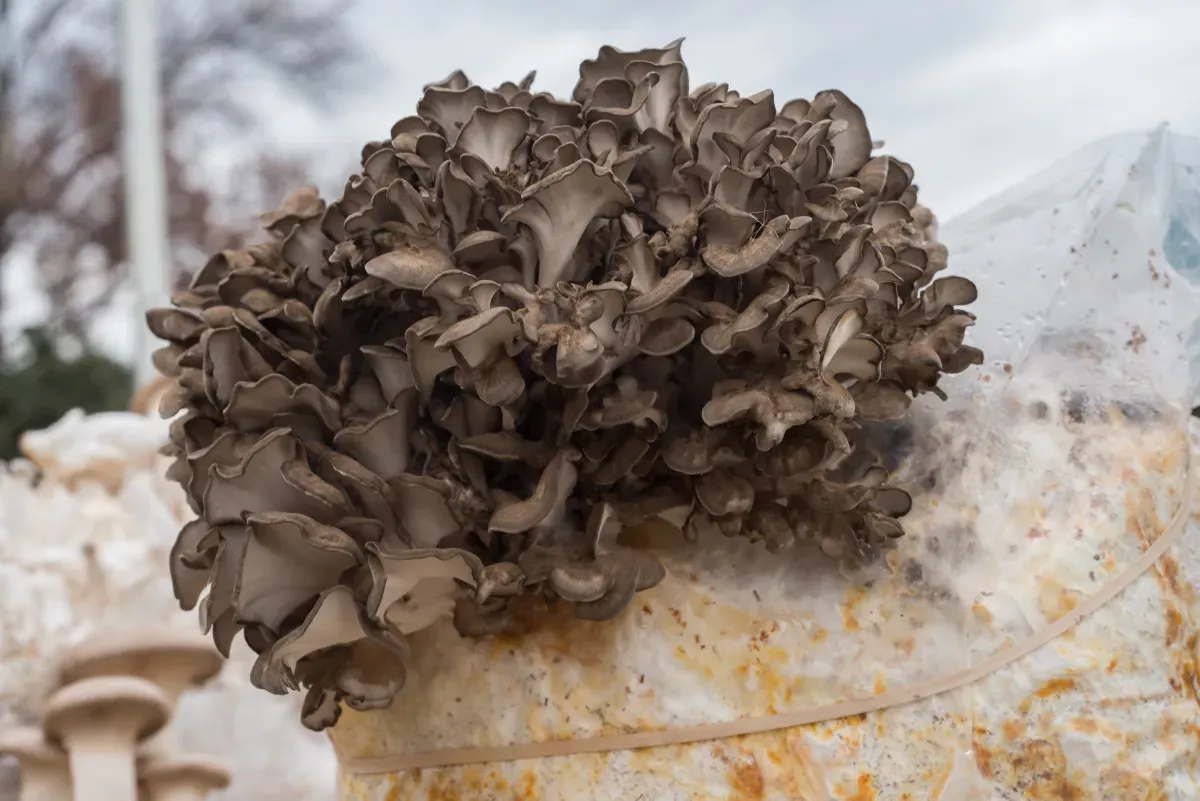
Foragers pay a premium for hen of the woods (Grifola frondosa) at farmers’ markets because wild clusters are seasonal, regional, and rarely small. A cultivated 5 lb block can yield a single 10-inch rosette that holds a meaty, umami-forward flavor most gourmets can’t match, and the same species carries one of the most-studied medicinal polysaccharide profiles in the literature. The combination of culinary value and documented compound chemistry is why maitake is the species experienced growers move toward after they’ve gotten comfortable with oysters and shiitake.
It is not a beginner project. Spawn run takes 30–60 days depending on strain and formula, which is a long contamination window compared to oyster’s ~2 weeks. Fruiting needs a specific combination of light, low CO₂, and a temperature drop into the high 60s, which is easy to miss if your chamber drifts warm.
If you have a setup that holds 66–70 °F (19–21 °C) with 93–97% relative humidity and you’re patient enough to wait three months for a single flush, maitake is worth the chamber time. If you’re still calibrating a humidity tent on oysters, build that muscle first.
Hen of the woods mushroom substrate#
Maitake fruits on supplemented hardwood. The science is pretty consistent across the three independent studies in the published literature. Biological efficiency (BE, the ratio of fresh mushroom weight to dry substrate weight) lands in the 32–47% range on oak-based formulas, and the supplement matters more than any other variable apart from strain.
- Oak sawdust + 10% wheat bran + 10% millet + 10% rye. The U.S. commercial standard developed by Shen and Royse and documented by Penn State Extension. ~65% moisture; hits BE 47.1% in published trials.
- Oak sawdust + corn cob blend. 73% corn cob, ~2% rice straw, 23% wheat bran, 2% CaCO₃. Reaches BE 44.9%, similar to the Shen and Royse formula. Useful if hardwood pellets are expensive or unavailable in your region.
- Beech sawdust. The traditional Japanese substrate, often supplemented with rice bran at roughly 5:1. Lower regional availability in North America but a documented effective alternative.
- Sterilized oak logs. Traditional and possible, but maitake colonizes wood slowly and loses to faster wild competitors. Logs must be boiled or pressure-treated before inoculation; the unsterilized log path has a very low success rate for hobbyists.
Avoid pine, cedar, and walnut. Maitake won’t colonize coniferous substrates, and walnut’s juglone is fungitoxic. Low-supplement formulas (oak sawdust alone, oak with token bran) drop BE into the high 20s and aren’t worth the chamber time.
Our substrate calculator opens pre-filled with the Shen and Royse blend. Set your bag count and it gives you exact ingredient weights, water volume, and sterilization parameters.
How to grow hen of the woods mushrooms#
Three methods work for home growers. Bag culture is the most reliable. Log inoculation is the cheapest per pound long-term but takes 2+ years to first fruit. Outdoor beds sit between the two on effort and timeline.
Hen of the woods bag culture#
Best for: intermediate-to-advanced growers with a pressure cooker and a humidity-controlled fruiting space.
- Mix 2–2.5 kg of substrate per bag using the Shen and Royse formula above, hydrated to ~65% moisture.
- Pack into microfiltered polypropylene bags. Heat-seal loosely (you’ll re-seal after inoculation).
- Pressure-sterilize at 250 °F (121 °C) / 15 PSI for 2–3 hours, depending on bag size.
- Cool for 16–20 hours in a clean space, ideally in front of a still air box or laminar flow hood.
- Inoculate with 5–10% grain spawn or sawdust spawn. Heat-seal the bag.
- Shake to distribute spawn evenly through the substrate.
- Incubate at 73–79 °F in darkness. Colonization takes 30–60 days depending on strain.
- When fully colonized and exudate droplets (“spider eyes”) appear on the mycelium surface, move to the fruiting chamber.
Expect first harvest 10–14 weeks after inoculation. Penn State’s “fold-over” technique works well for fruiting: cut two holes in the colonized bag, select the strongest primordia, and fold the bag top so only those primordia see the fruiting environment.
Hen of the woods log inoculation#
Best for: growers with a wooded property and a long horizon. Two Spores Farm’s outdoor totem-method walkthrough is one of the clearer beginner-to-experienced demonstrations of stump inoculation with maitake spawn.
- Cut fresh oak logs or rounds (8–12 inches diameter) in late winter or early spring while sap is dormant.
- Boil or pressure-treat the logs to suppress wild fungi. Without this step, native competitors outcompete the maitake at very high rates.
- Drill 5/16” or 12 mm holes in a diamond pattern, 2 inches apart along rows, 4 inches between rows.
- Tap in plug spawn or pack with sawdust spawn.
- Seal each hole with melted beeswax or cheese wax.
- For totem-style stump inoculation, set a colonized round on top of a buried stump and cover the union with a damp cloth or mulch.
- Bury part of the log or stump in shaded ground, leaving 1–2 inches exposed.
Expect 2–3 years before first fruiting. Maitake on logs has the lowest reported success rate of common log-cultivated gourmets. One grower in an r/homestead thread reported plug-spawn outcomes of 100% on blue oyster, 50% on shiitake, 25% on lion’s mane, and 0% on maitake using the same protocol across all four species.
Hen of the woods outdoor bed#
Best for: growers who can dedicate a shaded ground bed and want a middle path between bag culture and log inoculation.
- Prepare a shaded bed in well-drained soil, ideally under an oak tree.
- Inoculate colonized 5 lb sawdust blocks (from bag culture) or sawdust spawn directly.
- Cover with 2–3 inches of hardwood chips and mulch.
- Keep consistently moist through the first growing season.
- Watch for fruiting in late summer or fall of the first or second season.
Yields are lower than bag culture but the bed produces year after year with minimal intervention once established.
We don’t recommend monotub or bucket setups for maitake. CO₂ accumulates in those formats and primordia abort before fronds develop.
Hen of the woods fruiting conditions#
Maitake is more particular about its fruiting environment than most gourmets. Get the temperature drop and the CO₂ level right and the rest is straightforward.
Temperature. 66–70 °F (19–21 °C). Above 73 °F, primordia abort or develop into dense, malformed clusters that never open into fronds.
Humidity. 93–97% relative humidity. This is higher than oyster fruiting and the most common reason hobbyist setups fail with maitake. Aim for the upper end; mist the chamber walls rather than the developing fronds directly.
Fresh air exchange. Moderate-to-high. CO₂ should drop from the colonization range (under 3000 ppm) to 400–700 ppm during fruiting. A small fan running on a timer or a passive vent at the chamber top works for hobby-scale setups.
Light. Approximately 200 lux on a 12-hour cycle. Maitake needs noticeably more light than oysters to develop the dark frond pigment. A small LED panel on a timer is enough.
Species-specific trigger: the “spider eye” exudate. Small dark exudate droplets on the mycelium surface signal the colony is metabolically ready to switch from vegetative growth to fruiting. Wait for these to appear before dropping the temperature and CO₂. Triggering early is the most common cause of failed primordia.
Harvesting hen of the woods mushrooms#
Cut the entire cluster at the base with a sharp knife once the fronds are fully developed and the cap edges are firm but not yet curling or yellowing. Don’t twist or pull; you’ll damage the substrate block and risk losing any chance at a secondary flush.
Expect 0.6–0.8 lb of fresh mushroom per 5 lb block at biological efficiency 32–47%. Hobbyist setups typically land at the lower end of the range; commercial growers using strain-selected genetics and tight environmental control hit the upper end.
Maitake is functionally a single-flush crop. A second small flush is sometimes reported but rarely large enough to justify the chamber time. After harvest, most growers compost the spent block or break it up for outdoor-bed inoculation rather than wait for a second flush.
Hen of the woods flavor and culinary uses#
The flavor is robust, meaty, and umami-forward with distinct nutty and slightly peppery notes. Young clusters are mild and delicate; older specimens can develop a bitter edge, so harvest before fronds start to brown. Texture is firm and holds shape under high-heat cooking. Searing, roasting, and tempura are the standard preparations. The dense central base is usually trimmed for stock rather than cooked with the fronds, because it stays fibrous even after long cooking.
Maitake also has a substantial research literature on its bioactive compounds, particularly the D-fraction beta-glucan, studied for immunomodulatory effects. The most current open-access review is Wu, Siu, and Geng 2021 in Foods.
For storage, fresh maitake holds 5–7 days in a paper bag in the refrigerator. It dries exceptionally well: slice the fronds into thin strips, dehydrate at 105–115 °F until crisp, and store in an airtight jar. Dried maitake reconstitutes in warm broth in 15–20 minutes. Freezing works if you blanch first (uncooked maitake gets mushy after freezing).
Common hen of the woods growing problems#
These are maitake-specific. For the problems any grow can hit (contamination, mold ID, stalled fruiting), see our mushroom growing problems guide.
Strain quality is the biggest variable#
Shen & Royse 2002 tested 23 maitake isolates from Asia, North America, and Europe on the same optimized substrate. Four reached competitive BE between 35.8% and 39.5%. The geographic split was striking: 8 of 12 Asian-origin isolates (67%) fruited consistently versus only 1 of 10 US-origin isolates (10%). The takeaway is that a high-yield Asian commercial strain on a mediocre substrate will outperform a US wild-clone or unlabeled strain on the best substrate. Buy from suppliers who name the strain (Field & Forest carries dark-fronded cool-temperature genetics; North Spore’s Maine-line organic spawn; Amelium Farms’ GF-9827-5 commercial isolate; Zombie Mushrooms’ Japanese growing-stock liquid culture) rather than generic spore prints or wild clones.
The long spawn run invites contamination#
30–60 days is a huge window for Trichoderma or Penicillium to take hold compared to oyster’s ~2 weeks. Sterilize aggressively (full 2–3 hour pressure cycle), work in a still air box or laminar flow hood, and inspect bags weekly during incubation. Discard any bag showing green or blue mold immediately rather than hoping the maitake will outcompete; it won’t.
Primordia abort if fruiting is triggered too early#
Triggering early is the most common cause of failed maitake harvests. The colony forms a dense “blob” of undifferentiated tissue, then yellows and dies without producing fronds. The fix is to wait for the “spider eye” exudate before dropping the temperature and CO₂. Patience here saves the entire chamber cycle.
Outdoor logs have a very low success rate without sterilization#
The plug-spawn outcome breakdown surfaced in one detailed r/homestead thread was 100% blue oyster, 50% shiitake, 25% lion’s mane, 0% maitake using the same protocol across all four species. The same thread notes that maple logs work but produce roughly a quarter as many fruiting seasons as oak. If you’re committed to log cultivation, pre-treat the logs with boiling or steam sterilization and accept the 2–3 year timeline.
Predation on outdoor logs and beds#
Woodpeckers and beetles will work over your colonized logs even after successful mycelial run-through. Cage the logs with hardware cloth, or accept that outdoor cultivation has post-colonization losses that bag culture doesn’t.
Where to buy maitake spawn#
Maitake spawn is harder to source than oyster or shiitake. Fewer suppliers carry it, and stock turns over because demand outpaces supply during fall fruiting season. Two suppliers in our directory consistently stock it: North Spore for USDA Organic sawdust spawn sourced from New England and North America, and Field & Forest Products for sawdust spawn, plus plug spawn and liquid culture options for log cultivators. When direct suppliers are out, an Amazon liquid-culture syringe is a Prime-eligible same-day fallback.
Equipment for growing hen of the woods#
For bag culture, you need three things. A pressure cooker: the All American 921 and Presto 23-quart are both standard hobby choices, with the All American built to last decades and the Presto cheaper upfront. Filter-patch grow bags, where Unicorn 14A is the standard for 5 lb blocks. And a still air box or laminar flow hood for the inoculation step.
For log inoculation, you’ll need a drill with a stop-bit (12 mm or 5/16”), plug or sawdust spawn, beeswax for sealing holes, and a large vessel for boiling logs if you’re sterilizing; a 60+ quart stockpot works for small rounds. Field & Forest sells the inoculation tools as a kit, including a high-quality stop bit and an angle-grinder adapter that turns log drilling from a back-breaking afternoon into a one-second-per-hole job.
For the fruiting chamber, a hygrometer is essential. Maitake’s 93–97% relative humidity range is tight and many cheap hygrometers read 10% low at the top of the scale. A fine-mist sprayer or ultrasonic humidifier handles humidity. A small fan on a timer handles the CO₂ exchange.
Related guides#
- Shiitake growing guide — the natural companion species for log cultivation, with overlapping equipment and a friendlier failure rate.
- Lion’s mane growing guide — another medicinal gourmet at a similar difficulty tier, with different fruiting requirements.
- Reishi growing guide — also documented for medicinal polysaccharide profiles, longer fruiting timeline, easier environmental tolerance.
- Shiitake log cultivation — the technique deep-dive that covers log selection, sterilization, and inoculation in detail.
- Substrate calculator — pre-fills the Shen and Royse maitake blend; scale to your bag count.
Newsletter
Grow better mushrooms