Enoki
Flammulina filiformis / Flammulina velutipes
Also known as: Enokitake, Winter Mushroom, Velvet Foot, Velvet Shank, Golden Needle Mushroom
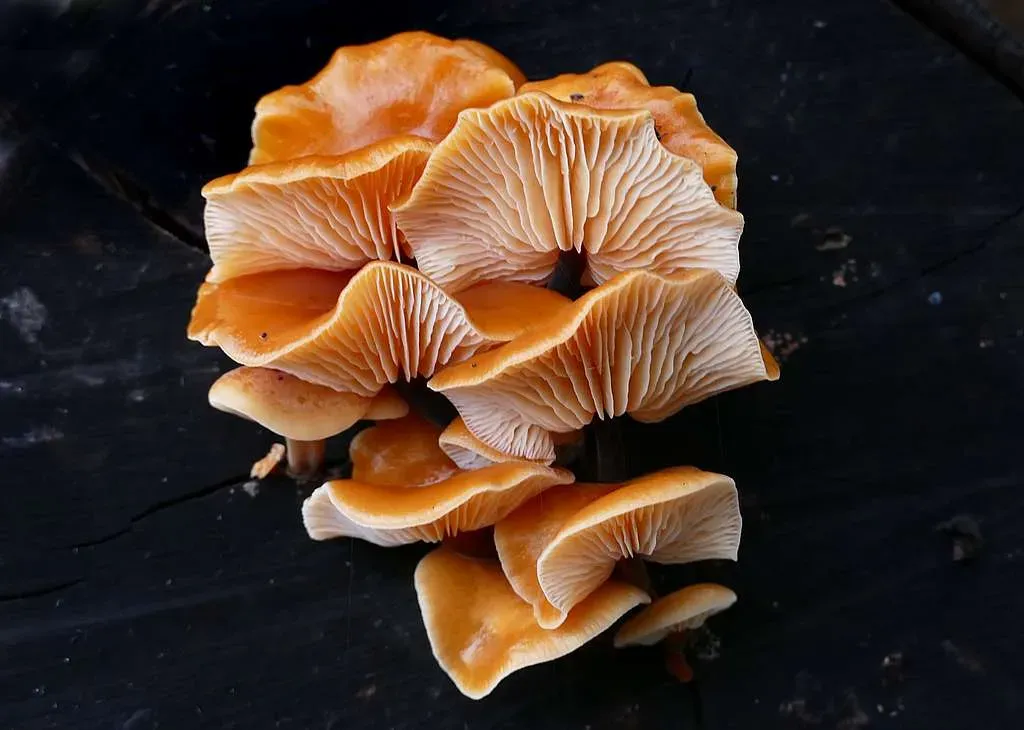
Quick Reference
- Difficulty
- Easy (2/5)
- Days to harvest
- 7–14 days
- Yield per 5lb block
- 1.2–1.5 lbs per 5 lb block on the first flush
- Fruiting temp
- 50–65°F
- Humidity
- 85–95%
- Use
- Culinary + Medicinal
- Best substrates
- Supplemented hardwood sawdust, Master's Mix (hardwood + soy hull), Hardwood logs, Corncob + bran
- Growing methods
- kit · bag · log
Contents
Why grow enoki mushrooms#
Enoki is the mushroom that fruits when nothing else will. The Japanese name enokitake and the European name winter mushroom both point at the same trait: this is a cold-weather species that pins at 50–55°F and matures at temperatures most gourmet mushrooms refuse to touch. If you’ve got a cool basement, a garage that sits in the 40s and 50s through winter, or a shaded outdoor log pile, you can grow enoki on a schedule that takes oysters and lion’s mane offline.
The white, long-stemmed, tiny-capped enoki in the grocery store and the brown, normal-looking mushroom you’ll grow at home are two different things, and not just morphologically. They were split into two species in 2015 (Wang et al., Mycological Progress). The cultivated Asian commercial variety is Flammulina filiformis; the wild temperate-forest species across Europe and North America is Flammulina velutipes.
That long-pale-stem, tiny-cap “needle” look isn’t a strain difference you can grow at home. It’s the result of growing the F. filiformis commercial lineage in sealed cold rooms at over 30,000 ppm CO₂ in total darkness. If you want the underlying science, Yan et al. 2019 in International Journal of Molecular Sciences walks through the molecular mechanism: high CO₂ suppresses cap expansion by interrupting cell-division pathways. Without that industrial setup, your home-grown enoki will look like the wild form: brown caps, normal-length stems, fuzzy stem bases. It’s a perfectly good mushroom. It just doesn’t photograph like the supermarket pack.
Enoki mushroom substrate#
Enoki is a wood-decay species with a strong preference for supplemented hardwood. The traditional Asian commercial substrate is hardwood sawdust (oak, alder, Cryptomeria, or Chamaecyparis) supplemented with rice or wheat bran at roughly a 4:1 ratio. That formula is the baseline for almost every published yield study.
Home growers usually skip the bulk sawdust-and-bran prep in favor of Master’s Mix: 50/50 hardwood fuel pellets and soy hull pellets, hydrated and sterilized. Both inputs ship dry in 40 lb bags from any home-improvement or feed store, store indefinitely without spoiling, and produce comparable or denser flushes than the bran formula with fewer steps. The trade is a slightly different nutrient profile for a much simpler workflow, and most hobbyists choose simplicity. Corncob plus bran is a viable alternative used in commercial Chinese production where corn waste is abundant and cheap, but it’s a niche choice in North America.
For the wild-type outdoor approach, fresh-cut hardwood logs (oak, beech, birch, alder) work exactly the way they do for shiitake.
Here’s how the substrates stack up by preference:
- Supplemented hardwood sawdust. Hardwood sawdust plus wheat or rice bran at 4:1, with lime to buffer pH. The commercial standard.
- Master’s Mix (hardwood + soy hull). 50/50 hardwood pellet and soy hull pellet, hydrated and sterilized. Denser flushes than straight sawdust; the hobbyist favorite.
- Hardwood logs. Freshly cut oak, beech, birch, or alder. Produces the wild brown morphology over a 1–3 year fruiting window.
- Corncob plus bran. A traditional alternative used in Asian commercial production. Comparable yields to sawdust if supplemented correctly.
Skip straight cereal straw and conifer woods. Yields drop sharply, and conifer resins inhibit Flammulina colonization. If you’re sizing a bag grow, the substrate calculator will give you the mix volumes for Master’s Mix or supplemented sawdust.
How to grow enoki mushrooms#
The two methods that actually work at home are bag culture (for the cool indoor grow) and log inoculation (for the outdoor grower). A third method, the polypropylene bottle culture that produces all commercial white enoki, is what the industry uses, but it isn’t a home setup. Each is covered below.
Growing enoki from a kit#
Best for: first-time growers who want to confirm they can fruit a cold-loving species before investing in bags and a pressure cooker.
A pre-colonized enoki kit ships as a sealed substrate block ready to fruit when you open the top and drop it into the right environment. Expect a first flush of half a pound to a pound from a standard kit.
- Open the kit per the supplier instructions, usually a slit across the top of the bag.
- Place it somewhere between 50 and 60°F. A cool basement, garage shelf, or unheated mudroom in winter all work. A standard kitchen refrigerator is too cold and dry without modification.
- Mist twice daily to keep the exposed substrate visibly damp.
- Pins should appear in 7–14 days. Once pinned, leave the kit alone; the bag walls trap enough CO₂ to encourage longer stems.
Enoki bag culture#
Best for: growers comfortable with sterile work who want the wild-type brown morphology on demand.
- Mix Master’s Mix or supplemented hardwood sawdust to about 60% moisture. Pack 4–5 pounds wet weight into a filter-patch grow bag.
- Sterilize at 15 psi for 2–3 hours in a pressure cooker and let cool completely.
- Inoculate with grain spawn or a liquid culture syringe inside a still-air box. Enoki colonizes more slowly than oyster; expect 3–5 weeks at 64–75°F to fully run a bag.
- Once fully colonized, move the bag to a fruiting space at 50–55°F. Fold or cut the top of the bag to expose the substrate, but leave the bag walls high enough to act as a CO₂ collar. This is the closest you can get to needle morphology without industrial gear.
- Mist 1–2 times a day. Pins typically form within 10–14 days of cold-shocking.
- Harvest in another 7–14 days, when stems are 3–5 inches long and caps are still tight.
A bag-cultured flush will look more like the wild form than the supermarket form: shorter stems, larger and browner caps, more visible fuzz at the base. The high CO₂ trick partially elongates the stems, but it doesn’t replicate a sealed industrial chamber.
Enoki log inoculation#
Best for: outdoor growers who already inoculate logs for shiitake or oyster.
Enoki is a strong natural saprotroph (a fungus that feeds on dead organic matter) on hardwood, and it’s one of the few gourmet species you can find wild on fallen logs after the first hard frost. The log method produces 100% wild-type morphology (brown caps, normal stems) and fruits in cold weather without any humidity control.
- Cut fresh hardwood logs (oak, beech, birch, alder) 3–6 inches in diameter and 3–4 feet long. Inoculate within 2–4 weeks of cutting.
- Drill 5/16” holes every 4–6 inches in a diamond pattern around the log.
- Plug with plug spawn or sawdust spawn, then seal each hole with melted cheese wax.
- Stack the logs in deep shade: a north-facing wall, a wooded area, or a shaded crib. Don’t seal them off the ground; Flammulina benefits from soil contact at the log ends.
- Logs typically begin fruiting after 12–18 months, triggered by the first cool, wet weather of fall. They’ll continue to fruit each cool season for 3–5 years.
Why store-bought enoki looks nothing like home-grown#
The commercial bottle method is worth understanding even if you can’t replicate it. Industrial F. filiformis production runs in 800–1300 ml polypropylene bottles in climate-controlled rooms that hold colonization at 64–68°F and drop maturation to 37–46°F, with CO₂ concentrations pushed above 30,000 ppm (over 3%) in total darkness. A 2020 Frontiers in Microbiology paper traced the long-thin-stipe morphology directly to that CO₂ environment: high CO₂ suppresses pileus expansion at the cellular level and forces stipe elongation as the mushroom reaches for fresh air.
A recent optimization study in Horticulturae on grass-based substrate formulations for F. filiformis documents how aggressively this is engineered. Formulation Y in that study hit 131.92% biological efficiency, well above what most species do under any conditions. Those numbers come from controlled rooms, sterile inoculation labs, and 4-hour autoclave cycles. The home version of that protocol doesn’t exist, and trying to chase needle morphology in a closet or grow tent generally produces ugly half-elongated clusters and reduced yields.
Can I regrow store-bought enoki?#
The fridge-revive trick (stick the original pack in the crisper drawer, get a small second flush) is one of the most-shared enoki tips on social media, and it does sometimes work. Whether you should is a different question.
Commercial enoki has a documented Listeria monocytogenes recall history in the US, with multi-state outbreaks tied to imported, packaged enoki between 2020 and 2022 (Sun Hong Foods, Guan’s Mushroom, H&C Food, and others). Sanitation tightened after the recalls, so the base rate on a current pack is low, but Listeria grows at refrigerator temperatures, and a multi-day refruit gives any contamination present time to multiply. Severity when it does hit is high (pregnancy, elderly, immunocompromised). Most refruit attempts end in bacterial blotch or mold before any second flush emerges anyway.
The cleaner alternative: a liquid culture syringe runs $15–25 and inoculates substrate you control with no packing-line history. After the first flush you’ve already covered the cost of the grocery pack you would’ve otherwise refruited.
Enoki fruiting conditions#
Enoki separates from most gourmet species on temperature. Colonization runs at a comfortable 64–75°F, close to where you’d hold lion’s mane or oyster grain spawn, but fruiting demands a cold drop that other species would refuse to tolerate.
Temperature. Drop the fruiting environment to 50–55°F to trigger primordia. The wild F. velutipes form develops normal short stems and full caps anywhere from 50 to 65°F. Holding the temperature in the low 50s through fruiting produces firmer, slower-growing mushrooms with better texture than pushing the upper end of the range. Anything above 65°F either kills pin formation or produces small, weak mushrooms that abort.
Humidity. 85–95% relative humidity, the same range as oyster fruiting. Lower humidity dries out the delicate pins; higher humidity invites bacterial blotch. Penn State Extension recommends dropping from saturated air at pinning down to roughly 85% during stipe elongation to keep blotch in check.
Fresh air exchange. This is where enoki diverges from most gourmet species. Flammulina responds to elevated CO₂ by elongating stems and suppressing caps. For the wild brown morphology, ambient airflow is fine. For partial stem elongation (the closest you can get without industrial gear), leave the bag walls high to trap CO₂ in a “well” above the substrate surface.
Light. Indirect light is fine for the wild form. Industrial F. filiformis production uses total darkness to maintain the white color, but the wild form develops normal pigmentation under any light schedule. Don’t use direct sun.
Cold shock. A 24–48 hour drop into a refrigerator (around 38–42°F) before moving the bag to its fruiting space is a reliable pinning trigger.
Harvesting enoki mushrooms#
Harvest enoki before the caps open. The window between “tight closed caps” and “fully expanded caps releasing spore” is short, typically 24–48 hours once the stems hit their target length. Even slightly late harvests coat the entire grow space in fine white spore dust, which is both irritating to inhale and a hassle to clean. Mask up if you delay past the target window.
To harvest, twist the entire cluster gently at the base and lift; the mycelium will release the cluster cleanly. Cut off the substrate-stained stem ends. Expect 1.2–1.5 pounds per 5 lb fruiting block on the first flush, calculated from the 70% biological efficiency that home setups typically hit. Commercial bottle production reaches 100% BE and above, but that figure isn’t a realistic home target without the matching environment.
Bag growers can sometimes get a second smaller flush by rehydrating the block in cold water for 12 hours, draining, and returning it to the fruiting space. Yields drop sharply; expect maybe a third of the first flush. Commercial bottle production almost always discards or composts substrate after one flush to maximize throughput, so don’t be surprised if a stubborn second flush is the cleanest path. Log inoculations fruit annually each cool season for 3–5 years and don’t need any retrigger beyond ambient weather.
Enoki flavor and culinary uses#
Fresh enoki has a mild, slightly fruity flavor with a clear umami backbone and a delicate aroma. Song et al. 2024 in Foods identified 16 key aroma compounds across yellow and white F. filiformis cultivars using gas chromatography–mass spectrometry, and found the yellow strain carries a “sweet” dominant character while the white strain reads as “green.” Either way, the flavor is mild. Enoki is a texture mushroom first, a flavor mushroom second.
The texture is where it earns its place in the kitchen. Long thin stems hold their snap through brief cooking. Blanched in dashi for two minutes, dropped into a hot pot at the last moment, or stir-fried over high heat for a quick sear, the stems stay crisp. Wild-type home-grown enoki with shorter stems and bigger caps cook a little differently, closer to a small oyster, but the same fast, high-heat methods work. Don’t braise enoki for an hour expecting depth of flavor; the texture collapses long before any meaningful broth develops.
Documented medicinal compounds in Flammulina include proflamin (a glycoprotein with antitumor activity in mouse models), polysaccharides FVP-1 and FVP-2 (immunomodulatory in cell studies), and unusually high concentrations of ergothioneine, a potent antioxidant amino acid. None of this clears the bar of clinical evidence for human supplementation, but the compounds are well-characterized in the laboratory literature.
Storage and handling. Fresh enoki keeps 5–7 days refrigerated in a paper bag; plastic traps moisture and accelerates rot. Cook enoki before eating, including the home-grown wild form. The 2020 Listeria outbreaks tied to packaged commercial enoki were the result of post-harvest contamination at packing facilities, but the recalls demonstrated something important: enoki was historically marketed for raw use, and that turned out not to be safe. According to the FDA’s investigation summary on the outbreak, brief cooking kills Listeria reliably. The home-grown version isn’t subject to the same packing-line risk, but the same “cook, don’t eat raw” rule applies.
Common enoki growing problems#
Pins won’t form even though the substrate is fully colonized#
The fruiting temperature isn’t cold enough. Enoki needs the actual environment, not just the air temperature, to drop into the low 50s. A bag sitting in a “50°F” room often has internal substrate temperatures 5–10°F warmer than ambient, especially if it’s near a window in afternoon sun. Move the bag to the coolest part of your fruiting space, away from any heat source, and consider a 24–48 hour cold shock in the fridge to push pin formation. An unheated basement or attached garage in winter beats any modified-fridge attempt for steady cool temperatures. If cold alone doesn’t do it, our guide to mushrooms that won’t pin covers the rest.
Wild-type morphology instead of needle morphology#
This is the most common frustration with enoki cultivation, but it isn’t something you can fix. The brown wild form is what F. velutipes (and untrained F. filiformis without the right CO₂) looks like. The needle morphology requires CO₂ concentrations above 30,000 ppm in total darkness in a sealed chamber. If you want partial elongation, leave the bag walls tall to trap CO₂ in a “well” above the substrate surface. That’s the closest a home setup can get, but it won’t reproduce the supermarket look.
Slow colonization and stalled bags#
Compared to oyster, enoki colonizes slowly; 3–5 weeks is normal for a 5 lb bag at the warm end of the colonization range. Slow colonization in non-sterile setups raises contamination risk because more time means more chances for mold or bacteria to take hold. If a bag stalls or shows green mold, abandon it. To reduce the risk, use a quality liquid culture or grain spawn from a reputable supplier, sterilize at 15 psi for the full 2–3 hours, and inoculate in a still-air box. Surface contamination is a much bigger factor than the substrate recipe.
Wet spot bacterial contamination in DIY bottle attempts#
In sterilized polypropylene bottles, growers sometimes hit “wet spot” bacterial blooms where heat didn’t fully penetrate the bottle’s core during sterilization. Reduce the substrate moisture to 60% before packing, and don’t pack the bottles tighter than the supplier recommendations specify. Heat penetration is the underlying issue: a denser pack means a colder core. Most home growers solve this by switching to filter-patch bags instead, which have far better heat-transfer characteristics than rigid bottles.
Spore release coating the grow space in white dust#
Enoki releases a lot of spores once caps open. The harvest window between “tight cap” and “fully open releasing spore” is roughly 24–48 hours, and missing it carpets every surface within several feet in fine white dust. Mask up if you’ve delayed past the target harvest window, and clean the area with a damp cloth, since dry sweeping just resuspends the spores. Spore exposure isn’t acutely toxic, but allergic sensitization to Flammulina spores has been documented in commercial growers and isn’t worth courting.
Where to buy enoki spawn#
Enoki spawn is available from most major US gourmet-spawn vendors, but with a labeling caveat: nearly all of them still list cultivated needle-strain cultures as Flammulina velutipes despite the 2015 taxonomic split. The strain you receive may or may not match the species name on the label. Read the morphology description before ordering. “Slender threadlike stems with petite button caps” is the cultivated F. filiformis lineage, while “caramel brown caps with fuzzy stem base” is wild-type F. velutipes.
The directory carries two suppliers with current enoki stock:
- North Spore sells organic golden enoki grain spawn at $29.99 for roughly 6 lb. Stock checks consistently in their inventory, and the strain description (“slender threadlike stems, petite button caps”) indicates the cultivated F. filiformis lineage despite the F. velutipes species label.
- Out-Grow carries both gold and white liquid culture variants, both labeled F. velutipes. The gold variant is more forgiving for first-time enoki growers; the white variant is the cultivated lineage and demands tighter cold-room control to express needle morphology.
Equipment for growing enoki#
A kit needs nothing: open it, mist it, put it somewhere cold. For bag culture, the requirements are the standard sterile-work setup: a pressure cooker capable of holding 15 psi (the Presto 23-quart is the standard hobbyist starter), filter-patch grow bags sized for 4–5 lbs of substrate, and a still-air box for inoculation. A digital thermometer and hygrometer in the fruiting space are non-negotiable for hitting the cold target temperatures consistently.
The species-specific equipment problem is the fruiting environment. Most home setups can’t hold a steady 50–55°F for the two-to-four week fruiting cycle. A wine fridge converted to a fruiting chamber is the cleanest home solution. The NewAir 23-bottle freestanding wine cooler is a compressor-based 41–64°F adjustable unit in the $150–$300 range with enough headroom for one or two 5 lb blocks. If you’re comparing other wine fridges, look for the same two specs: a compressor system (not thermoelectric, which often can’t reach the low 50s in a warm room) and a thermostat that goes below 50°F. An unheated basement or garage in winter works for free if you have the geography for it.
A CO₂ meter ($50–$200) is only worth buying if you’re attempting commercial-style needle morphology, which isn’t realistically achievable without industrial gear. For the wild brown form most home setups will actually produce, ambient airflow is fine and you don’t need to measure CO₂ at all.
Related guides#
- Oyster Mushroom Growing Guide — the indoor gourmet species to pair with enoki for warm-weather production
- Shiitake Growing Guide — log inoculation companion if you’ve already got logs in the yard
- King Stropharia Growing Guide — the outdoor-bed counterpart for shaded yard space
- Substrate Calculator — pre-fill for Master’s Mix or supplemented hardwood sawdust
- How to Grow Mushrooms at Home — Beginner Guide
Newsletter
Grow better mushrooms