Golden Oyster Mushroom
Pleurotus citrinopileatus
Also known as: Golden oyster, Yellow oyster, Pleurotus citrinopileatus, Tamogitake
Quick Reference
- Difficulty
- Beginner (1/5)
- Days to harvest
- 2–5 days
- Yield per 5lb block
- 1–2 lbs per 5 lb block across 2–3 flushes
- Fruiting temp
- 70–84°F
- Humidity
- 85–95%
- Use
- Culinary
- Best substrates
- Wheat straw, Master's Mix (hardwood + soy hull pellets), Supplemented hardwood sawdust, Coffee grounds
- Growing methods
- kit · bag · bucket
Contents
- Why grow golden oyster mushrooms
- What makes golden oyster mushrooms different
- How to grow golden oyster mushrooms
- Golden oyster fruiting conditions
- Harvesting golden oyster mushrooms
- Golden oyster flavor and culinary uses
- Common golden oyster growing problems
- How to get started growing golden oysters
- Is golden oyster the same as yellow oyster?
- Related guides
Why grow golden oyster mushrooms#
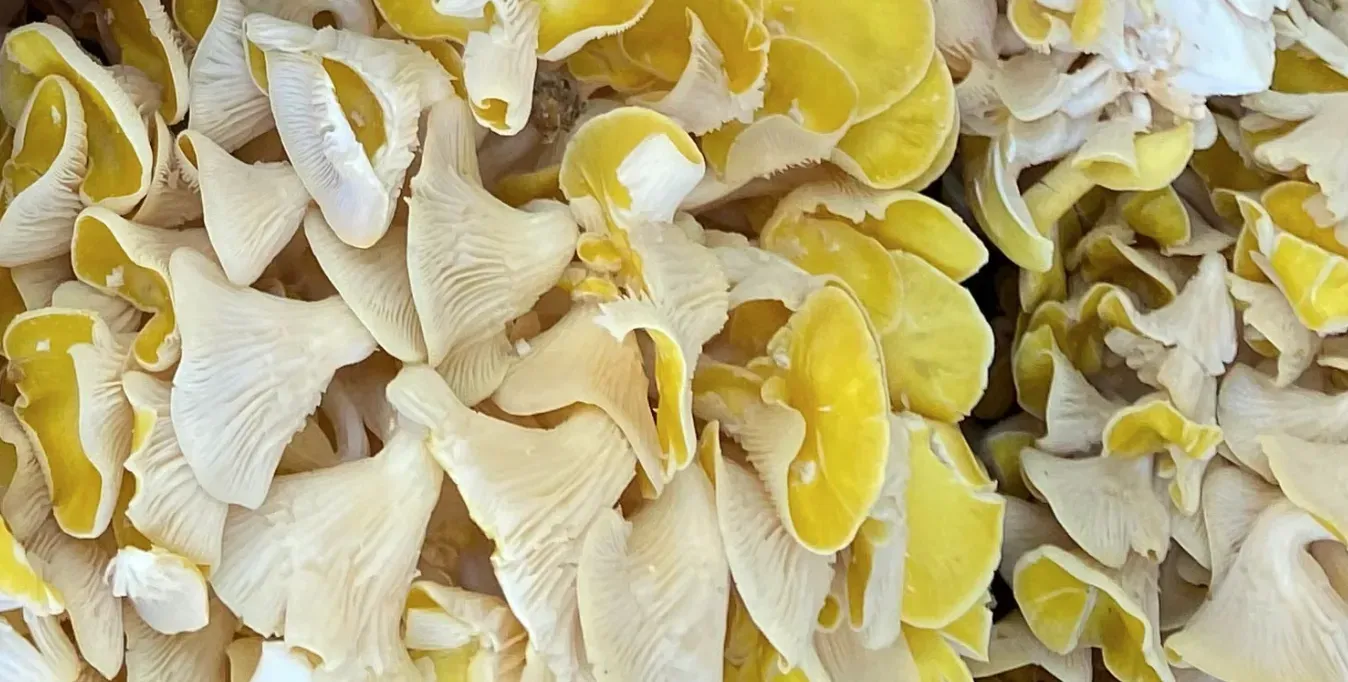
Golden oyster is the one that stops people at the farmers market. A fully formed cluster is a bright, almost canary-yellow rosette, and nothing else on the home-cultivation shelf looks like it. It’s also one of the fastest and most forgiving oysters to grow: it colonizes aggressively, fruits in two to three weeks, and tolerates the warm rooms that make summer cultivation hard for most other species. On our difficulty scale it’s a 1, a true beginner mushroom, and the shared basics on the main oyster guide carry it most of the way.
The appeal beyond the color is a gentle, distinctive flavor. Golden oyster is mild and nutty with a faint citrus edge, and fresh clusters give off a lemony, cucumber-like scent that you’ll notice the moment you cut one. It’s a good-looking, good-smelling mushroom that happens to be easy.
Two honest caveats come with it. Golden is the most delicate oyster to handle and the shortest-keeping after pink, so it wants to be cooked or dried within a day or so of harvest rather than stored. And there’s a bigger one that shapes how we recommend growing it: golden oyster has escaped cultivation and become an invasive species across North American forests. That makes indoor-only growing and careful disposal of spent substrate part of the deal, and it’s why the methods below stay indoors.
What makes golden oyster mushrooms different#
Most oyster cultivation is generic across the genus, so the substrate, spawn, and core method instructions on the main oyster guide apply to golden without changes. Four things genuinely set it apart.
It loves warmth and shrugs off summer heat. Where blue oyster prefers cool rooms and pink demands tropical warmth, golden sits comfortably in between and is less fussy than pink. Its fruiting range runs roughly 70–84°F (21–29°C); it’s the warm-season oyster, well suited to a heated home or a summer grow, but it slows below about 60°F and can stall outright in a cold space.
It’s fragile and short-lived. Golden’s flesh is thin and bruises easily, and its fridge life is the shortest of the common oysters apart from pink. This isn’t a flaw you can grow your way around; it’s the nature of the mushroom. Plan to use it fast.
The color and aroma shift with light. The bright yellow is strongest on the living mushroom and cooks out to a soft tan. Light quality drives both the color and the aroma, and blue light in particular brings out the deepest color and the strongest scent. Grow it in good indirect light or under an LED, not in the dark.
It’s an invasive species, so grow it indoors. Golden oyster is native to East Asia but escaped North American cultivation and naturalized widely. A 2025 study in Current Biology documented its spread to 25 states and one Canadian province and found it actively displacing native fungi: dead trees colonized by golden oyster hosted roughly half the fungal species of uninvaded trees. Spores and dumped spent substrate are the main vectors. For that reason we don’t recommend growing golden on outdoor logs or beds, and you should bag and bin spent blocks (or compost them in a closed system) rather than tossing them in the yard.
How to grow golden oyster mushrooms#
Golden grows by the standard indoor oyster methods: a pre-colonized kit, bucket tek, and sterilized bag culture on Master’s Mix. The mechanics are identical to the rest of the genus, so rather than repeat them, the full step-by-step for each method lives on the main oyster guide, along with the substrate options and the equipment you’ll need.
Three golden-specific notes layer on top of those shared instructions:
- Keep it warm. Golden wants fruiting temperatures in the 70–84°F band. In a cool space, a seedling heat mat under the block or a warmer room makes the difference between fast pins and a stalled grow.
- Skip outdoor logs and beds. Unlike blue, we don’t recommend log or bed cultivation for golden because of the invasive-species risk above. Grown indoors, spores stay contained and spent substrate goes in the trash.
- Skip the monotub. Like all oysters, golden needs far more fresh air than a sealed tub provides and will throw leggy, malformed clusters in one. Use a kit, bucket, or bag instead.
From a kit, expect first pins about a week after opening and harvest 14–21 days in. Bag and bucket grows colonize in roughly two to three weeks before you move them to fruiting conditions.
Golden oyster fruiting conditions#
Colonization is the easy part and matches the rest of the genus: keep the substrate around 64–84°F in the dark, and golden’s mycelium runs fast and aggressively. Fruiting is where its warm streak shows.
Temperature. Golden fruits best at roughly 70–84°F (21–29°C), warmer than blue or pearl and more tolerant of heat than almost any oyster except pink. It needs no cold shock to pin. Below about 60°F it slows down and may refuse to fruit, so a cool overnight dip is the most common reason a golden block stalls.
Humidity and fresh air. Hold humidity at 85–95% through pinning and fruiting; the colonization phase runs slightly drier, around 80%. Golden fruits best at moderate CO₂ rather than ultra-low. Cultivation studies put peak yield and biological efficiency at CO₂ levels of 0.05–0.1% (about 500–1,000 ppm), with good cap quality holding up toward 0.15%. Too little fresh air gives long stems and small caps; very high CO₂ pushes dense, cauliflower-like clusters. Steady, automated air exchange keeps caps forming normally.
Light. Give developing pins indirect light or a low LED on a daily cycle, both to form normal caps and to bring out the yellow. Full darkness produces pale, deformed clusters and a weaker aroma.
Harvesting golden oyster mushrooms#
Harvest golden oysters early. They mature quickly and the caps are thin, so pick while the edges are still curled rather than flat, often just two to five days after pins first appear. Twist the whole cluster off at the base in one motion; the harvest technique, flush timing, and spore-load precautions that apply to any oyster are covered in full on the main oyster guide. Handle golden by the cluster base, not the caps, because it bruises and tears more readily than blue or pearl.
Yield runs a little below the sturdier oysters and swings hard with substrate. Cultivation trials on common reed reported biological efficiency in the high 60s to mid 70s percent across several flushes, while coffee husk came in far lower, around 27%. In practice, expect roughly 1–2 lbs of fresh mushrooms per 5 lb block across two or three flushes. After the first flush, soak and rest the block as you would any oyster to push the next one. The bright color is at its best right at harvest and fades quickly, which is one more reason to pick promptly and cook or dry the same day.
Golden oyster flavor and culinary uses#
Golden oyster is the mildest and most delicate of the common oysters, with a gentle nutty flavor and a faint citrus note that sets it apart from the savory, anise-tinged blue and pearl. Fresh clusters carry a lemony, cucumber-like aroma that mostly cooks off. The thin flesh cooks fast and turns limp and watery if you overdo it, so treat it gently.
The best methods are a quick sauté or a hot roast in small clusters until the edges crisp; the yellow cooks out to a soft tan along the way. For storage, golden keeps the shortest of the common oysters after pink, about one to three days fresh in a paper bag in the fridge. It dries exceptionally well and rehydrates in fifteen minutes, which is the better way to hold a large flush. Freezing raw turns it to mush, so sauté lightly before freezing if you need to.
Common golden oyster growing problems#
Most oyster problems are shared across the genus: leggy stems from poor fresh air exchange, aborted pins, and wet “schlog” substrate. Those are covered on the main oyster guide. Three issues stand out for golden specifically.
A stalled grow in a cool room#
Golden is warm-loving, and below about 60°F it slows and often refuses to pin. A block that colonized beautifully but won’t fruit is usually just too cold. Move it to a warmer spot or add a seedling heat mat and bring the fruiting temperature into the 70–84°F band. If warmth doesn’t fix it, our guide to mushrooms that won’t pin covers the non-temperature causes.
Mushrooms that tear, bruise, or go limp#
Golden’s thin flesh is the most fragile of the common oysters. Bruised or torn clusters usually mean rough handling or a late harvest; limp, watery results usually mean they were overmature on the block or overcooked. Pick early with the caps still curled, lift by the base, and cook hot and fast.
Leggy stems or cauliflower clusters#
This is the shared fresh-air-exchange failure, but it’s worth restating because golden’s warm grows often run in less-ventilated summer setups. Too little fresh air gives long stems and tiny caps; very high CO₂ produces dense, cauliflower-shaped growth. Golden fruits best at moderate CO₂, so a small inline fan on a timer almost always fixes it.
How to get started growing golden oysters#
The easiest way in is a pre-colonized kit. No substrate prep, no sterile work, just cut the bag, mist, and wait. A golden oyster grow kit on Amazon fruits on a kitchen counter in two to three weeks, and Midwest Grow Kits offers golden in kit form alongside its other oyster varieties.
Affiliate link — we may earn a commission, at no extra cost to you.
Once you’re past kits, golden is one of the more widely stocked gourmet oysters as spawn. North Spore carries it in both grain and sawdust spawn, Out-Grow stocks golden as grain spawn and liquid culture at good prices for DIY growers, and Fungi Ally discloses named strains on its spawn if you want to compare notes with other growers running the same cultivar.
We deliberately don’t point golden growers toward plug spawn for log inoculation. Plugs are sold for it, but outdoor log cultivation is exactly the route that has helped this species escape into the wild, so for golden we keep the recommendation to indoor grain, sawdust, and kit formats.
Is golden oyster the same as yellow oyster?#
Golden vs. yellow oyster. Same mushroom. “Golden oyster” and “yellow oyster” are interchangeable common names for Pleurotus citrinopileatus, also sold under the Japanese name tamogitake. There’s no difference in how you grow or cook them, so a recipe or spawn listing using either name is the same thing.
Golden vs. blue and pearl. A different species, not a color form of P. ostreatus. Golden is closely related to P. cornucopiae and was historically catalogued as P. cornucopiae var. citrinopileatus, but for growing purposes it’s its own warm-loving mushroom with its own temperature needs.
Golden vs. the toxic Jack-o’-lantern. This matters if you forage, since wild golden oysters are now common in North American woods. The toxic Jack-o’-lantern (Omphalotus illudens in the eastern US) is also yellow-orange and grows on wood, and both have gills that run down the stem, so that feature won’t separate them. Jack-o’-lantern grows in dense fused clusters from buried roots and stumps, is orange throughout, has faintly bioluminescent gills, and drops a pale, cream-colored spore print. Golden grows shelf-like on dead standing or fallen hardwood, fades from lemon-yellow to tan, and gives a white-to-lilac spore print. If you do forage golden, remember it’s a spreading non-native: pick freely, but don’t move logs or scatter spent material in a way that helps it spread.
Related guides#
- Oyster Mushrooms — Complete Growing Guide — shared substrate, methods, harvest, and spore-safety details for the whole oyster family
- Blue Oyster Growing Guide — the cold-tolerant, cobalt-capped sibling, and a good pick for unheated spaces
- How to Grow Mushrooms at Home — Beginner Guide
- Substrate Calculator — pre-fills for Master’s Mix or pasteurized straw
- Pressure Cooker Buying Guide — sterilization for bag culture
Newsletter
Grow better mushrooms