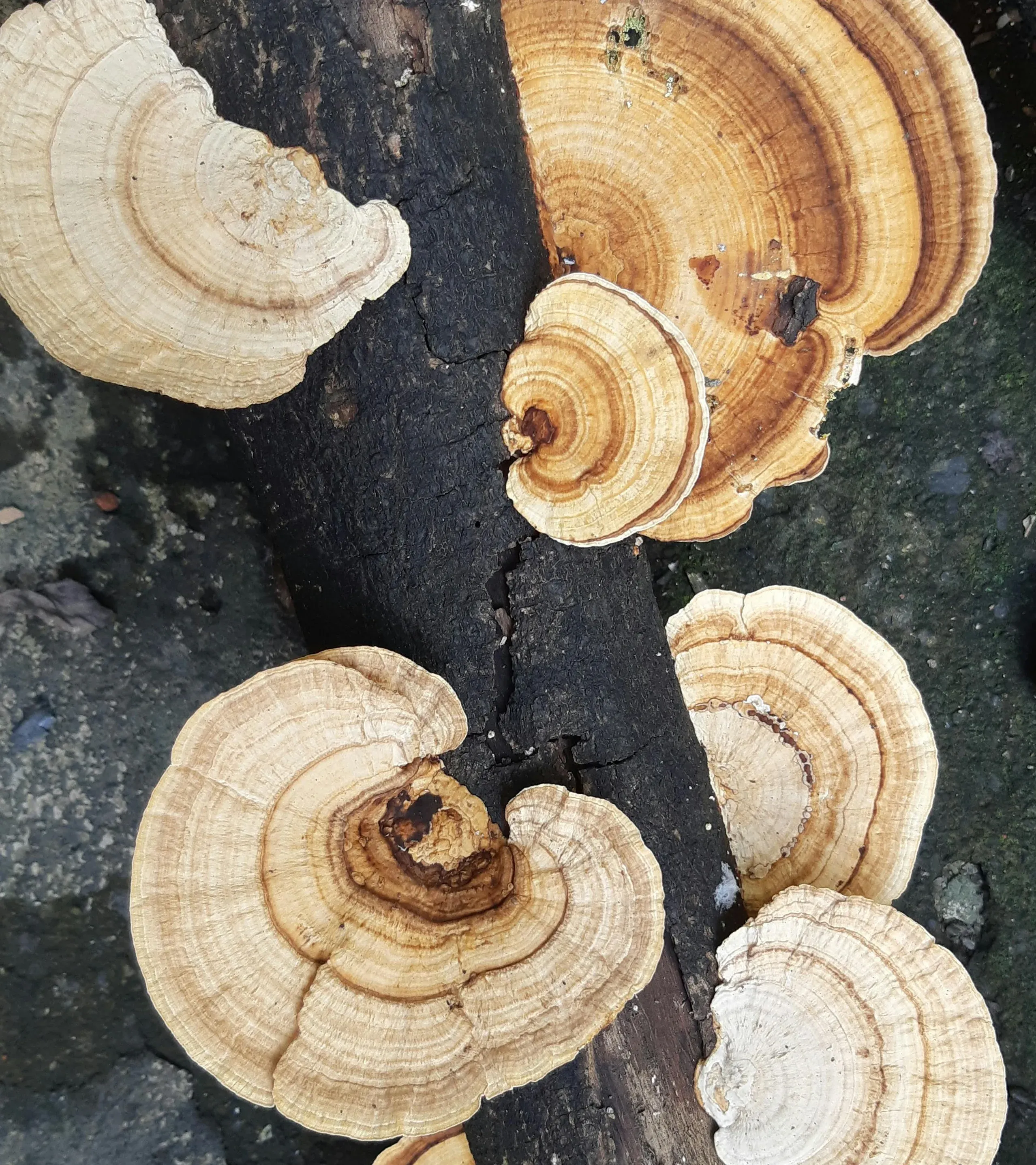
Turkey Tail
Trametes versicolor
Also known as: Kawaratake, Yun Zhi, Cloud Mushroom, Many-Zoned Polypore
Quick Reference
- Difficulty
- Easy (2/5)
- Days to harvest
- 14–21 days
- Yield per 5lb block
- 0.6–1.0 lbs per 5 lb block (2–3 flushes)
- Fruiting temp
- 65–75°F
- Humidity
- 85–95%
- Use
- Medicinal
- Best substrates
- Hardwood sawdust (oak, beech, birch), Supplemented sawdust (10-20% wheat bran), Hardwood logs (oak, maple), Hardwood woodchips
- Growing methods
- kit · bag · log · outdoor-bed
Contents
- Why grow turkey tail
- Turkey tail mushroom substrate
- How to grow turkey tail mushrooms
- Turkey tail fruiting conditions
- Harvesting turkey tail mushrooms
- Turkey tail flavor and culinary uses
- Common turkey tail growing problems
- Where to buy turkey tail spawn
- Equipment for growing turkey tail
- Related guides
Why grow turkey tail#
Turkey tail is the most widely researched medicinal mushroom in the world, and it’s one of the easiest to cultivate at home. The mycelium colonizes aggressively, fights off contamination better than most species, and fruits on a wide range of hardwood substrates with minimal fuss. If you’re interested in growing mushrooms specifically for immune support — tea, tinctures, powdered extract — this is the species to start with.
The appeal is almost entirely medicinal. Two protein-bound polysaccharides — PSK (Krestin) and PSP — have been studied extensively in Japan and China for their immunomodulatory and anti-tumor properties, and turkey tail is one of the few mushrooms with clinical trial data behind it. Beta-glucans, triterpenoids, and ergosterol round out the bioactive profile. You’re not growing this for dinner — you’re growing it for the medicine cabinet.
One honest caveat: turkey tail is slow. Compared to blue oysters or lion’s mane, the timeline from inoculation to harvest stretches into months, not weeks. Pins to harvest alone takes 14–21 days, and total time from inoculation on a sawdust block is typically 2–4 months. On logs, expect a year or more before you see your first flush. If you need fast gratification, start with blue oysters and come back to turkey tail once you’ve calibrated your patience.
Turkey tail mushroom substrate#
Turkey tail is a white-rot fungus that strongly prefers hardwoods. It’ll colonize a surprisingly wide range of lignocellulosic materials, but performance varies significantly by substrate density and nitrogen content.
Hardwood sawdust — oak, beech, or birch — is the standard for indoor production. Supplementing with 10–20% wheat bran or rice bran increases nitrogen levels and pushes yields higher, though it also raises contamination risk if your sterilization isn’t thorough. For outdoor grows, freshly cut hardwood logs are the traditional choice, and woodchip beds work for a more passive, garden-integrated approach.
- Hardwood sawdust (oak, beech, birch) — the industry standard for controlled medicinal production. Clean, consistent, and well-documented in both academic and commercial literature.
- Supplemented sawdust — sawdust plus 10–20% wheat bran or rice bran. Higher yields than plain sawdust, but requires reliable sterilization to avoid bacterial contamination from the added nitrogen.
- Hardwood logs (oak, maple) — the traditional outdoor method. Slower to produce but can fruit for 3–5 years with minimal maintenance.
- Hardwood woodchips — viable for outdoor bed culture. Lower yields and more prone to competition from wild fungi, but essentially free if you have access to a tree service or arborist.
Straw is not a good substrate for turkey tail. Unlike oyster mushrooms, which thrive on straw, turkey tail needs the lignin-rich structure of hardwood to produce well-formed, zoned fruiting bodies.
When you’re ready to weigh out your own batches, the substrate calculator can help with supplemented sawdust ratios.
How to grow turkey tail mushrooms#
Turkey tail works well across four methods — from zero-effort kits to multi-year log cultivation. The method you pick depends on whether you want fast results indoors or a long-term outdoor supply.
Growing turkey tail from a kit#
Best for: absolute beginners, first-time medicinal growers.
- Order a pre-colonized turkey tail grow kit from North Spore or another supplier with turkey tail kits in stock.
- Cut an X or a few slits in the bag per the kit instructions.
- Mist the cut areas 2–3 times daily — turkey tail needs high humidity (85%+) to pin.
- Place in indirect light at 65–75°F with decent airflow.
- Pins should appear within 2–4 weeks of opening the kit.
- Harvest when the concentric color zones are fully formed and the white growing edge has stopped advancing — typically 14–21 days after pinning.
Expect total time from opening the kit to first harvest of 4–6 weeks. Kits are the fastest path to turkey tail, but yields are modest.
Turkey tail bag culture#
Best for: growers ready to invest in sterilization equipment and produce meaningful quantities for processing into tea or extract.
- Mix hardwood sawdust pellets with 10–20% wheat bran and hydrate to approximately 60% moisture.
- Load into filter-patch grow bags (Unicorn 14A or similar).
- Pressure sterilize at 15 PSI for 2.5 hours in a pressure cooker.
- Cool overnight, then inoculate with grain spawn in front of a flow hood or still-air box.
- Incubate at 75–77°F. Colonization takes 4–8 weeks — significantly longer than oyster species.
- Once fully colonized, cut slits or remove the top of the bag and move to a humid fruiting environment. Several experienced growers on r/MushroomGrowers report that top-fruiting — exposing the top surface of the block rather than cutting side slits — produces denser, higher-yielding flushes.
- Maintain 85–95% humidity, 65–75°F, and moderate fresh air exchange until fruiting bodies mature.
Expect total time from inoculation to first harvest of 2–4 months. This is the most practical method for producing enough turkey tail to process into powder or extract.
Turkey tail mushroom logs#
Best for: outdoor growers who want a multi-year supply with minimal ongoing effort.
- Source fresh-cut hardwood logs — oak and maple are ideal. Logs should be 3–8 inches in diameter and 3–4 feet long, cut within the last 2–6 weeks (live sapwood, no decay yet).
- Drill holes in a diamond pattern, spaced 4–6 inches apart, using an 8.5mm bit with a stop collar.
- Pack each hole with sawdust spawn or tap in plug spawn.
- Seal every inoculation site with cheese wax or beeswax to lock in moisture and block competitor fungi.
- Stack logs in a shaded, humid location — leaning against a fence or stacked in a crib pattern.
- Keep logs moist during dry spells. A sprinkler on a timer or shade cloth helps in hot climates.
- Wait. Colonization takes 6–12 months depending on log diameter and temperature.
Expect first fruiting 1–2 years after inoculation. Once producing, logs can fruit for 3–5 years with little maintenance beyond occasional watering. Field & Forest Products has the most detailed published guide for log inoculation of turkey tail specifically.
Outdoor turkey tail beds#
Best for: gardeners and permaculture-oriented growers who want turkey tail integrated into their landscape.
- Choose a shaded area with good drainage — under trees or along a north-facing fence.
- Layer fresh hardwood woodchips 4–6 inches deep in the bed.
- Mix grain spawn into the woodchip layer at roughly a 1:10 ratio (spawn to chips by volume).
- Top with a thin layer of plain woodchips and water thoroughly.
- Keep moist — the bed should never dry out completely.
Outdoor beds are the lowest-effort method but also the least predictable. Wild Trametes strains and other fungi will compete for the substrate, and yields are lower than controlled indoor methods. Think of beds as a supplemental source, not your primary supply.
Turkey tail fruiting conditions#
Turkey tail is more adaptable than most cultivated species, but it still has preferences — and getting the details right is the difference between thin, pale shelves and the thick, vividly zoned fruiting bodies you’re after.
Temperature. Fruit at 65–75°F for the best results. Turkey tail is flexible here — some strains will fruit as low as 50°F — but growth slows significantly at the extremes. Colonization runs optimally at 75–77°F. If your fruiting area regularly exceeds 80°F, expect thinner, faster-growing shelves with less-developed concentric zoning.
Humidity. This is the critical parameter. Keep humidity at 85–95% during fruiting, and push toward 90%+ during pin formation. Turkey tail’s thin, bracket-like fruiting bodies dry out faster than the chunky clusters of oyster or lion’s mane. If humidity drops below 80%, pins stall or abort. A Martha tent with a humidifier on a timer is the most reliable setup; for a single block or kit, a humidity tent made from a clear plastic bag with holes punched in it works in a pinch.
Fresh air exchange. Moderate — not as demanding as blue oysters, but stagnant air causes problems. Turkey tail grows as thin shelves, not dense clusters, so CO2 buildup manifests as abnormally elongated or curled growth rather than the “leggy stems” you’d see on oysters. A fan running 15 minutes per hour — as recommended by several YouTube growers — is a reasonable starting point for a tent or chamber setup.
Light. Turkey tail benefits from indirect light or a 12/12 cycle. Light helps trigger primordia formation and influences the development of the characteristic concentric color bands. Total darkness produces pale, poorly zoned fruiting bodies.
Harvesting turkey tail mushrooms#
When to harvest. Turkey tail is ready when the concentric color zones are fully developed and the white growing edge at the margin has stopped advancing. Unlike gourmet mushrooms where you’re racing to pick before caps open, turkey tail gives you a wider harvest window — the fruiting bodies don’t degrade as quickly once mature. That said, don’t leave them indefinitely; old brackets get tough and leathery even by turkey tail standards, and the bioactive compound concentration is highest in fresh, actively growing tissue.
How to harvest. Use a sharp knife or scalpel to cut the brackets off at the base where they meet the substrate. Turkey tail is thin and fibrous — twisting doesn’t work the way it does with oyster clusters. Cut cleanly to avoid damaging the mycelium underneath, which needs to stay intact for subsequent flushes.
Yield. Expect 0.6–1.0 lbs of fresh mushrooms per 5 lb fruiting block across 2–3 flushes. Academic studies report biological efficiency around 12–13% for unoptimized setups; commercial growers with dialed-in supplementation and environmental control push that to 30–50% BE. The first flush produces the bulk of total yield. These numbers are lower than gourmet species like oysters or shiitake — turkey tail produces thin, lightweight brackets, not dense clusters.
Triggering subsequent flushes. After harvesting the first flush, soak the block in cold water for 6–12 hours, drain, and return to the fruiting environment. Allow 2–3 weeks between flushes. Most blocks produce 2–3 flushes before the substrate is spent.
Processing after harvest. Since turkey tail isn’t eaten whole, you’ll want to dry it immediately. Air-dry on a mesh rack in a well-ventilated area, or use a food dehydrator at 95–115°F until the brackets snap cleanly. Once dried, grind to a fine powder in a blender or coffee grinder. One tip from Willows Green Permaculture: blend dried turkey tail with a handful of whole grains (rice, oats) to keep the lightweight pieces from flying around the blender container.
Turkey tail flavor and culinary uses#
Turkey tail is not a culinary mushroom in the traditional sense. The fruiting bodies are thin, leathery, and fibrous — even after extended cooking, they remain too tough to eat as a whole food. The flavor is mild, slightly sweet, and faintly mushroomy, with a woody quality that comes through more as aroma than taste.
Primary use: tea and extract. Simmer dried turkey tail pieces or powder in hot water for 20–60 minutes to extract the water-soluble polysaccharides (beta-glucans, PSK, PSP). The longer you simmer, the more you extract. The resulting tea has a mild, earthy flavor that takes well to ginger, honey, or lemon. For a more concentrated preparation, dual extraction — hot water followed by alcohol — pulls both the water-soluble and alcohol-soluble compounds (triterpenoids, sterols). Tincture-making is straightforward: soak dried, ground turkey tail in high-proof alcohol for 4–6 weeks, strain, and combine with the water extract.
Medicinal profile. Turkey tail’s bioactive compounds are among the most clinically studied in the mushroom world. PSK (Polysaccharide-K, also called Krestin) has been used as an adjunct cancer therapy in Japan since the 1970s. PSP (Polysaccharide Peptide) is its Chinese counterpart with similar immunomodulatory research behind it. Beta-glucans stimulate innate immune response. Research suggests these compounds support immune function — but “research suggests” is the honest framing here, not “cures” or “treats.” If you’re growing turkey tail for health reasons, the evidence is encouraging but not a substitute for medical advice.
Storage. Dried turkey tail in airtight jars with a desiccant packet keeps indefinitely. Ground powder should be stored the same way. Let dried pieces or powder cool completely before sealing — trapped warmth creates condensation that leads to mold.
Common turkey tail growing problems#
Extremely slow colonization#
Turkey tail colonizes more slowly than oyster species, and first-time growers often mistake normal pace for a problem. Full colonization of a 5 lb sawdust block takes 4–8 weeks — compared to 2–3 weeks for blue oysters. If you’re seeing no visible growth after 3 weeks at 75°F, check that your spawn was viable and your substrate moisture is in the 55–65% range. Otherwise, patience is the fix.
Thin, pale fruiting bodies with poor zoning#
Insufficient light or humidity below 85%. Turkey tail’s signature concentric color bands develop in response to light cycles and consistent moisture. Fruiting in darkness or dry conditions produces washed-out, poorly differentiated brackets. Move to indirect light on a 12/12 cycle and verify humidity is above 85%.
Pins form but stall or abort#
Humidity dropped during pin formation — turkey tail’s thin brackets are especially vulnerable to drying out at this stage. Push humidity to 90%+ until pins develop into recognizable shelves. A fine mist spray bottle helps, but a humidifier on a timer is more reliable.
Top of block fruits but sides won’t#
This is actually the species telling you what it prefers. According to several growers on r/MushroomGrowers, turkey tail produces denser, higher-quality fruiting bodies when allowed to top-fruit rather than being forced to fruit through side slits. If your bag-culture blocks are only fruiting from the top, lean into it — remove the top of the bag entirely and let the whole surface fruit.
Competition from wild fungi on outdoor logs or beds#
Turkey tail is a common wild species, and outdoor setups attract competing Trametes strains and other polypores. This is more of a nuisance than a disaster — your inoculated strain may get outcompeted in patches, but it won’t contaminate your harvest. Ensure logs are freshly cut (not already colonized by wild fungi) and sealed properly after inoculation.
Where to buy turkey tail spawn#
Two suppliers in our directory carry turkey tail cultures and spawn.
North Spore offers liquid culture and plate culture for turkey tail with certified organic, lab-verified genetics. Their cultures are clean and vigorous, and their educational content — blog and YouTube — covers turkey tail identification and growing in detail. Pricing is mid-to-premium, but the quality and support justify the cost for growers who want reliable genetics.
Out-Grow carries turkey tail liquid culture and grain spawn at competitive prices. They’re a good fit for budget-conscious growers or anyone looking to scale up production without paying premium rates. The experience is more utilitarian — less hand-holding, more product — which is exactly what some growers prefer.
A few suppliers we’d recommend that aren’t yet in the directory: Field & Forest Products is the industry standard for plug spawn and log inoculation — if you’re doing outdoor log culture, start there. Mushroom Mountain (Tradd Cotter’s brand) offers grain spawn, plug spawn, and agar cultures with a focus on ecological restoration and mycoremediation. Fungaia Farm specializes in Pacific Northwest genetics for outdoor growers. All three are on our shortlist to add as full directory entries — check back as the supplier index expands.
Equipment for growing turkey tail#
For kit growing, you need a fine-mist spray bottle and a digital hygrometer — nothing else.
For bag culture, you’ll need a pressure cooker for sterilization (the Presto 23-quart is the standard beginner choice), filter-patch grow bags, an impulse sealer, and either a flow hood or still-air box for clean inoculation. A Martha tent or similar humidity chamber makes fruiting significantly more consistent than open-air misting.
For log culture, the essential tools are a drill with an 8.5mm bit and depth stop, a palm-style inoculator for packing sawdust spawn (or a hammer for plug spawn), cheese wax or beeswax, and wax daubers. Field & Forest Products sells a complete log inoculation tool kit if you’d rather buy it bundled.
Universal essentials regardless of method: a digital hygrometer, 70% isopropyl alcohol for sterilizing surfaces and tools, and a sharp harvest knife or scalpel — turkey tail’s leathery texture requires a clean cut. For processing, a food dehydrator and a blender or coffee grinder for making powder.
Related guides#
- How to Grow Mushrooms at Home — Beginner Guide
- Substrate Calculator — for supplemented sawdust ratios
- Pressure Cooker Buying Guide — sterilization for bag culture
- Oyster Mushroom Growing Guide — if you want a faster-growing species while your turkey tail colonizes
- Shiitake Growing Guide — another log-friendly medicinal species