Lion's Mane
Hericium erinaceus
Also known as: Bearded tooth mushroom, Pom pom mushroom, Yamabushitake, Hou tou gu, Monkey's head, Hedgehog mushroom
Quick Reference
- Difficulty
- Easy (2/5)
- Days to harvest
- 7–14 days
- Yield per 5lb block
- 0.75–1.5 lbs per 5 lb block (2–3 flushes)
- Fruiting temp
- 59–68°F
- Humidity
- 85–95%
- Use
- Culinary + Medicinal
- Best substrates
- Supplemented hardwood sawdust, Master's Mix (hardwood + soy hull pellets), Hardwood sawdust + wheat bran, Straw-sawdust blend, Hardwood logs
- Growing methods
- kit · bag · log · bucket
Contents
- Why grow lion's mane
- Lion's mane mushroom substrate
- How to grow lion's mane mushrooms
- Lion's mane fruiting conditions
- Harvesting lion's mane mushrooms
- Lion's mane flavor and culinary uses
- Common lion's mane growing problems
- Where to buy lion's mane spawn
- Equipment for growing lion's mane
- Related guides
Why grow lion’s mane#
Lion’s mane is the gourmet mushroom with the most interesting story. It tastes like crab or lobster when cooked — genuinely, not in the vague way every mushroom gets compared to seafood — and it’s the only cultivated species with published research on its neurotrophic compounds. The compounds that make it interesting medicinally (erinacines in the mycelium, hericenones in the fruiting body) are documented to stimulate Nerve Growth Factor synthesis in lab studies, and the culinary pay-off is a dense, fibrous, shellfish-like texture you can’t get from any other mushroom we cover. That combination of flavor and bioactivity is what keeps people growing it.
It’s the natural second species after blue oyster. Once you’ve gotten comfortable with kits or bucket tek on oysters, lion’s mane is the logical next step: same basic equipment, similar prep, different fruiting behavior. It grows on the same supplemented hardwood substrates, colonizes in the same temperature range, and works in kits, bags, buckets, or on logs. First harvests from a kit typically come in 14–21 days — fast enough to stay engaging.
One honest caveat: vendor marketing tends to call lion’s mane “beginner friendly,” and hobbyists who’ve grown it consistently disagree. It’s not hard in the same way morels are hard — you’ll almost certainly get mushrooms — but it’s finickier than blue oyster about humidity and fresh air exchange, and the most common failure mode isn’t no harvest, it’s weird harvest. Instead of dense pom-poms, you get thin coral-like branches or browning teeth, both of which are environmental problems that are hard to diagnose without knowing what to look for. We cover those failure modes in Common problems and tell you what to fix.
Lion’s mane mushroom substrate#
Lion’s mane is a wood-decomposing species, and it strongly prefers supplemented hardwood. Unlike blue oyster, it does not do well on straw alone — you’ll get something, but the fruiting bodies will be small, thin, and underdeveloped. The reason is nitrogen: lion’s mane needs more nitrogen than pure straw or pure sawdust provides, which is why every serious substrate recipe adds either wheat bran, soybean hulls, or soy meal.
For sterilized bag culture, Master’s Mix is the default — it’s the same 50/50 hardwood pellet / soy hull pellet blend used for oysters, and published studies on H. erinaceus biological efficiency report yields on optimized supplemented substrates ranging from roughly 70% to 88% BE. The soy hulls aren’t optional — they’re where the nitrogen comes from. If you can’t source soy hull pellets, the fallback is hardwood sawdust supplemented with 10–20% wheat bran, which gets you most of the way there.
- Supplemented hardwood sawdust — oak, beech, or maple plus 10–20% wheat bran. The most cited substrate in research literature and the commercial standard in Asia.
- Master’s Mix — 50/50 hardwood fuel pellets and soy hull pellets. Easiest to source in the US (Lowes and Tractor Supply carry both), and the highest-yielding option for home sterilized bag culture.
- Hardwood sawdust + soy hull pellets — a middle-ground blend. Slightly more work than pure pellets but produces dense, well-formed fruiting bodies.
- Straw-sawdust blend — straw can replace up to 40% of the sawdust without major yield loss. Useful if sawdust is expensive locally.
- Hardwood logs — oak, beech, or sugar maple. The traditional outdoor method. Slower to fruit than bags but produces for several years from one inoculation.
Avoid straw alone. It’s the single most common substrate mistake. Straw has enough carbon but not enough nitrogen for lion’s mane to build dense fruiting bodies, and you’ll end up with undersized, coral-like growth. If you’ve only got straw on hand, supplement it heavily with bran or mix it with sawdust — don’t use it pure.
When you’re ready to weigh out your own batches, the substrate calculator pre-fills for masters mix.
How to grow lion’s mane mushrooms#
Lion’s mane works with kits, bag culture, bucket tek, and log inoculation. We don’t recommend monotub tek for this species — like blue oyster, it needs more fresh air exchange than a sealed tub provides, and you’ll get coral-like deformed growth instead of proper pom-poms.
Growing lion’s mane from a kit#
Best for: absolute beginners, first-time growers, anyone who wants harvest in three weeks with no substrate prep.
- Order a pre-colonized lion’s mane kit from North Spore or Out-Grow.
- Cut a small X or a single 2-inch slit through the plastic on the side of the bag — lion’s mane fruits best from smaller openings than oysters.
- Mist the cut area lightly with a fine spray bottle two to three times a day. Mist the air around the opening, not the developing fruit body directly — more on that in Fruiting conditions.
- Stand the bag upright in indirect light at 60–68°F.
- First pins appear in 5–10 days. They look like small white nubs, then elongate into spiny balls.
- Harvest by cutting the cluster off at the base with a sharp knife just before the teeth begin to brown or release spores.
Expect first pins in about a week and total time to harvest of 14–21 days from opening the kit. Most kits will give you 2–3 flushes before the block is spent.
Lion’s mane bag culture#
Best for: growers ready to invest in sterilization equipment and chase consistent yields on their own substrate.
- Mix 50% hardwood fuel pellets, 50% soy hull pellets, and water to roughly 60–65% moisture.
- Load filter-patch grow bags (Unicorn 14A or 3T are the standards).
- Pressure sterilize at 15 PSI for 2.5 hours in a pressure cooker.
- Cool overnight, then inoculate with grain spawn in front of a flow hood or still-air box.
- Incubate at 68–77°F until the block is fully colonized. Lion’s mane mycelium looks wispy and thin, not the dense cotton-white you’re used to from oysters. Many first-time growers throw out healthy blocks thinking they’re uncolonized or contaminated. Give it the full colonization period before judging.
- Cut a 2-inch slit in the bag and move the block to a humid fruiting environment with strong FAE.
Expect colonization in 14–21 days, pinning within 5–7 days after introducing fresh air, and first harvest 7–14 days after pinning.
Lion’s mane bucket tek#
Best for: growers who want to skip the pressure cooker step. Higher contamination risk, lower ceiling on yield — but genuinely achievable.
- Mix supplemented hardwood sawdust (or Master’s Mix) and hydrate to around 60% moisture. Squeeze-test: a few drops come out when you squeeze, no more.
- Mix grain spawn through the substrate at a 5:1 substrate-to-spawn ratio as you pack it into a food-grade 5-gallon bucket.
- Drill quarter-inch holes in a grid pattern on the sides of the bucket before packing.
- Cover the holes with micropore tape during colonization.
- Once fully colonized (2–4 weeks), peel off the tape over a few holes and move to a humid, well-ventilated area.
- Mist the air around the holes twice daily until fruiting bodies emerge from them.
The bucket method is popular with growers who’ve seen bucket tek videos from channels like Folk Fungi and want to avoid pressure sterilization. It works, but contamination risk is meaningfully higher than bagged sterile culture.
Lion’s mane log inoculation#
Best for: growers with access to fresh-cut hardwood logs and patience.
- Source fresh-cut oak, beech, or sugar maple logs, 3–6 inches in diameter and 3–4 feet long. Logs should be dormant-season cut and used within 2–6 weeks of felling.
- Drill a grid of holes spaced about 6 inches apart along the log using an 8.5mm drill bit with a depth stop.
- Pack plug spawn or sawdust spawn into each hole.
- Seal each hole with melted cheese wax or food-grade paraffin to retain moisture and block contaminants.
- Stack logs in a shaded, humid area — under trees, against a north-facing wall, or in a greenhouse with regular misting.
- First fruiting typically comes in 6–12 months. Logs will fruit one to two times a year for 3–6 years from one inoculation.
Log cultivation is slower than any other method but produces excellent-flavored fruiting bodies and requires almost no ongoing work after inoculation. If you’ve got a shaded yard and a few hardwood logs, it’s the lowest-effort long-term option.
Lion’s mane fruiting conditions#
Lion’s mane has the narrowest fruiting temperature range of any species we cover, and the tightest humidity and FAE balance. This is why hobbyists find it finickier than the vendor guides suggest — it’s not that you can’t grow it, it’s that the acceptable range for good growth is narrower than for oysters.
Temperature. Target 59–68°F (15–20°C) during fruiting. Standard commercial strains fruit poorly above 70°F — fruiting bodies come out thin, pale, and underdeveloped. A few warm-tolerant isolates (He-Denizli, He-Erkel) can fruit effectively at 77°F according to a 2021 study by Atila et al., but these are research strains and not what you’ll get from most suppliers. For anyone growing in an indoor space during summer, the fruiting temperature constraint is usually the binding one — a cool basement or a climate-controlled grow tent is almost required.
Humidity. Keep humidity at 85–95% during fruiting. Below roughly 80%, the long “teeth” (the spines that give lion’s mane its appearance) dry out and brown before they finish developing. Above roughly 95%, standing water collects on the fruit body and causes soft rot. The sweet spot is high ambient humidity with no direct water contact — which leads to the most important handling rule for this species.
Do not mist directly onto the fruit body. Water droplets that land on the developing teeth cause immediate browning, and growers consistently report that direct misting is the #1 cause of cosmetically ruined harvests. Mist the environment — the walls of the chamber, the floor, the air around the bag — not the mushroom itself. If you’re using a humidity tent, make sure the bag or plastic doesn’t touch the fruit body; skewers are the standard trick for keeping tenting propped off the growing mushroom. Some growers design their fruiting chambers so humid air enters from the bottom and exhausts at the top, which keeps condensation from settling on the fruit surface.
Fresh air exchange. This is the second biggest failure point, and it’s where the “beginner friendly” framing breaks down. Lion’s mane is more CO2-sensitive than oysters — high CO2 during fruiting produces the “coral growth” failure mode where fruiting bodies come out as thin branching antlers instead of dense pom-poms. High CO2 is fine during incubation (up to 40,000 ppm, per a Southwest Mushrooms technical breakdown), but once pins form you need real airflow — ideally an inline fan on a timer pulling fresh air through the chamber for a few minutes every hour. Manual fanning is rarely enough.
Light. Indirect natural light or a low-wattage LED on a 12-hour cycle is sufficient. Total darkness produces malformed fruiting bodies; direct sun dries the teeth out.
An optional trick: the slap technique. In nature, H. erinaceus often fruits after physical trauma — a tree falling, a branch cracking — which may be why some growers find that giving a stubborn colonized block a firm slap, or dropping it a few inches onto a table, triggers a stronger fruiting response. GroCycle’s lion’s mane guide lists it alongside cold shock as a way to encourage fruiting. It’s not essential, and we haven’t seen it validated in peer-reviewed literature — file it under “worth trying if your block is slow to pin.” Cold shock has stronger community backing and is covered under Harvest and yield.
Harvesting lion’s mane mushrooms#
When to harvest. Harvest lion’s mane when the teeth are fully elongated — hanging like long icicles from the fruit body — but before they start to brown at the tips or release visible white spore dust. The window is narrower than with oysters: wait too long and the teeth turn yellow or brown, which is usually mistaken for contamination but is actually just over-maturity. A light yellow tint on the tips is the warning sign. Harvest that day.
How to harvest. Cut the cluster off at the base with a sharp knife. Don’t twist — lion’s mane attaches more firmly to the substrate than oysters, and twisting can tear the substrate and invite contamination into the next flush.
Yield. Expect 0.75–1.5 lbs of fresh mushrooms per 5 lb fruiting block, spread across 2–3 flushes. Biological efficiency on supplemented hardwood substrates typically lands between 70% and 88% according to published research on optimized commercial protocols. Most of the yield comes from the first flush; second and third flushes shrink noticeably.
Triggering the second flush with cold shock. After harvesting the first flush, place the block in the refrigerator for 24–48 hours. This is a consistent community-backed technique — it simulates a cold-weather fruiting trigger and reliably produces stronger second flushes than simply waiting. After the cold shock, return the block to fruiting conditions and soak it briefly (no more than 5–10 minutes; lion’s mane blocks fall apart if soaked like oyster blocks). A second flush typically appears within 7–14 days.
Lion’s mane flavor and culinary uses#
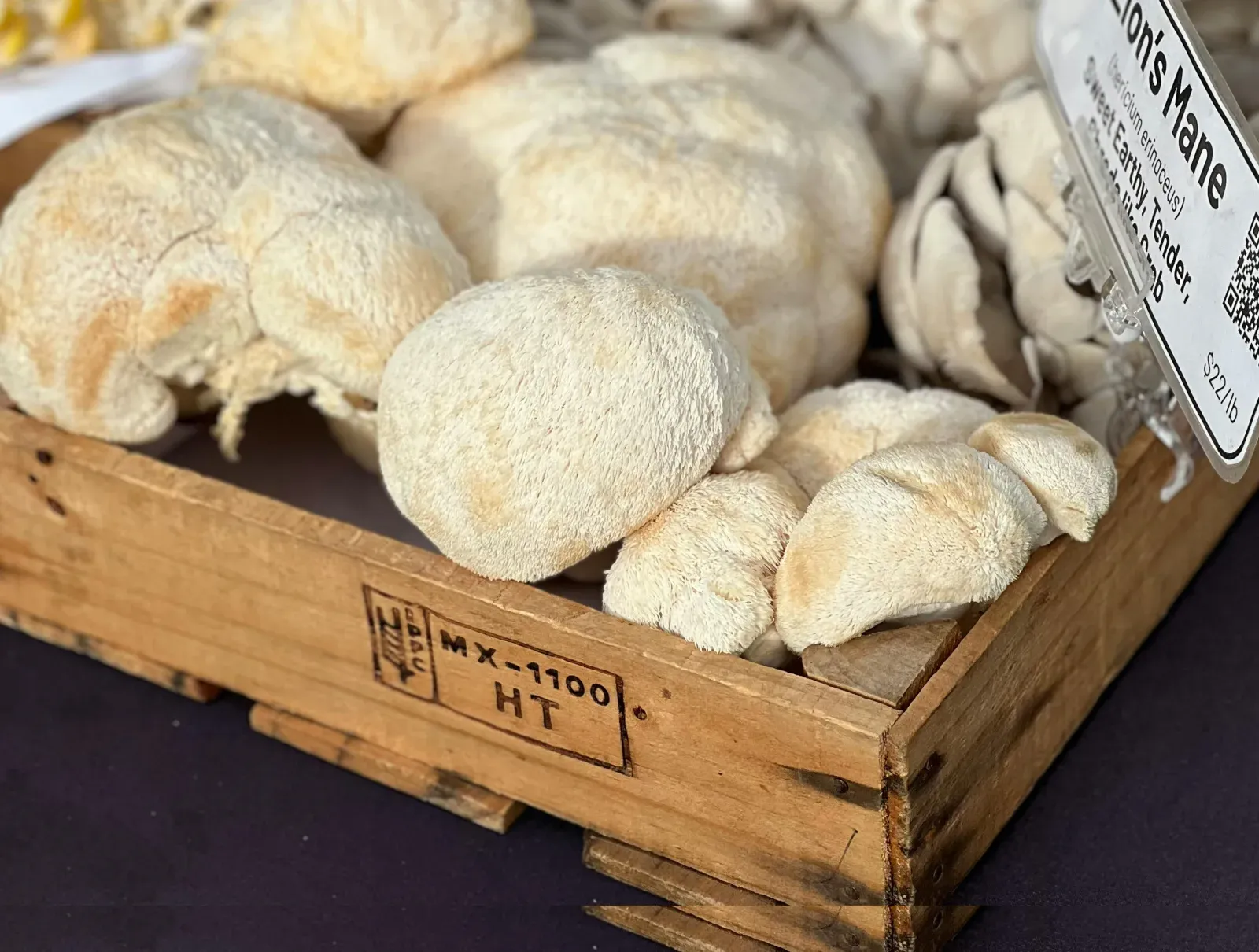
Lion’s mane tastes like seafood. Specifically, like lump crab meat or cooked lobster — not in the way many mushrooms vaguely get called “meaty,” but in a direct, umami-rich, shellfish-like way. The high concentrations of glutamic and aspartic acids in the fruiting body generate the strong umami signature, and detailed flavor profiling identifies volatile aroma compounds that contribute to the characteristic sweet-savory profile. Raw, it has a mild, slightly sweet smell. Cooked, it turns firm, fibrous, and scallop-like — the closest any mushroom gets to actual shellfish texture.
A quick taxonomic note: the common name “lion’s mane” is sometimes applied loosely to Hericium coralloides (coral tooth) and Hericium americanum (bear’s head tooth), which are closely related species with similar culinary properties. They are not the same mushroom. This guide covers Hericium erinaceus specifically — the true lion’s mane — which is what nearly all commercial spawn listings refer to. If you see a supplier selling “bear’s head tooth” or “coral tooth,” those are the siblings, and while they’re both delicious, their fruiting behavior differs enough that the growing protocols here don’t all translate cleanly.
Best cooking methods. Dry-sear in a hot pan first (no oil) to drive off moisture, then finish in butter. This is the single cooking technique that best brings out the crab-like texture. Lion’s mane is also excellent breaded and pan-fried as “crab cakes” or “scallop” substitutes — this is the most popular use in vegan and vegetarian cooking, and it works because the texture is genuinely that close. Avoid boiling or steaming; both turn it rubbery.
Medicinal value. H. erinaceus is studied for its production of erinacines and hericenones — compounds documented to stimulate Nerve Growth Factor synthesis and cross the blood-brain barrier in preclinical research. Additional studies suggest gastroprotective effects from the β-glucans in the fruiting body. This is early-stage research, not medical advice — treat the medicinal angle as a bonus rather than the reason to grow it. The fruiting body contains the hericenones; the mycelium contains the erinacines, which is why most commercial lion’s mane supplements are sold as dual-extracts covering both.
Storage. Fresh in the fridge: 5–7 days in a paper bag (plastic accelerates browning). Dried in airtight jars with desiccant: indefinitely. Lion’s mane dries well and reconstitutes quickly in warm water, retaining most of its texture. For long-term medicinal use, a dual alcohol-and-hot-water extract captures both the water-soluble β-glucans and the fat-soluble terpenoids.
Common lion’s mane growing problems#
Coral-like branching instead of dense pom-poms#
The CO2 failure mode, and the #1 complaint in r/MushroomGrowers threads about lion’s mane. Fruiting bodies come out as thin, antler-like branches instead of round, dense balls. The fix is more fresh air exchange during fruiting — an inline fan on a timer is almost always necessary. This r/MushroomGrowers thread shows several growers working through this exact problem.
Browning or yellowing teeth#
Usually mistaken for contamination. The cause is either (a) direct water landing on the developing fruit body from over-enthusiastic misting, or (b) humidity dropping below roughly 80%, drying the teeth out before they finish forming. Fix both: mist the environment, not the mushroom, and verify your hygrometer is accurate at the fruit body’s location — not just at the edge of the tent. This r/mycology thread walks through the diagnosis.
”It’s not colonizing” — but it actually is#
Lion’s mane mycelium is naturally wispy and thin, nothing like the dense cottony growth of oyster mycelium. Many first-time growers dump healthy blocks assuming they’re uncolonized or contaminated. Give it the full 14–21 day incubation period before judging, and watch for signs of actual contamination (green, black, or orange patches; off smells) rather than just thin-looking mycelium.
Premature pinning inside the bag#
Lion’s mane occasionally forms pins inside the bag before colonization is complete, especially if the block gets bumped or exposed to a sudden temperature drop. These pins are functional — move the block to fruiting conditions early and work with the pins you have. The alternative (waiting and hoping the pins abort) usually doesn’t work and wastes the early fruiting signal.
Inconsistent teeth length#
Growers chasing the long, icicle-like teeth seen in professional photos often end up with short, stubby ones. This is almost always a humidity stability issue — fluctuating between 75% and 95% produces irregular tooth development, while a steady 90%+ produces uniform long teeth. Stable humidity matters more than peak humidity.
Where to buy lion’s mane spawn#
Two suppliers in our directory currently carry lion’s mane spawn, kits, or cultures.
North Spore is the gold standard for growers moving from kits to bulk production. They carry the widest strain selection of any US supplier we’ve tracked — including genetics like “Lion’s Brain,” “WA Lion,” and “Tree Beard” optimized for different climates — and they sell grain spawn, sawdust spawn, plug spawn, liquid culture, plate culture, and Spray & Grow kits. Pricing runs mid-to-premium, and their free shipping threshold ($150) makes small orders expensive. Their YouTube channel doubles as a free growing course.
Out-Grow is the go-to for liquid cultures and DIY-focused growers. They offer a “Warm Weather” lion’s mane strain for growers in climates where cooling is impractical, and their prices on syringes and plate culture are consistently the best value for lab-comfortable growers.
A few suppliers we’d recommend if you need something the above two don’t carry: Field & Forest Products is the standard for plug spawn if you want to inoculate logs, and they stock both H. erinaceus and H. coralloides. Cascadia Mushrooms makes USDA Certified Organic kits that are the most beginner-friendly entry point we’ve found if you want a guaranteed first grow. Liquid Fungi has the best price-to-quality ratio on liquid cultures for growers doing their own lab work. Grow Mushrooms Canada is the best option for Canadian residents, with 4 lb+ kit blocks that outyield most US kits. All four are on our shortlist to add as full directory entries — check back as the supplier index expands.
Equipment for growing lion’s mane#
For kit growing, you don’t need anything beyond a fine-mist spray bottle and a hygrometer.
For bucket tek, you’ll need a food-grade 5-gallon bucket, a power drill with a quarter-inch bit, micropore tape, and grain spawn from a reputable supplier.
For bag culture, the substrate sterilization step requires a pressure cooker — the Presto 23-quart is the standard beginner choice, and the All American 921 is the long-term workhorse upgrade. You’ll also need filter-patch grow bags (Unicorn 14A or 3T), an impulse sealer, and either a flow hood or a still-air box for clean inoculation.
For log inoculation, you’ll need an 8.5mm drill bit with a depth stop, plug spawn or sawdust spawn, cheese wax or food-grade paraffin, and a heat source to melt the wax.
A few universal essentials regardless of method: a digital hygrometer (lion’s mane’s humidity window is tight enough that a cheap, inaccurate one will cost you harvests), 70% isopropyl alcohol for sterile work, and a sharp harvest knife — twisting damages the fruit body on this species more than on oysters. For any indoor grow beyond a single kit, an inline fan on a timer is the single highest-impact piece of equipment you can add. It’s the fix for coral growth, and the reason experienced hobbyists consistently out-grow vendor kit instructions.
Related guides#
- Oyster Mushroom Growing Guide — the easier first species family if lion’s mane feels ambitious
- Shiitake Growing Guide — the other gourmet species well-suited to log cultivation
- Substrate Calculator — pre-fill for Master’s Mix or supplemented sawdust
- Pressure Cooker Buying Guide — sterilization for bag culture
- How to Grow Mushrooms at Home — Beginner Guide