King Stropharia
Stropharia rugosoannulata
Also known as: Wine Cap, Garden Giant, Wine-red Stropharia, Burgundy Mushroom, Godzilla Mushroom
Quick Reference
- Difficulty
- (1.5/5)
- Days to harvest
- 5–10 days
- Yield per 5lb block
- About 1 lb per square foot per year in an established outdoor bed
- Fruiting temp
- 50–70°F
- Humidity
- 85–95%
- Use
- Culinary + Medicinal
- Best substrates
- Hardwood woodchips, Cereal straw, Straw + woodchip blend, Cardboard
- Growing methods
- outdoor-bed · bag
Contents
Why grow wine cap (king stropharia)#
If you have a shaded patch of yard and a bag of hardwood chips, you can grow king stropharia. It’s the lowest-effort entry into outdoor mushroom cultivation we cover — no sterile work, no pressure cooker, no grow tent. You scatter sawdust spawn into a layered woodchip-and-straw bed, water it during dry spells, and a single inoculation will keep producing for two to four years. The mushrooms themselves are large, photogenic, and culinarily useful, and the mycelium does double duty as a soil-builder and nematode predator in vegetable beds and chicken runs.
It is not a fast indoor mushroom. King stropharia isn’t a kit-on-a-counter species — it wants soil contact, ground-level humidity, and the gradual temperature cycling of a real outdoor environment. Indoor and bag-based attempts work, but the species was selected by gardeners and permaculturists, not bag culture growers, and that’s the context where it earns its “Garden Giant” reputation.
The honest caveat: this species has a well-known split personality. Hobbyists call it the easiest mushroom to plant and the hardest to reliably time. Growers report beds with healthy white mycelium sitting for 12 months or more without fruiting, then erupting all at once after a single rainstorm. If you want a guaranteed harvest within three weeks, grow blue oysters. If you want a low-effort patch that pays you back for years, this is the species.
Wine cap mushroom substrate#
King stropharia is a hardwood-loving saprotroph with an unusually broad palate. It will eat almost any cellulose-rich material, but the kind of substrate you use determines how the bed behaves more than whether it produces. Hardwood chips give you a slow, multi-year bed. Straw gives you a faster first flush but a shorter bed life.
A few specifics worth knowing. Conifer chips (pine, cedar, fir) should be avoided or kept under ~10% of the mix — their resins inhibit colonization. If you’re sourcing chips through ChipDrop or a local tree service, specify “no cedar or conifer” in the request notes. Aged chips that have already started to weather are better than fresh — fresh chips can carry aggressive wood-decay fungi that outcompete Stropharia.
- Hardwood woodchips — beech, birch, maple, oak, and poplar are all excellent. The standard outdoor substrate. Aged chips colonize faster than fresh; size 1–3 inches works well.
- Cereal straw — wheat or oat straw. Faster colonization and faster first fruiting than chips, but the bed exhausts in a single season.
- Straw + woodchip blend — the “best of both worlds” approach. Straw drives an early flush while the chips build a multi-year base. This is the most common advice we’ve seen for first beds.
- Cardboard — plain, non-shiny corrugated cardboard works as the bottom moisture-wicking layer of any bed. Avoid glossy printed cardboard; some inks inhibit mycelium.
A study published in the Journal of Fungi reports that king stropharia performs best at a C:N ratio around 40:1, with biological efficiencies between 50% and 100% on straw and woodchip substrates. Fig branches at exactly 40:1 produced 71.7% BE in one trial. You don’t need to engineer the C:N ratio for a backyard bed — but if you’re amending a bed and wondering whether a nitrogen source helps, the answer from the literature is “yes, in moderation.”
When you’re sizing a bed, the substrate calculator can help you estimate how many cubic feet of chips you need for a given square footage.
How to grow wine cap mushrooms#
King stropharia is, first and foremost, an outdoor-bed species. Bag culture is technically possible and a few suppliers sell sawdust spawn intended for indoor use, but the bed is what this species was bred for. Don’t try to grow it in a monotub or a sealed grow tent — the conditions are wrong and there are easier species for those setups.
Growing wine cap mushrooms in a woodchip bed#
Best for: anyone with a shaded outdoor space, raised garden beds, food forests, or chicken runs.
- Pick a shaded site. Dappled or full shade is required — some sources describe king stropharia as “sun-tolerant,” but in practice direct sun dries the bed and kills the mycelium.
- Lay down a base of plain corrugated cardboard as a weed barrier and moisture wick.
- Add a 4-inch layer of soaked hardwood chips (or a chip-and-straw blend).
- Scatter sawdust spawn evenly across the layer — about 5 lbs of spawn per 25 square feet.
- Cover with another 4-inch layer of chips. End with chips, not spawn — exposed spawn dries out and dies.
- Water the bed thoroughly and keep it moist but not waterlogged for the first 4–6 weeks.
- Mulch with extra chips heading into summer to prevent desiccation, and again in fall to protect the mycelium through winter.
Expect first fruiting 2–6 months after inoculation in spring or fall, with subsequent flushes in shoulder seasons for 2–4 years. A well-established bed produces roughly 1 lb per square foot per year according to the Cornell Small Farms Program.
Wine caps in garden mulch#
Best for: permaculture growers integrating mushrooms into existing food systems.
This is the same method as a dedicated bed, just applied to existing mulched paths, garden borders, or the mulch around fruit trees and perennials. Inoculate the mulch directly when you top up in spring or fall. The advantage is that you’re getting mushrooms from infrastructure you already maintain — the disadvantage is less control over moisture and shade than a purpose-built bed.
Growing wine caps in containers#
Best for: growers without ground space, or anyone wanting a more controlled environment.
Build a layered bed inside a large planter, half-barrel, or raised bed frame. Container beds dry out faster than ground-level beds, so they need more attentive watering. Mushroom Mountain’s “wheatgrass casing” trick — sowing a thin lawn of wheatgrass over the top of a container bed — creates a living humidity layer that supports primordia development.
King stropharia bag culture#
Best for: experimental growers in regions with no outdoor option.
A handful of suppliers sell king stropharia sawdust spawn intended for bag fruiting, and it does work, but the species is significantly less productive in bags than in beds. If your only option is indoor cultivation, blue oyster, lion’s mane, or shiitake will reward your effort more reliably. We mention bag culture here for completeness, not as a recommendation.
Wine cap fruiting conditions#
King stropharia is a temperature-driven, soil-coupled species. The conditions you’re managing are mostly moisture and protection from extremes — the bed itself buffers most of what would matter inside a grow tent.
Temperature. Colonization runs hottest at 70–80°F (21–27°C), with growth slowing sharply above 90°F and ceasing around 95°F. Fruiting wants 50–70°F (10–21°C), with optimal flushes around 60°F. In practice this means your bed will produce in spring and fall, with summer and deep winter as dormant periods. Beds in hot southern climates may struggle through July and August; beds in cold northern climates need a heavy mulch layer to overwinter the mycelium.
Humidity and substrate moisture. Surface humidity around the bed should sit at 85–95% during fruiting, but the more important number is the substrate moisture itself. A king stropharia bed wants to feel like a wrung-out sponge throughout — never dry, never standing water. Mid-summer desiccation is the single most common cause of bed death reported on Reddit. The fix is a deep mulch layer (4+ inches of fresh chips on top heading into hot weather) and a soaker hose or sprinkler timer for dry spells.
Light. Indirect light is fine. Dappled shade under deciduous trees is ideal. Avoid full sun, which dries the bed faster than you can water it.
Fresh air exchange. Outdoors, FAE is automatic — this is one of the reasons king stropharia is so much easier than indoor species.
Triggering fruiting. Beds tend to fruit in response to a temperature drop combined with rain or heavy watering. If your bed is colonized but stalled, several growers report that lightly disturbing the surface — scuffing the top inch of mulch — can simulate environmental change and trigger pinning. We cover the full stalled-bed protocol in Common problems below.
Harvesting wine caps#
When to harvest. Pick king stropharia at the button stage, before the cap fully opens. This is the most important harvest call for this species, and the place where vendor marketing and grower experience diverge most sharply. Vendors emphasize the “Garden Giant” size — caps can reach the size of a dinner plate — but growers consistently warn that anything past button stage tends to be pithy, woody, and full of fungus gnat larvae. Treat the “giant” name as a botanical description, not a culinary recommendation. Pick when the cap is still rounded and the veil is intact.
How to harvest. Use a sharp knife to cut the stem at the soil line. Don’t yank — the rhizomorphic base is connected to the bed, and pulling can disturb the mycelium and damage future flushes. Save a few stem butts to bury in fresh mulch elsewhere in the yard; experienced growers use these as free secondary inoculum, effectively cloning the bed without buying new spawn.
Yield. Established outdoor beds produce roughly 1 lb of fresh mushrooms per square foot per year, distributed across 2–3 flushes during spring and fall shoulder seasons. A 25-square-foot bed (the standard 5x5 starter size) can therefore produce 20+ lbs annually once it’s mature. First-year yields are usually lighter than second- and third-year yields as the bed builds out.
Triggering subsequent flushes. Don’t try to force a flush during summer or winter — wait for natural temperature shifts. Within a fruiting season, deep watering after a dry spell often triggers a new wave of pins within 3–7 days. Topping up the bed with fresh chips each spring and fall extends bed life and supports continued production.
Wine cap flavor and culinary uses#
King stropharia at button stage has a complex umami flavor with a notable sweetness, often compared to potato, asparagus, or roasted nuts. The texture is the standout: thick, meaty, and firm, with a crisp mouthfeel that survives cooking better than the softer texture of oyster mushrooms. According to a 2023 review in the Journal of Fungi, the flavor profile is driven by high concentrations of 1-octen-3-ol (the classic “mushroomy” note) and a range of aldehydes that contribute grassy and fruity overtones.
Best cooking methods. Sauté or roast at high heat to develop the texture and concentrate the flavor. Slice thicker than you would for oysters — the firmness rewards substantial pieces. They hold up well in stir-fries, grilled skewers, and stews where softer mushrooms would disintegrate. Overripe specimens that are past their best for fresh eating can be chopped and added to soup stocks.
Medicinal angle. Recent research summarized in MDPI’s 2025 review of S. rugosoannulata reports that king stropharia contains polysaccharides with antitumor, immunomodulatory, and antioxidant activity in lab studies, along with lectins under investigation for potential effects on certain cancer cell lines. The honest framing: these are early-stage studies in cells and animals, not clinical evidence of human health benefits. Eat them because they taste good and grow themselves; the medicinal compounds are a bonus.
Storage. Fresh in the fridge: 5–7 days in a paper bag, button stage only. Drying works well — slice and dehydrate at 110°F until brittle, then store in airtight jars. Freezing raw produces mush; sauté lightly first if you need to store a heavy flush.
Common wine cap growing problems#
Stalled bed — visible mycelium but no fruit#
The single most common king stropharia complaint. A bed colonizes beautifully — you can pull back the chips and see white rhizomorphs everywhere — but it sits for 12 months or more without producing a single mushroom. Three things to try, in order:
- Wait for the right season. This species fruits in spring and fall. If your bed colonized in summer, you probably won’t see mushrooms until the first sustained cool, wet stretch in autumn. Patience is part of the protocol.
- Trigger with disturbance and water. Scuff the top inch of mulch with a rake to simulate environmental change, then deeply water the bed. Growers report this combination is often enough to break stalled beds.
- Top up with fresh substrate. Adding a 2-inch layer of fresh chips and lightly watering them in often triggers fruiting within a few weeks. The new substrate seems to signal “fresh food” to the mycelium and push it into reproductive mode.
If none of these work after a full year of seasonal cycling, the bed may have been outcompeted by another fungus during colonization — see the “Free arborist chips” entry below.
Substrate desiccation in summer#
A king stropharia bed that dries out completely will kill the mycelium, and beds without enough mulch are the most common way they die in hot months. Add 4+ inches of fresh chips on top heading into summer, install a soaker hose on a timer if you’re in a dry climate, and water deeply (not just surface misting) once or twice a week during heat waves. Container beds dry out fastest and need the most attention.
Free arborist chips bringing competing fungi#
Free wood chips from local tree services are the cheapest substrate you can get, but they often arrive pre-inoculated with aggressive wood-decay fungi like Trametes or unidentified molds that outcompete king stropharia before it can establish. Two mitigations: specify “no cedar or conifer” when requesting chips (some growers report better results with chips from hardwood-only loads), and consider letting borderline-suspicious chips weather in a pile for a few weeks to let the most aggressive competitors burn through their easy nutrients before you build the bed.
Slugs, rodents, and fungus gnat larvae#
King stropharia mushrooms are large and conspicuous, and pests find them within hours of fruiting. Growers report slugs eating entire flushes overnight and fungus gnat larvae infesting mature caps. The single best mitigation is to harvest at button stage rather than letting mushrooms reach full size — bugs colonize the gills as the cap opens. For slug pressure specifically, copper tape around raised beds and beer traps both help.
Identification confusion#
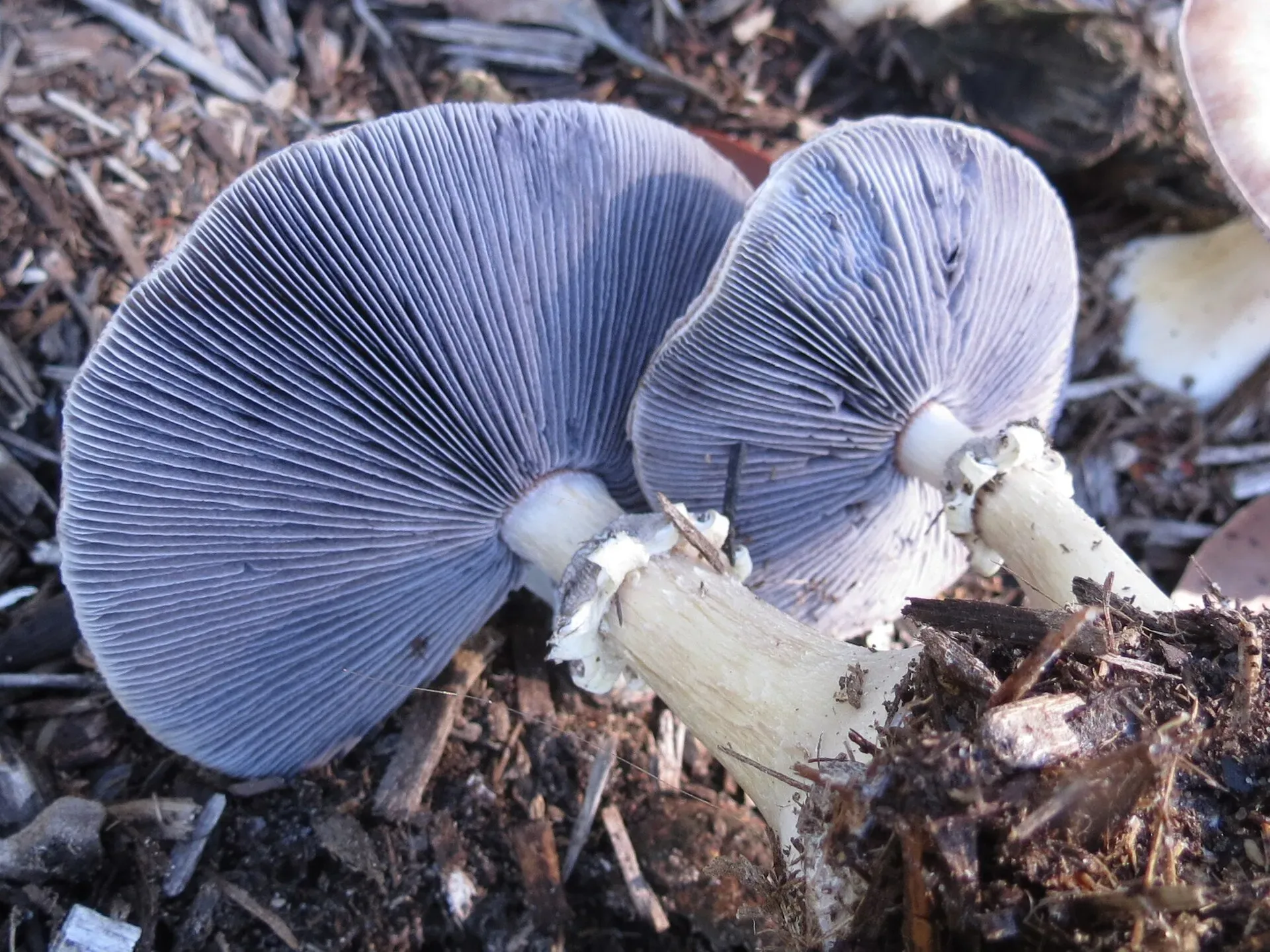
This is a safety issue, not a growing problem. King stropharia at button stage can look similar to several other dark-capped mulch-growing Agarics, including bicolored boletes and a few less-friendly Stropharia relatives. The diagnostic features: a wine-red to burgundy cap, a thick distinctive ring (annulus) on the upper stem, and dark purple-grey spores that turn the gills nearly black at maturity. If you’re unsure, post a clear photo showing the cap, gills, ring, and stem base to r/mycology for ID confirmation before eating anything from a new bed.
Where to buy king stropharia spawn#
Both suppliers in our directory carry king stropharia, in different forms and at different price points.
North Spore is the most beginner-friendly option. Their organic sawdust spawn is the standard starting point for first-time outdoor bed builders, and they pair it with a thorough how-to library on their blog and YouTube channel that walks through bed construction step by step. Pricing runs mid-to-premium ($29.99 for a 5 lb bag at the time of research), but the educational support is hard to beat.
Out-Grow is the better fit for growers who want to work from liquid culture or agar plates, with competitive pricing on syringes ($12) and a “Golden” wine cap variant alongside the standard strain. If you’re already doing your own grain-spawn expansion, this is where you’d buy the genetics.
A few suppliers we’d recommend if you’re scaling up, ordering from Canada, or hunting for specific strains:
- Field & Forest Products is the standard for commercial-scale outdoor cultivation and stocks 5 lb sawdust spawn at $28. Their site is more technical than vendor-friendly but the spawn quality and outdoor-bed expertise are first-rate.
- Mushroom Mountain sells the “Clemson” strain, noted by growers for vigorous colonization, and the team there (led by Tradd Cotter) specializes in mycoremediation and permaculture-style integrations like chicken-run inoculation.
- Fungi Akuafo is the best option for Canadian growers — locally sourced sawdust substrate adapted to Canadian hardwoods, with seasonal pre-orders timed to outdoor planting windows, avoiding cross-border shipping headaches.
Equipment for growing wine caps#
King stropharia has the lightest equipment list of any species we cover, which is part of the appeal. For an outdoor bed you need: a wheelbarrow and pitchfork for moving and mixing chips, a sharp harvest knife for cutting stems at the soil line, a spray bottle or garden hose for surface watering, and plain cardboard for the bottom layer of new beds. None of these need a buying guide.
A few categories worth thinking about as you scale up: a soaker hose or smart irrigation timer (Orbit B-hyve, Rain Bird hose-end timers) for keeping beds moist through dry spells without manual watering, a chipper or shredder if you’re sourcing your own woodchips (the Sun Joe CJ603E and similar home-scale electric chippers handle most yard waste), and a dehydrator (the Excalibur 9-Tray and Nesco Gardenmaster are both well-regarded) for processing surplus harvests.
If you’re tempted to try indoor bag culture for king stropharia, you’d need the same equipment as any sterilized bag grow — a pressure cooker, filter-patch grow bags, and either a flow hood or still-air box. We don’t recommend bag culture for this species, but if you’re going to try it, the pressure cooker buying guide is the place to start.
Related guides#
- Oyster Mushroom Growing Guide — the easiest indoor species family to pair with an outdoor king stropharia bed
- Shiitake Growing Guide — for log inoculation if you’re already comfortable with outdoor cultivation
- Substrate Calculator — estimate woodchip volume for a new bed
- How to Grow Mushrooms at Home — Beginner Guide