Morel
Morchella importuna
Also known as: Black morel, Landscape morel, True morel
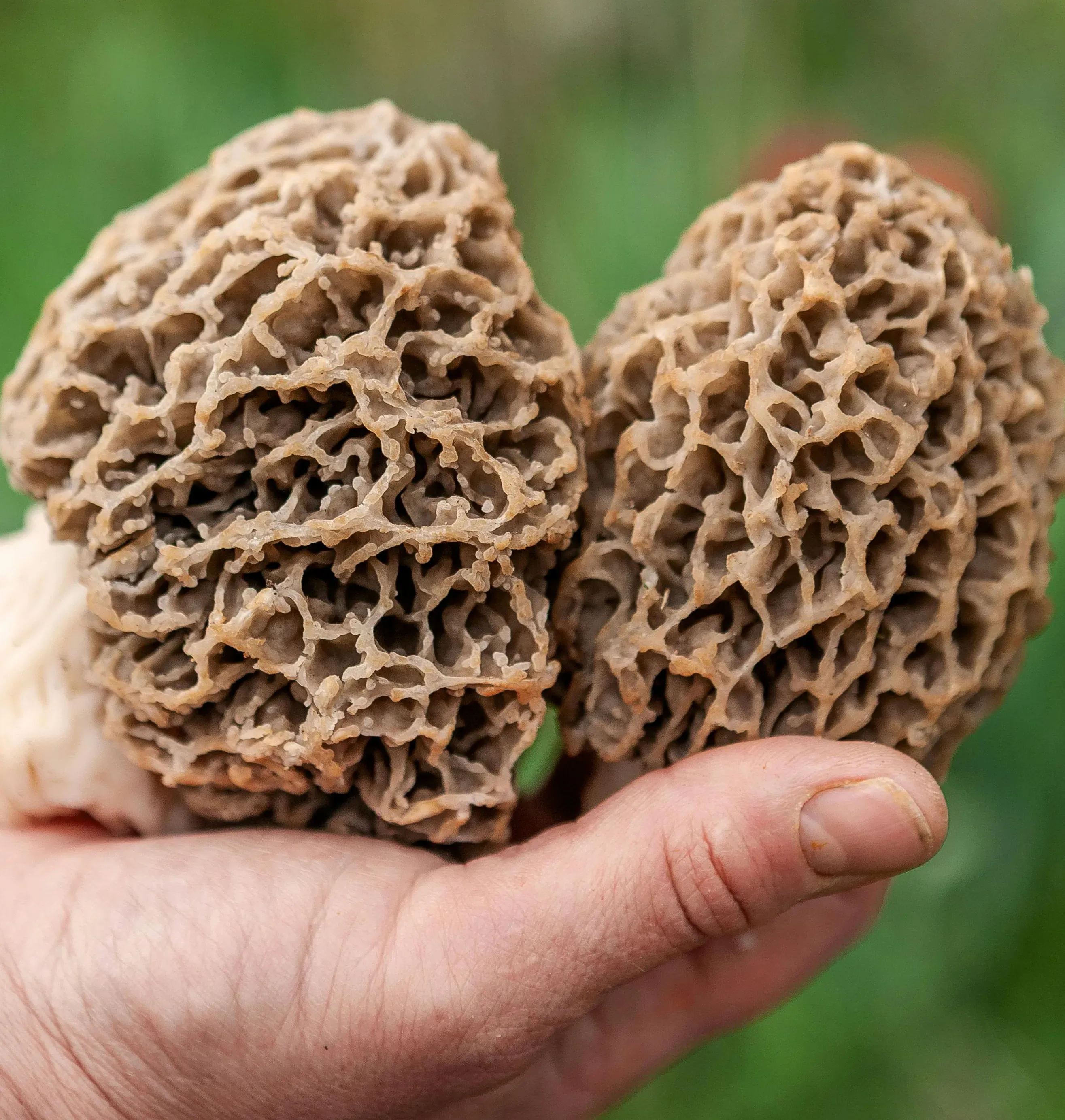
Quick Reference
- Difficulty
- Expert (5/5)
- Days to harvest
- 7–14 days
- Yield per 5lb block
- Highly variable — research plots report 500–1,000 g per square meter of bed; many home attempts yield nothing
- Fruiting temp
- 50–60°F
- Humidity
- 85–95%
- Use
- Culinary + Medicinal
- Best substrates
- Hardwood woodchip bed (alder, ash, oak), Soil with exogenous nutrient bags, Sterilized sawdust + grass seed (sclerotia prep)
- Growing methods
- outdoor-bed
Contents
Why grow morel#
Morels are the mushroom most home growers fail to produce. Morchella importuna — the black morel, sometimes called the landscape morel — is the only morel species with a documented cultivation method that works outside of a research lab, and even that method has a multi-year time horizon, a narrow seasonal fruiting window, and a high rate of complete failure. This is a difficulty-5 species, and the rating is honest.
The reason people keep trying anyway is that fresh morels are one of the most valuable edible mushrooms in the world. Dried morels sell for $25–40 per ounce at specialty retailers, and a successful outdoor patch can produce for several seasons once established. They’re also one of the few cultivated species where the flavor is genuinely indistinguishable from the wild version — you’re growing the real thing, not a cultivated approximation.
Before buying spawn, know what you’re signing up for: a year-plus timeline from inoculation to a possible first flush, a dedicated outdoor bed in a specific climate window, and genuine patience with a species where “successful colonization with no fruiting” is a normal outcome. If that sounds discouraging, start with blue oysters or lion’s mane and come back to morels after you’ve logged a few successful flushes with easier species.
Substrates#
Morels are different from most cultivated mushrooms in that their “substrate” is really a hybrid of soil, hardwood woodchip mulch, and a separate nutrient source called an exogenous nutrient bag (ENB). The soil is the fruiting interface, the woodchips are the carbon source, and the ENB provides the concentrated nutrition that lets the mycelium form the sclerotia that eventually fruit.
- Hardwood woodchip bed — Alder, ash, oak, or maple chips layered with topsoil in a prepared outdoor bed. This is the primary physical substrate and matches where M. importuna actually appears in the wild: anthropogenic habitats like landscaped areas, wood-chipped trails, and old burn sites.
- Exogenous nutrient bags (ENBs) — Sterilized wheat, rice straw, sawdust, and cottonseed hulls in filter-patch bags, laid on top of the colonized soil as a concentrated food source. Research on ENB decomposition in field cultivation shows that M. importuna actively breaks down the bags to fuel sclerotia formation, which is the prerequisite for spring fruiting.
- Sclerotia production substrate (preparation step) — A mix of grass seed (tall fescue or rye) and sterilized hardwood sawdust in jars or filter-patch bags. This isn’t the fruiting substrate; it’s how you expand a liquid culture syringe into the sclerotia-rich spawn that gets planted in the outdoor bed.
Soil pH matters more for morels than for most cultivated species. Target slightly alkaline — pH 7.0 to 7.5 — and adjust with garden lime if your site runs acidic. The substrate calculator handles the sclerotia-prep sawdust blend but doesn’t currently pre-fill for outdoor bed recipes.
Growing methods#
Only one method has a real track record for home growers: outdoor bed cultivation with exogenous nutrient bags. Indoor morel growing exists in research literature but isn’t yet a hobbyist-accessible technique — we cover why at the end of this section.
Outdoor bed cultivation#
Best for: patient growers with a shaded outdoor site, a full year of lead time before expecting a harvest, and realistic expectations about failure rates.
- Choose a shaded site with well-drained soil, ideally near but not directly under hardwood trees. Avoid conifer stands — M. importuna is saprophytic and doesn’t need a tree partner, but acidic conifer duff works against the alkaline pH it prefers.
- Till a bed 6 inches deep, roughly 2–4 feet wide by 5–10 feet long. Remove rocks and roots. Amend the soil with garden lime to bring pH toward 7.0–7.5.
- In late fall or early winter (October–December), once ambient temperatures stay consistently below 70°F, spread your sclerotia-rich spawn thinly and evenly across the bed. Cover with 2 inches of topsoil, then a layer of hardwood woodchips.
- After 10–15 days of initial colonization, place exogenous nutrient bags on the bed surface. Leave them for approximately two months, then remove and compost the spent bags.
- Cover the bed with 80% shade cloth for the duration of the grow to prevent soil temperature spikes and direct sun exposure.
- In early spring, once daily average temperatures rise above 45°F and accumulated growing degrees approach the target threshold (see Fruiting conditions below), begin slow, consistent irrigation to hold soil moisture at 65–70% and air humidity at 85–95%.
- Monitor daily during the fruiting window. Primordia can appear within 7 days of the irrigation trigger and mature to harvestable size in another 7–14 days.
Expected timeline: 6–8 months from fall inoculation to spring fruiting, with one primary flush. Some beds produce a smaller second flush; most don’t. A successful bed may continue producing for 2–4 seasons before needing re-inoculation. Many beds never fruit at all — that’s the reality of the species, not a personal failure.
Sclerotia production (preparation)#
Best for: growers who want to expand a single liquid culture into enough spawn to inoculate a full outdoor bed.
- Prepare a grass seed and hardwood sawdust mix in filter-patch bags or quart jars.
- Sterilize at 15 PSI for 2.5–3 hours in a pressure cooker.
- Cool to room temperature, then inoculate with a morel liquid culture syringe in a still-air box or in front of a flow hood.
- Incubate at 68–77°F in indirect light for approximately 35 days. The mycelium colonizes the grass seed, then forms visible sclerotia — dense, dark-yellow to reddish-brown mycelial masses — in the nutrient-poor sawdust.
- Plant the resulting sclerotia-rich substrate directly into your prepared outdoor bed per the method above.
This step is what separates “has a chance of fruiting” from “won’t fruit at all.” Sclerotia are the morel’s overwintering structure, and without them formed in the spawn, the bed has no viable pathway to spring fruiting.
What about indoor morel growing?#
You’ll see vendor marketing and YouTube channels that imply indoor morel cultivation is a solved problem for home growers. It isn’t. The legitimate indoor research — most notably Masaphy 2010, who demonstrated successful fruiting body formation for Morchella rufobrunnea in a soilless system — was laboratory-scale, used a different species than the one sold as “morel spawn,” and required precise control of sclerotia formation, induction temperature, and flooding triggers that commercial kits don’t replicate. The Danish Morel Project has demonstrated year-round indoor production at commercial scale, but publishes no actionable protocol for home growers.
If you’re curious about the research behind indoor morel cultivation, we wrote a deep-dive technique article that covers M. rufobrunnea, the soilless-system protocol, and what would need to change for hobbyist-scale indoor growing to become viable: Indoor Morel Cultivation — The Research Reality. For now, outdoor beds with M. importuna are the only method we’d recommend you attempt.
Fruiting conditions#
Morels are environmental-trigger mushrooms, not schedule-based ones. You can do everything right with the bed and still miss the fruiting window if the weather doesn’t cooperate.
Temperature. Fruiting triggers when soil temperatures sit in the 50–60°F range. Below 45°F the mycelium stays dormant; above 70°F sustained, primordia abort or fail to form. In practice this means most of North America has a 4–8 week window in early spring where fruiting is possible — roughly late February through April depending on your climate.
Accumulated growing degrees. Commercial field cultivation literature uses an accumulated growing degrees metric to predict fruiting: the running sum of (average daily temperature − 32°F) from your planting date, which should reach roughly 1,440 before primordia are expected. North Spore’s morel growing guide notes the threshold as research-derived from Chinese commercial cultivation. Track your local accumulated degrees from inoculation — it’s a better predictor of fruiting readiness than the calendar.
Humidity and moisture. Air humidity around the bed needs to reach 85–95% during the fruiting window, and soil moisture should hold at 65–70%. Drip irrigation or micro-spray on a timer is more reliable than hand-watering because consistency matters more than volume — a bed that dries out for even a day during the fruiting window can abort an entire flush.
Light. Morels tolerate low indirect light, which is why 80% shade cloth is the standard bed cover. Direct sun spikes soil temperature and dries out the surface, both of which kill developing primordia.
Cold period. The bed needs sustained cold — below 45°F for several weeks in mid-winter — to break sclerotial dormancy. This is why fall or early winter inoculation is standard: you want the cold shock to happen naturally during the overwintering phase, not as an artificial trigger.
Harvest and yield#
When to harvest. Morels are ready when the cap reaches full height and the pits and ridges are fully formed. Unlike most cultivated species, the window is short — a morel that looked perfect yesterday can be past its prime today, especially during warm spring weather. Check the bed daily during the active fruiting period.
How to harvest. Cut the morel at the base with a sharp knife, leaving the below-soil portion intact. Cutting is gentler on the surrounding mycelium than pinch-twisting and less likely to disrupt neighboring primordia.
Yield. Be honest with yourself about expectations. Peer-reviewed field data reports yields of 500–1,000 grams per square meter of bed during a successful grow, which translates to a biological efficiency around 20% — far below oysters (100–200%) or shiitake (75–100%). For a home grower running a 10-square-foot bed, a successful season might produce 0.5–2 lbs of fresh mushrooms. A less successful season produces nothing, and that outcome is common enough that we’d call it typical rather than exceptional.
Multiple flushes. Morels are primarily a single-flush species in cultivation. Occasional second flushes occur but are rare and typically small. Don’t plan around them — the better long-term strategy is maintaining the bed for 2–4 seasons of reliable single flushes rather than chasing second flushes in year one.
Storage. Fresh morels keep for 4–7 days in the fridge, loosely covered in a paper bag (never sealed plastic). For long-term storage, dry them on a dehydrator at 110–115°F until brittle, then store in airtight jars with desiccant. Dried morels rehydrate beautifully in warm water or stock, and the soaking liquid itself is intensely flavorful — save it for risottos, sauces, or soups. Frozen raw morels turn to mush; if you need to freeze them, sauté first.
Flavor, texture, and uses#
Morels are the reason people tolerate the difficulty. The flavor is deeply savory, nutty, and complex, with distinct almond and hazelnut notes driven by aromatic compounds including benzaldehyde and 1-octen-3-ol. The texture is firm and meaty — the stipe is notably chewy, while the cap holds its shape in rich sauces and cream-based preparations.
Best cooking methods. Sauté in butter with shallots and finish with cream or sherry — the classic preparation exists because it works. Dried morels reconstituted in warm stock are the foundation of serious spring risottos and pasta sauces. Never eat morels raw: they contain small amounts of heat-labile toxins that cause GI distress in some people, and they should always be cooked through before eating.
Medicinal value. Morchella species are studied for polysaccharide and flavone content. Lab studies on M. importuna specifically have documented polysaccharides (MIP) with antioxidant and hypoglycemic activity, and flavones linked to intestinal integrity. As with most mushroom medicinal research, these results are from in vitro and animal studies — treat the medicinal angle as a bonus on top of eating well, not a reason to grow them.
Common problems#
Bed colonizes but never fruits#
The single most common outcome for first-year morel beds. Causes include insufficient sustained cold during overwintering, soil that dried out during the fruiting window, or sclerotia that didn’t form properly in the original spawn. If you see healthy white mycelium in spring but no primordia, the mycelium itself is likely fine — the trigger conditions weren’t met. Evaluate your accumulated growing degrees, soil moisture during the fruiting window, and whether the bed got sustained below-45°F temperatures in winter.
Trichoderma and competitor molds#
Morel mycelium grows slowly, which gives faster-colonizing molds — especially Trichoderma (green mold) and cobweb mold — the opportunity to take over both the sclerotia production substrate and the outdoor bed. Avoid adding excess nutrients or fertilizer to the bed soil (both encourage competitors), sterilize sclerotia spawn at full pressure for 2.5+ hours, and keep bed pH alkaline to favor the morel.
Growing the wrong species#
Many morel cultivation failures trace back to attempting methods meant for mycorrhizal morel species — M. esculenta, the yellow morel familiar from foraging, which requires a tree root partnership and can’t be cultivated without it. Kuo et al. 2012 distinguished landscape and saprophytic morels like M. importuna from symbiotic species specifically to clear up this confusion. When buying spawn, verify the product page explicitly names Morchella importuna — generic “morel spawn” listings don’t always.
Primordia that stall and never develop#
Once primordia appear, they need consistent moisture and shade to develop. A single hot, dry day during the fruiting window can stall them permanently — they’ll sit at an early stage and never mature. Automated irrigation and full shade cloth address this; hand-watering is too inconsistent for the active fruiting period.
Slug and pest damage at fruiting#
Once primordia emerge from the soil, slugs find them quickly and can destroy a flush overnight. Fine mesh pest netting over the bed during the fruiting window handles most of it. Copper barrier tape around the bed edges is a secondary defense worth adding if you’ve lost primordia to slugs before.
Where to buy morel spawn#
Two suppliers currently in our directory carry Morchella importuna spawn or liquid culture.
North Spore carries a morel liquid culture syringe and an Organic Morel Habitat Kit that includes sawdust spawn and bed-preparation guidance. The kit is the most beginner-friendly option we’ve found for anyone starting a first morel bed from scratch — it’s priced at a premium compared to liquid culture alone, but the included instructions and spawn volume are calibrated for the outdoor bed method described above.
Out-Grow carries both liquid culture and agar plates for Morchella importuna, making them a better fit for growers who want to expand their own spawn rather than buy a pre-packaged kit. Agar work is a real commitment, and we’d only recommend this path if you’re already comfortable with sterile technique from another species.
Several other suppliers carry quality M. importuna spawn and aren’t yet in our directory. Field & Forest Products sells a landscape morel sawdust spawn and a complete Morel Bed Bundle with exogenous nutrient bags — the most end-to-end outdoor bed option we found during research. Sporeworks carries a wild Oregon-isolate liquid culture with detailed cultivation notes. Root Mushroom Farm offers a budget-friendly liquid culture at the lowest price point of any verified supplier. All three are on our shortlist to add as full directory entries — check back as the supplier index expands.
Recommended equipment#
For sclerotia production, you’ll need a pressure cooker rated for 15 PSI — the Presto 23-quart handles the 2.5–3 hour sterilization cycle standard for the grass-seed-and-sawdust spawn substrate. You’ll also need filter-patch bags or quart jars, a still-air box or flow hood for clean inoculation, and a morel liquid culture syringe.
For the outdoor bed, the non-optional equipment is 80% shade cloth mounted over the bed on a hoop or frame, a drip or micro-spray irrigation system on a programmable timer, and a soil thermometer for tracking temperatures during the fruiting window. Beyond that: hardwood woodchips from a local arborist (alder, ash, or oak), garden lime for pH adjustment, and fine mesh pest netting to protect primordia from slugs.
A digital hygrometer and a simple max/min thermometer placed at bed level will tell you more about why a bed did or didn’t fruit than almost any other piece of equipment. Morels are an environmental-data species — the more you measure, the better your diagnostic picture for next year.
Related guides#
- How to Grow Mushrooms at Home — Beginner Guide
- Indoor Morel Cultivation — The Research Reality — the full breakdown on M. rufobrunnea, the Masaphy soilless-system protocol, and the Danish Morel Project
- Pressure Cooker Buying Guide — for sclerotia spawn sterilization
- Blue Oyster Growing Guide — start here if morels are your second or third species
- Lion’s Mane Growing Guide — another beginner-friendly species to grow while your morel bed overwinters